. 2023 Nov 3;40(11):msad233.
doi: 10.1093/molbev/msad233.

Evolutionary Insights from a Large-Scale Survey of Population-Genomic Variation

Affiliations

Evolutionary Insights from a Large-Scale Survey of Population-Genomic Variation

Zhiqiang Ye et al. Mol Biol Evol. .

Abstract

The field of genomics has ushered in new methods for studying molecular-genetic variation in natural populations. However, most population-genomic studies still rely on small sample sizes (typically, <100 individuals) from single time points, leaving considerable uncertainties with respect to the behavior of relatively young (and rare) alleles and, owing to the large sampling variance of measures of variation, to the specific gene targets of unusually strong selection. Genomic sequences of ∼1,700 haplotypes distributed over a 10-year period from a natural population of the microcrustacean Daphnia pulex reveal evolutionary-genomic features at a refined scale, including previously hidden information on the behavior of rare alleles predicted by recent theory. Background selection, resulting from the recurrent introduction of deleterious alleles, appears to strongly influence the dynamics of neutral alleles, inducing indirect negative selection on rare variants and positive selection on common variants. Temporally fluctuating selection increases the persistence of nonsynonymous alleles with intermediate frequencies, while reducing standing levels of variation at linked silent sites. Combined with the results from an equally large metapopulation survey of the study species, classes of genes that are under strong positive selection can now be confidently identified in this key model organism. Most notable among rapidly evolving Daphnia genes are those associated with ribosomes, mitochondrial functions, sensory systems, and lifespan determination.

Keywords: Daphnia pulex; adaptive divergence; background selection; fluctuating selection; linkage disequilibrium; population genomics; site-frequency spectrum.


Conflict of interest statement

Conflict of interest statement. None declared.

Figures

Fig. 1.
Fig. 1.
Top) Summary of the polymorphism and Hardy–Weinberg (HW) statistics, with fractions of sites with different minor-allele frequency (MAF) estimates given as the bar graph. Bottom) The average inbreeding coefficient, FIS, as a function of the MAF (bars denote two standard errors); the dotted line is the expected value (0.0) under random mating.
Fig. 2.
Fig. 2.
Scaling of the pattern of linkage disequilibrium (LD) with physical distance between sites. r2 is the population-level LD, with averages over all sites and years given for various windows of minor-allele frequencies (MAFs). Δ is the correlation of zygosity, an individual-based measure of LD based on the joint distribution of heterozygosity at pairs of sites, here given as averages over 10 individuals from each of the 10 sampling years.
Fig. 3.
Fig. 3.
The pooled SFSs for six classes of genomic sites. Results for silent and replacement sites are based, respectively, on for 4-fold and 0-fold redundant sites. a) Results from the pooling of the nine annual PA samples; the monomorphic sites are included in the first bin. The expected scaling under the neutral expectation, given by the solid line, is proportional to 1/[p(1p)], where p is the allele frequency, with the elevation being arbitrarily set for visualization purposes. The dashed line is the expected pattern under a scaling of 1/p2. b) The SFS for site categories scaled by that for silent sites. c) The SFS for the 10-population pooled metapopulation sample from Maruki et al. (2022), with the neutral scaling expectation shown in panel a) included for comparison. d) Ratios of the within-population (PA) SFSs to those for the corresponding site types for the metapopulation sample [i.e. the ratio of the data in panels a) and c)].
Fig. 4.
Fig. 4.
Expected forms of the SFSs for selected sites and linked neutral sites, for various levels of - and σs, derived by simulations in a Wright–Fisher format as described in the text. Each folded SFS is based on 250 frequency bins of width 0.004, with counts derived from simulations generally over 106N generations, where N=106 is the population size. With very strong mean selection (-), the results for selected sites are generally not visible, as the probability of attaining appreciable frequencies is very close to 0.0.
Fig. 5.
Fig. 5.
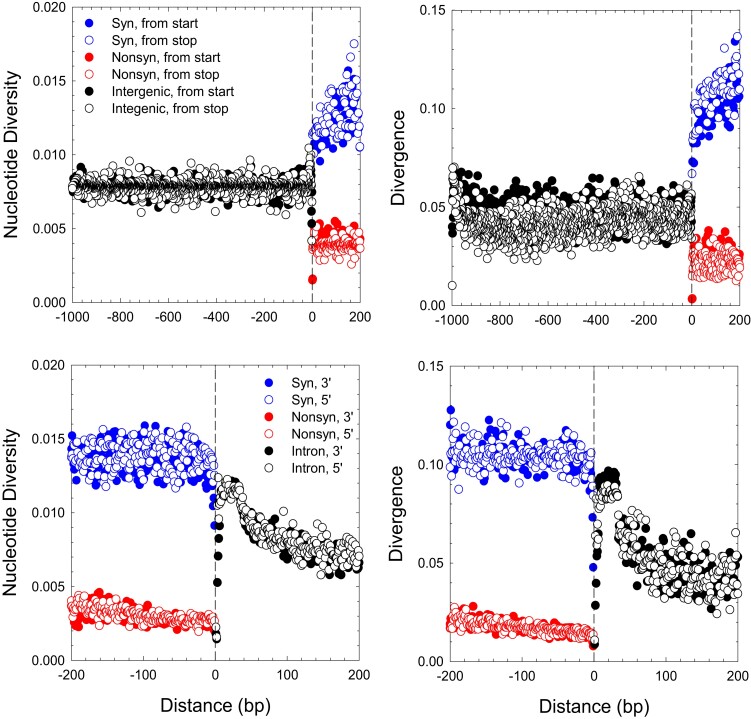
Measures of average levels of within-population nucleotide diversity (left panels) and between-species divergence (from D. obtusa orthologs; right panels). For the upper panels, site positions are given in absolute locations downstream of translation start codons and upstream of stop codons, with the estimates for each gene extending just to the half distance to the nearest intron. For the lower panels, site positions are given in absolute distances from each intron end, with estimates for exons extending to the midpoint of the distance to the next intron, and estimates for introns extending to intron midpoints.
Fig. 6.
Fig. 6.
Frequency distributions of the polymorphism ratio, πN/πS. a) πN/πS for classes of genes with and without orthologs in the outgroup species D. obtusa. b) Joint distributions of πN/πS for the PA population and the average of 10 D. pulex populations (from Maruki et al. 2022). The diagonal dashed line denotes equality. Colored points denote estimates that are significantly >1.0.
Fig. 7.
Fig. 7.
Joint distribution of neutrality-index estimates from 10 years of PA data and from the metapopulation study; r2=0.267; slope=0.373 (SE=0.007); N=8,078. Colored points denote estimates that are significantly <1.0. The dashed line is the reference for equality.
Fig. 8.
Fig. 8.
Gene ontology categories with the highest and lowest average NI indices over all component genes, denoting the strongest indications of purifying (upper panel) vs. positive (lower panel) selection. Results are given for the 10 outliers at the extremes of the distributions for the primary categories of biological processes, cellular components, and molecular functions.

Update of

References

    1. Ackerman MS, Johri P, Spitze K, Xu S, Doak T, Young K, Lynch M. Estimating coefficients of pairwise relatedness using population-genomic data. Genetics. 2017:206(1):105–118. 10.1534/genetics.116.190660 - DOI - PMC - PubMed
    1. Ashburner M, Ball CA, Blake JA, Botstein D, Butler H, Cherry JM, Davis AP, Dolinski K, Dwight SS, Eppig JT. Gene ontology: tool for the unification of biology. Nat Genet. 2000:25(1):25–29. 10.1038/75556 - DOI - PMC - PubMed
    1. Baer CF, Miyamoto MM, Denver DR. Mutation rate variation in multicellular eukaryotes: causes and consequences. Nat Rev Genet. 2007:8(8):619–631. 10.1038/nrg2158 - DOI - PubMed
    1. Barnard-Kubow KB, Becker D, Murray CS, Porter R, Gutierrez G, Erickson P, Nunez JCB, Voss F, Suryamohan K, Ratan A, et al. Genetic variation in reproductive investment across an ephemerality gradient in Daphnia pulex. Mol Biol Evol. 2022:39(6):msac121. 10.1093/molbev/msac121 - DOI - PMC - PubMed
    1. Bolger AM, Lohse M, Usadel B. Trimmomatic: a flexible trimmer for Illumina sequence data. Bioinformatics. 2014:30(15):2114–2120. 10.1093/bioinformatics/btu170 - DOI - PMC - PubMed

Publication types