Review
. 2024 Jan;10(1):28-37.
doi: 10.1016/j.trecan.2023.09.006. Epub 2023 Oct 18.

The tumor-draining lymph node as a reservoir for systemic immune surveillance

Affiliations
Review

The tumor-draining lymph node as a reservoir for systemic immune surveillance

Ines Delclaux et al. Trends Cancer. 2024 Jan.

Abstract

Early in solid tumor development, antigens are presented in tumor-draining lymph nodes (tdLNs), a process that is necessary to set up immune surveillance. Recent evidence indicates that tdLNs fuel systemic tumor-specific T cell responses which may halt cancer progression and facilitate future responses to immunotherapy. These protective responses, however, are subject to progressive dysfunction exacerbated by lymph node (LN) metastasis. We discuss emerging preclinical and clinical literature indicating that the tdLN is a crucial reservoir for systemic immunity that can potentiate immune surveillance. We also discuss the impact of LN metastasis and argue that a better understanding of the relationship between LN metastasis and systemic immunity will be necessary to direct regional disease management in the era of immunotherapy.

Keywords: immune surveillance; immunotherapy; lymph node; metastasis.


Conflict of interest statement

Declaration of interests A.W.L. reports consulting services for AGS Therapeutics. The other authors declare no conflicts of interest.

Figures
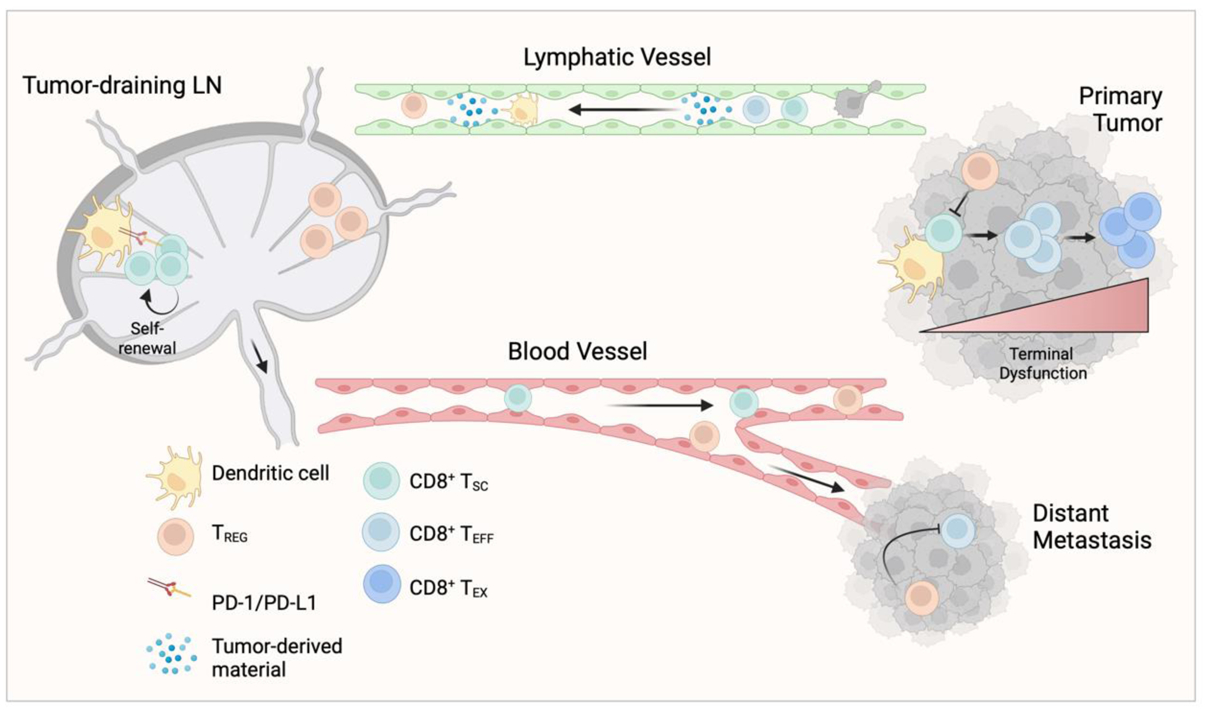
Figure 1.
Figure 1.. The tumor-draining lymph node supports systemic anti-tumor immune surveillance.
The afferent lymphatic vasculature transports tumor-derived material (e.g. antigens), leukocytes, and tumor cells from the primary tumor to the tumor draining lymph node (tdLN). Dendritic cells in the tdLN express PD-L1 and exhibit a more immature phenotype, resulting in suboptimal priming of CD8+ T cells, characterized by a failure to activate full effector function. Further contributing to these dysfunctional CD8+ T cell states, regulatory T cells (TREG) expand in tdLNs, even before metastasis, and home to sites of tumor where they inhibit effector function. Tumor-primed CD8+ T cells retain a more stem-like phenotype (TSC), self-renew, and circulate from the tdLN through the blood to sites of tumor, particularly in response to immunotherapy, where they are necessary to seed the intratumoral T cell repertoire. Within tumor, a second antigen encounter provided by local antigen presenting cells induce TSC differentiation to an effector (TEFF) and then towards terminal differentiation and exhaustion (TEX). CD8+ T cells that remain in the TSC fate or receive only weak antigen stimulation also egress the tumor to return to the tdLN.
Figure 2.
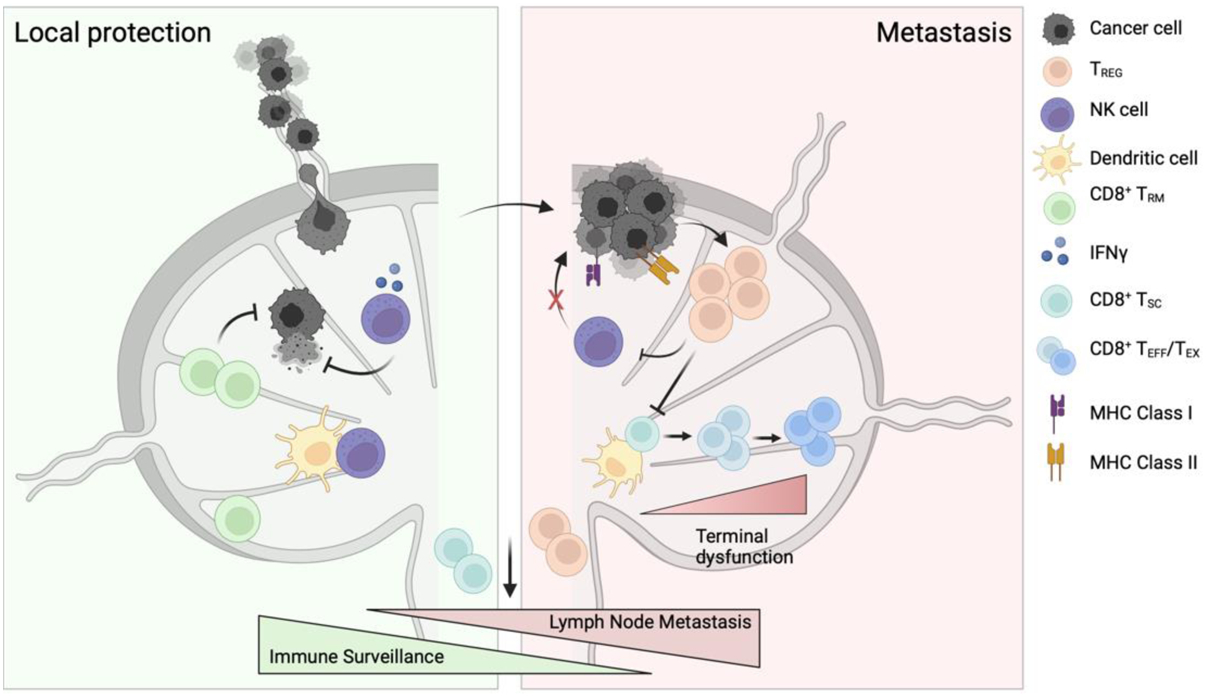
Figure 2.. Metastasizing tumor cells evade local mechanisms of protection and induce immune dysfunction.
Local protection. Lymph nodes harbor defense mechanisms that limit tumor cell seeding. Cytotoxic resident memory CD8+ T cells (TRM) and natural killer (NK) cells provide rapid cytotoxicity in response to tumor arrival, limiting tumor cell seeding and protecting the antigen-specific, stem-like CD8+ T cells (TSC) that circulate and mediate primary tumor control. Metastasis. Eventual seeding of the lymph node by cancer cells may depend on upregulation of MHC Class I, allowing them to evade killing by NK cells. The seeding of tumor cells then further conditions the lymph node by expanding regulatory T cells (TREG), in part by MHC Class II expression, and promoting a decrease in dendritic cell maturation and local antigen presentation that drives the TSC population towards dysfunction (TEFF/TEX). TREG further suppress NK cell cytotoxicity, limit the priming of effector CD8+ T cell responses, and recirculate to exert their suppressive function at distant tumor locations.

References

    1. Morton DL et al. (2014) Final Trial Report of Sentinel-Node Biopsy versus Nodal Observation in Melanoma. N Engl J Med 370, 599–609 - PMC - PubMed
    1. Padera TP et al. (2002) Lymphatic Metastasis in the Absence of Functional Intratumor Lymphatics. Science 296, 1883–1886 - PubMed
    1. Brown M et al. (2018) Lymph node blood vessels provide exit routes for metastatic tumor cell dissemination in mice. Science 359, 1408–1411 - PubMed
    1. Leiter U et al. (2019) Final Analysis of DeCOG-SLT Trial: No Survival Benefit for Complete Lymph Node Dissection in Patients With Melanoma With Positive Sentinel Node. J Clin Oncol 37, 3000–3008 - PubMed
    1. Faries MB et al. (2017) Completion Dissection or Observation for Sentinel-Node Metastasis in Melanoma. New England Journal of Medicine 376, 2211–2222 - PMC - PubMed

LinkOut - more resources