


The NOAA NCEI marine microplastics database
- PMID: 37863915
- PMCID: PMC10589325
- DOI: 10.1038/s41597-023-02632-y
The NOAA NCEI marine microplastics database
Abstract
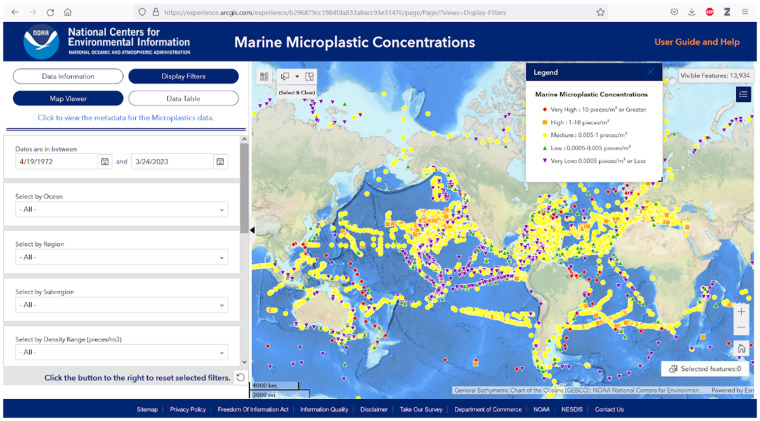
Microplastics (<5 mm) pollution is a growing problem affecting coastal communities, marine ecosystems, aquatic life, and human health. The widespread occurrence of marine microplastics, and the need to curb its threats, require expansive, and continuous monitoring. While microplastic research has increased in recent years and generated significant volumes of data, there is a lack of a robust, open access, and long-term aggregation of this data. The National Oceanic and Atmospheric Administration (NOAA) National Centers for Environmental Information (NCEI) now provides a global open access to marine microplastics data on an easily discoverable and accessible GIS web map and data portal ( https://www.ncei.noaa.gov/products/microplastics ). The objective of this data portal is to develop a repository where microplastics data are aggregated, archived, and served in a user friendly, consistent, and reliable manner. This work contributes to NCEI's efforts towards data standardization, integration, harmonization, and interoperability among national and international collaborators for monitoring global marine microplastics. This paper describes the NOAA NCEI global marine microplastics database, its creation, quality control procedures, and future directions.
© 2023. Springer Nature Limited.
Conflict of interest statement
The authors declare no competing interests.
Figures



References
-
- Barrows APW, Neumann CA, Berger ML, Shaw SD. Grab vs. neuston tow net: a microplastic sampling performance comparison and possible advances in the field. Anal. Methods. 2017;9:1446–1453. doi: 10.1039/C6AY02387H. - DOI
-
- Hale RC, Seeley ME, La Guardia MJ, Mai L, Zeng EYA. Global perspective on microplastics. J. Geophys. Res.: Oceans. 2020;125:e2018JC014719. doi: 10.1029/2018JC014719. - DOI
Publication types
Grants and funding
LinkOut - more resources
Full Text Sources
