


Individual participant data systematic review and meta-analysis of randomised controlled trials assessing adult mindfulness-based programmes for mental health promotion in non-clinical settings
- PMID: 37867573
- PMCID: PMC7615230
- DOI: 10.1038/s44220-023-00081-5
Individual participant data systematic review and meta-analysis of randomised controlled trials assessing adult mindfulness-based programmes for mental health promotion in non-clinical settings
Abstract
Introduction: Mindfulness-based programmes (MBPs) are widely used to prevent mental ill-health that is becoming the leading global cause of morbidity. Evidence suggests beneficial average effects but wide variability. We aimed to confirm the effect of MBPs on psychological distress, and to understand whether and how baseline distress, gender, age, education, and dispositional mindfulness modify the effect of MBPs on distress among adults in non-clinical settings.
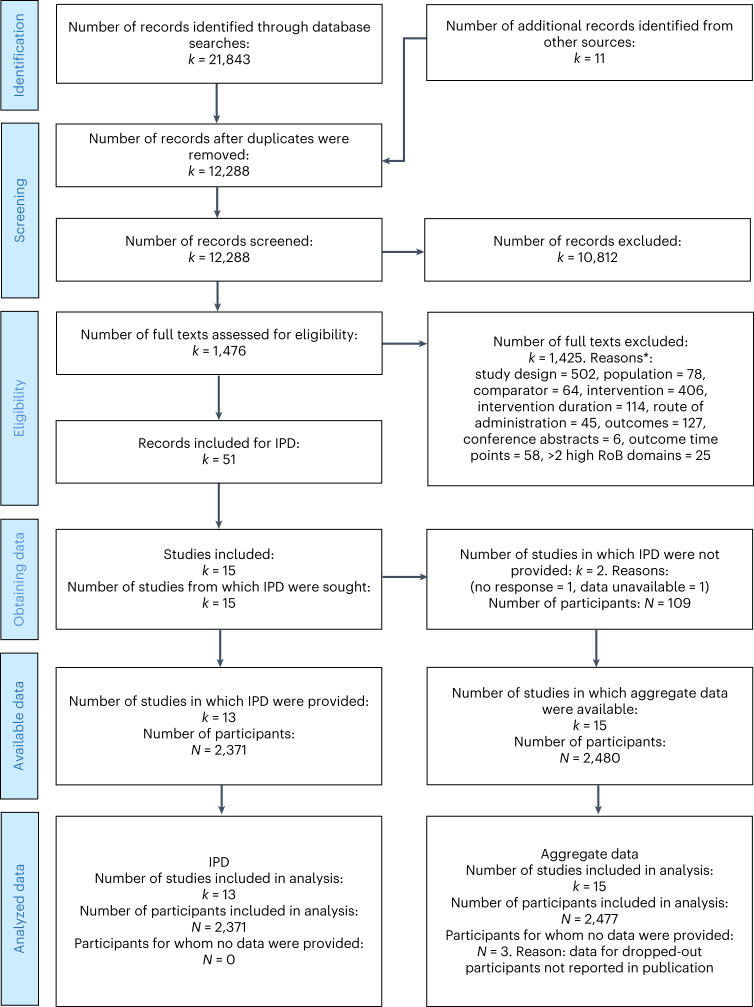
Methods: We conducted a pre-registered systematic review and individual participant data (IPD) meta-analysis (PROSPERO CRD42020200117). Thirteen databases were searched in December 2020 for randomised controlled trials satisfying a quality threshold and comparing in-person, expert-defined MBPs in non-clinical settings with passive control groups. Two researchers independently selected, extracted, and appraised trials using the revised Cochrane Risk-of-Bias Tool (RoB2). Anonymised IPD of eligible trials were sought from collaborating authors. The primary outcome was psychological distress (unpleasant mental or emotional experiences including anxiety and depression) at 1 to 6 months after programme completion. Data were checked and imputed if missing. Pairwise, random-effects, two-stage IPD meta-analyses were conducted. Effect modification analyses followed a within-studies approach. Public and professional stakeholders were involved in the planning, conduct and dissemination of this study.
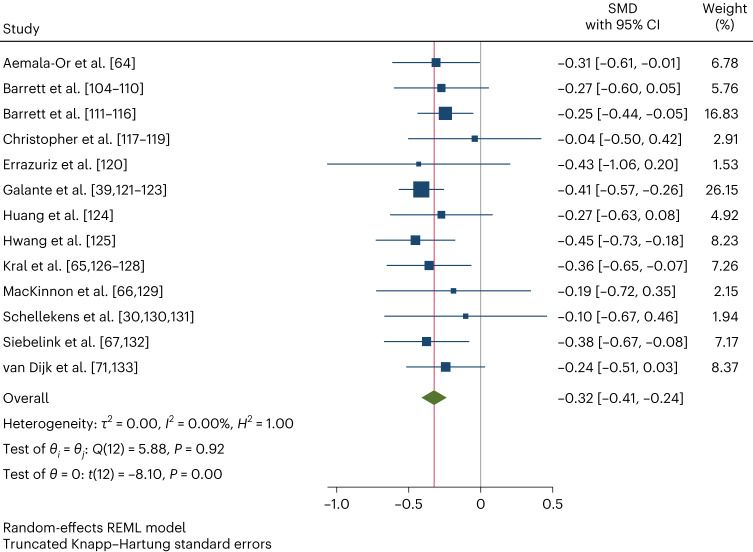
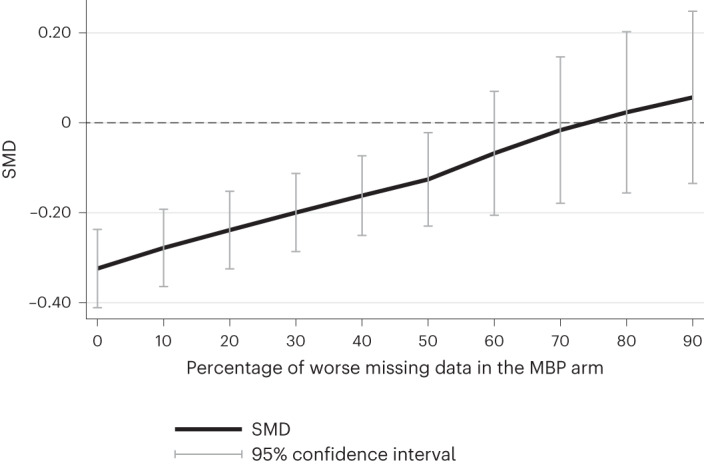
Results: Fifteen trials were eligible, 13 trialists shared IPD (2,371 participants representing 8 countries, median age 34 years-old, 71% women, moderately distressed on average, 20% missing outcome data). In comparison with passive control groups, MBPs reduced average distress between one- and six-months post-intervention with a small to moderate effect size (standardised mean difference (SMD) -0.32; 95% confidence interval (CI) -0.41 to -0.24; p-value < 0.001; 95% prediction interval (PI) -0.41 to -0.24 (no heterogeneity)). Results were robust to sensitivity analyses, and similar for the other psychological distress time point ranges. Confidence in the primary outcome result is high. We found no clear indication that this effect is modified by baseline psychological distress, gender, age, education level, or dispositional mindfulness.
Conclusions: Group-based teacher-led MBPs generally reduce psychological distress among community adults who volunteer to receive this type of intervention. More research is needed to identify sources of variability in outcomes at an individual level.
Conflict of interest statement
Competing Interests Statement JG, CF, TD, IRW, PBJ, NA, MAdJ, BB, SMB, MMC, MSC, AE, SBG, CUG, MJH, SLH, MH, YSH, OM, MAR, MPJS, NMS, NNS, AEMS, FCT, LTM have no conflicts of interest to declare. JKB has been in the past 3 years a consultant to / member of advisory board of / and/or speaker for Medice, Angelini, Janssen, Boehringer-Ingelheim, and Servier, he is not an employee of any of these companies, and not a stock shareholder of any of these companies, he has no other financial or material support, including expert testimony, patents, royalties. RJD is the founder and president of Healthy Minds Innovations, a non-profit organisation.
Figures
References
-
- Vos T, et al. Global, regional, and national incidence, prevalence, and years lived with disability for 301 acute and chronic diseases and injuries in 188 countries, 1990-2013: a systematic analysis for the Global Burden of Disease Study 2013. Lancet. 2015;386:743–800. doi: 10.1016/S0140-6736(15)60692-4. - DOI - PMC - PubMed
-
- World Health Organization Depression and Other Common Mental Disorders: Global Health Estimateshttps://apps.who.int/iris/handle/10665/254610 (World Health Organization, 2017).
-
- Cenat JM, et al. Prevalence of symptoms of depression, anxiety, insomnia, posttraumatic stress disorder, and psychological distress among populations affected by the COVID-19 pandemic: a systematic review and meta-analysis. Psychiatry Res. 2021;295:113599. doi: 10.1016/j.psychres.2020.113599. - DOI - PMC - PubMed
Grants and funding
- 095844/WT_/Wellcome Trust/United Kingdom
- U24 AT011289/AT/NCCIH NIH HHS/United States
- K01 MH130752/MH/NIMH NIH HHS/United States
- K23 AT010879/AT/NCCIH NIH HHS/United States
- MC_UU_00030/5/MRC_/Medical Research Council/United Kingdom
- P01 AT004952/AT/NCCIH NIH HHS/United States
- R01 MH043454/MH/NIMH NIH HHS/United States
- 104908/WT_/Wellcome Trust/United Kingdom
- 107496/WT_/Wellcome Trust/United Kingdom
- PDF-2017-10-018/DH_/Department of Health/United Kingdom
- P50 MH084051/MH/NIMH NIH HHS/United States
- MC_UU_00004/06/MRC_/Medical Research Council/United Kingdom
LinkOut - more resources
Full Text Sources
Research Materials
Miscellaneous