


Efficient long-term multilineage engraftment of CD33-edited hematopoietic stem/progenitor cells in nonhuman primates
- PMID: 37868209
- PMCID: PMC10585325
- DOI: 10.1016/j.omtm.2023.101121
Efficient long-term multilineage engraftment of CD33-edited hematopoietic stem/progenitor cells in nonhuman primates
Abstract
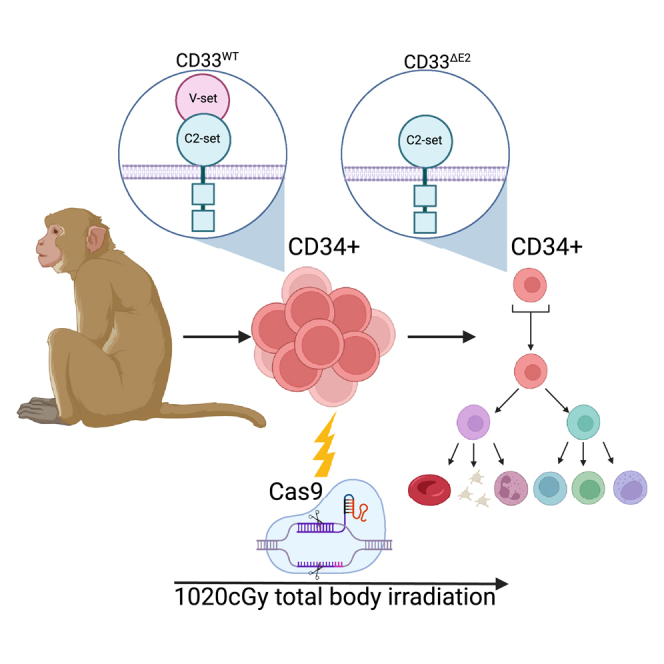
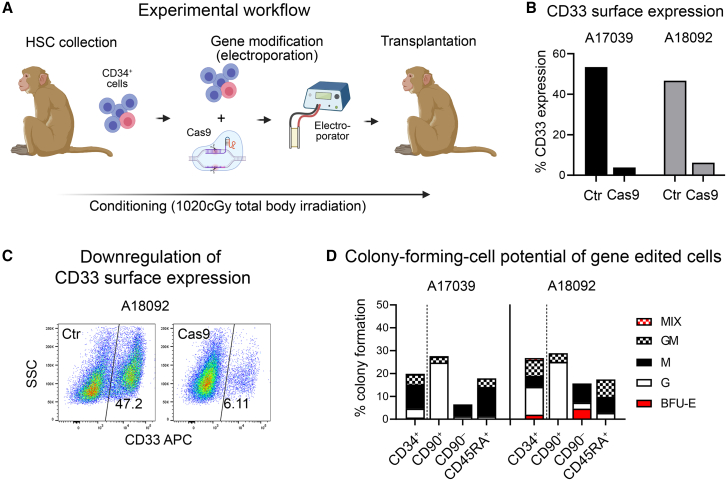
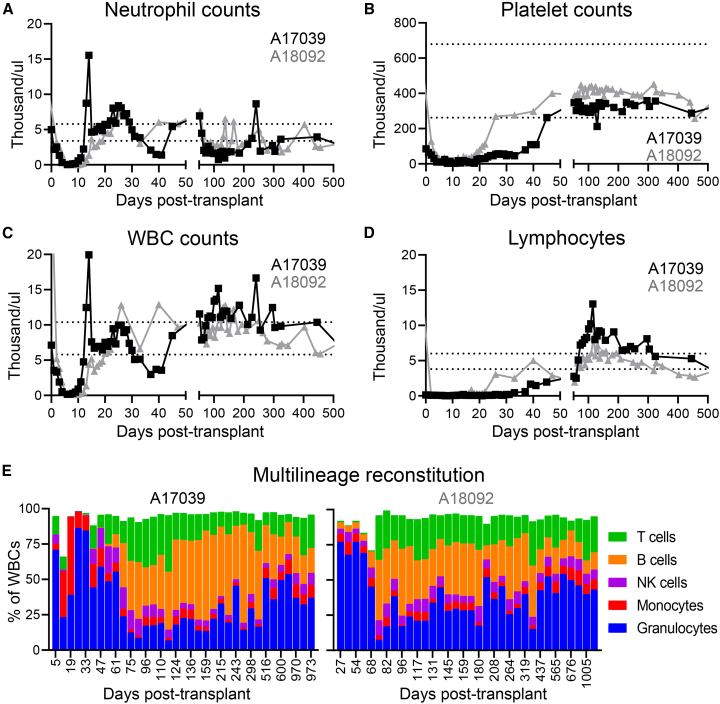
Current immunotherapeutic targets are often shared between neoplastic and normal hematopoietic stem and progenitor cells (HSPCs), leading to unwanted on-target, off-tumor toxicities. Deletion or modification of such targets to protect normal HSPCs is, therefore, of great interest. Although HSPC modifications commonly aim to mimic naturally occurring phenotypes, the long-term persistence and safety of gene-edited cells need to be evaluated. Here, we deleted the V-set domain of CD33, the immune-dominant domain targeted by most anti-CD33 antibodies used to treat CD33-positive malignancies, including acute myeloid leukemia, in the HSPCs of two rhesus macaques, performed autologous transplantation after myeloablative conditioning, and followed the animals for up to 3 years. CD33-edited HSPCs engrafted without any delay in recovery of neutrophils, the primary cell type expressing CD33. No impact on the blood composition, reconstitution of the bone marrow stem cell compartment, or myeloid differentiation potential was observed. Up to 20% long-term gene editing in HSPCs and blood cell lineages was seen with robust loss of CD33 detection on myeloid lineages. In conclusion, deletion of the V-set domain of CD33 on HSPCs, progenitors, and myeloid lineages did not show any adverse effects on their homing and engraftment potential or the differentiation and functionality of myeloid progenitors and lineages.
Keywords: CD33; CRISPR; HSCs; NHP; autologous transplantation; gene therapy and editing; hematopoietic stem cells; non-human primate.
© 2023 The Authors.
Conflict of interest statement
S.R. is a consultant to Forty-Eight BIO Inc. and Ensoma Inc. R.B.W. received laboratory research grants and/or clinical trial support from Amgen, Aptevo, Celgene, ImmunoGen, Janssen, Jazz, Kura, MacroGenics, and Pfizer; has ownership interests in Amphivena; and is (or has been) a consultant to Abbvie, Adicet, Amphivena, BerGenBio, Bristol Myers Squibb, GlaxoSmithKline, ImmunoGen, Kura, and Orum. H.P.K is or was a consultant to and has or had ownership interests with Rocket Pharmaceuticals, Homology Medicines, V.O.R. Biopharma, and Ensoma Inc. H.P.K. has also been a consultant to CSL Behring and Magenta Therapeutics.
Figures


References
-
- Liu Y., Wang S., Schubert M.L., Lauk A., Yao H., Blank M.F., Cui C., Janssen M., Schmidt C., Göllner S., et al. CD33-directed immunotherapy with third-generation chimeric antigen receptor T cells and gemtuzumab ozogamicin in intact and CD33-edited acute myeloid leukemia and hematopoietic stem and progenitor cells. Int. J. Cancer. 2022;150:1141–1155. doi: 10.1002/ijc.33865. - DOI - PubMed
-
- Humbert O., Laszlo G.S., Sichel S., Ironside C., Haworth K.G., Bates O.M., Beddoe M.E., Carrillo R.R., Kiem H.P., Walter R.B. Engineering resistance to CD33-targeted immunotherapy in normal hematopoiesis by CRISPR/Cas9-deletion of CD33 exon 2. Leukemia. 2019;33:762–808. doi: 10.1038/s41375-018-0277-8. - DOI - PubMed
Grants and funding
LinkOut - more resources
Full Text Sources
