Review
. 2023 Oct 6:14:1269451.
doi: 10.3389/fimmu.2023.1269451. eCollection 2023.

Mechanisms and regulations of ferroptosis

Affiliations
Review

Mechanisms and regulations of ferroptosis

Xu-Dong Zhang et al. Front Immunol. .

Abstract

Regulation of cell mortality for disease treatment has been the focus of research. Ferroptosis is an iron-dependent regulated cell death whose mechanism has been extensively studied since its discovery. A large number of studies have shown that regulation of ferroptosis brings new strategies for the treatment of various benign and malignant diseases. Iron excess and lipid peroxidation are its primary metabolic features. Therefore, genes involved in iron metabolism and lipid metabolism can regulate iron overload and lipid peroxidation through direct or indirect pathways, thereby regulating ferroptosis. In addition, glutathione (GSH) is the body's primary non-enzymatic antioxidants and plays a pivotal role in the struggle against lipid peroxidation. GSH functions as an auxiliary substance for glutathione peroxidase 4 (GPX4) to convert toxic lipid peroxides to their corresponding alcohols. Here, we reviewed the researches on the mechanism of ferroptosis in recent years, and comprehensively analyzed the mechanism and regulatory process of ferroptosis from iron metabolism and lipid metabolism, and then described in detail the metabolism of GPX4 and the main non-enzymatic antioxidant GSH in vivo.

Keywords: autophagy; ferroptosis; iron metabolism; lipid metabolism; lipid peroxidation.


Conflict of interest statement

The authors declare that the research was conducted in the absence of any commercial or financial relationships that could be construed as a potential conflict of interest.

Figures
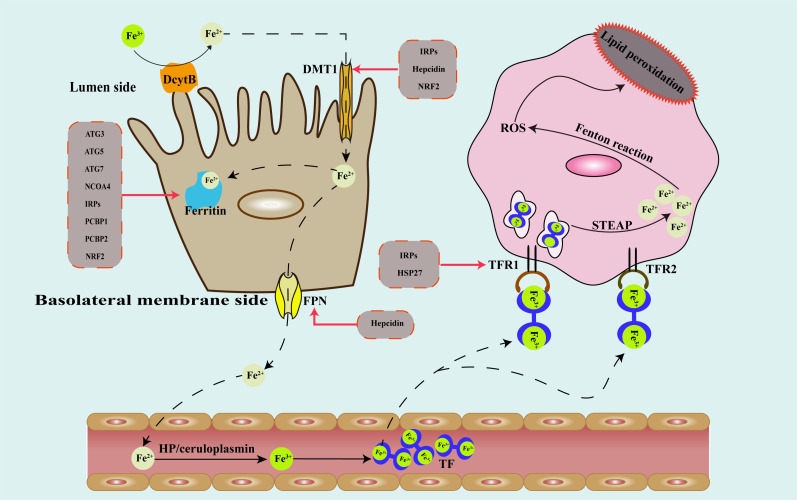
Figure 1
Figure 1
Schematic diagram of the metabolic pathway of iron in the human body and regulatory targets of genes that modulate iron metabolism. DcytB, duodenal cytochrome b; DMT1, divalent metal transporter 1; FPN, ferroportin; HP, hephaestin; TF, transferrin; TFR1, transferrin receptor 1; TFR2, transferrin receptor 2; STEAP3, six-transmembrane epithelial antigen of prostate 3; ROS, reactive oxygen species; ATG, autophagy associated gene; NCOA4, nuclear receptor coactivator 4; IRPs, iron response element binding proteins; PCBP, poly(rC)-binding proteins; HSP, heat shock protein; NRF2, nuclear factor erythroid 2-related factor 2.
Figure 2
Figure 2
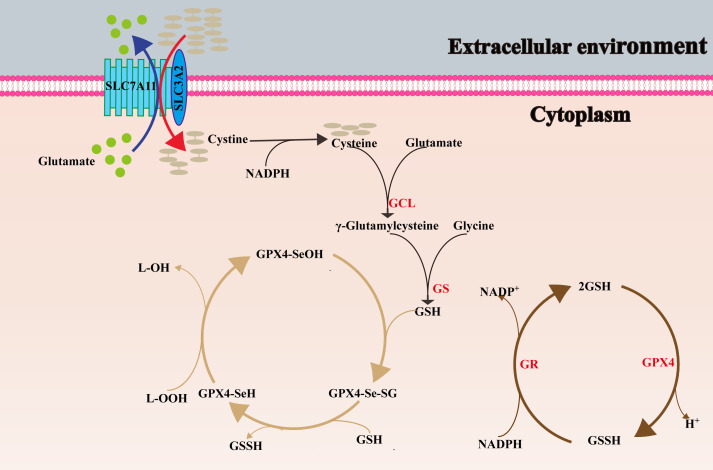
The synthesis process of GSH, and the conversion between oxidized and reduced GPX4. SLC7A11, solute carrier family 7 member 11; SLC3A2, solute carrier family 3 member 2; GCL, glutamate cysteine ligase; GS, glutathione synthase; L–OOH, lipid peroxides; L-OH, alcohol; SeOH, selenenic acid; Se–H, selenol; Se-SG, selenium- glutathione adduct; GR, glutathione reductase.
Figure 3
Figure 3
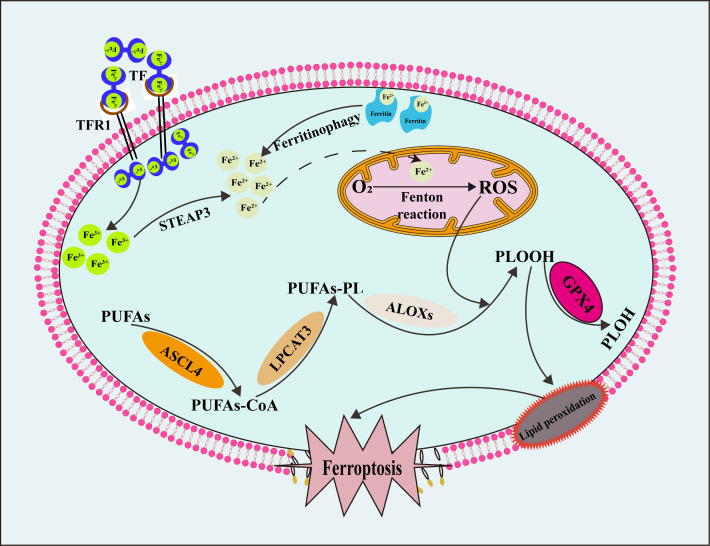
The mechanism and process of ferroptosis. TF, transferrin; TFR1, transferrin receptor 1; STEAP3, six transmembrane epithelial antigen of prostate 3; ROS, reactive oxygen species; PUFAs, polyunsaturated fatty acids; PUFAs-CoA, polyunsaturated fatty acids- coenzyme A; PUFAs-PL, polyunsaturated fatty acids- phospholipid; PLOOH, phospholipid peroxides; PLOH, phospholipid alcohol; ASCL4, long-chain acyl-CoA synthetase 4; LPCAT3, phosphatidylcholine acyltransferase 3; ALOXs, arachidonate lipoxygenases.

References

    1. Galluzzi L, Vitale I, Aaronson SA, Abrams JM, Adam D, Agostinis P, et al. Molecular mechanisms of cell death: recommendations of the Nomenclature Committee on Cell Death 2018. Cell Death Differ (2018) 25:486–541. doi: 10.1038/s41418-017-0012-4 - DOI - PMC - PubMed
    1. Tang D, Kang R, Berghe TV, Vandenabeele P, Kroemer G. The molecular machinery of regulated cell death. Cell Res (2019) 29:347–64. doi: 10.1038/s41422-019-0164-5 - DOI - PMC - PubMed
    1. Koren E, Fuchs Y. Modes of regulated cell death in cancer. Cancer Discovery (2021) 11:245–65. doi: 10.1158/2159-8290.CD-20-0789 - DOI - PubMed
    1. Cobine PA, Brady DC. Cuproptosis: Cellular and molecular mechanisms underlying copper-induced cell death. Mol Cell (2022) 82:1786–7. doi: 10.1016/j.molcel.2022.05.001 - DOI - PubMed
    1. Friedmann Angeli JP, Schneider M, Proneth B, Tyurina YY, Tyurin VA, Hammond VJ, et al. Inactivation of the ferroptosis regulator Gpx4 triggers acute renal failure in mice. Nat Cell Biol (2014) 16:1180–91. doi: 10.1038/ncb3064 - DOI - PMC - PubMed

Publication types

LinkOut - more resources