


Heterogenous electrophysiological features in early stage of hereditary transthyretin amyloidosis neuropathy
- PMID: 37870643
- PMCID: PMC10942904
- DOI: 10.1007/s10072-023-07140-w
Heterogenous electrophysiological features in early stage of hereditary transthyretin amyloidosis neuropathy
Abstract
Introduction: Hereditary transthyretin-mediated amyloidosis (ATTRv, v for variant) is a progressive disease caused by mutations in the TTR gene, leading to sensory-motor, axonal and length-dependent neuropathy. However, some patients may show variable electrophysiological pattern. The aim of this study was to evaluate the electrophysiological features of TTR amyloid neuropathy at the time of the first nerve conduction study (NCS) to assess whether there were distinguishing features useful for early diagnosis.
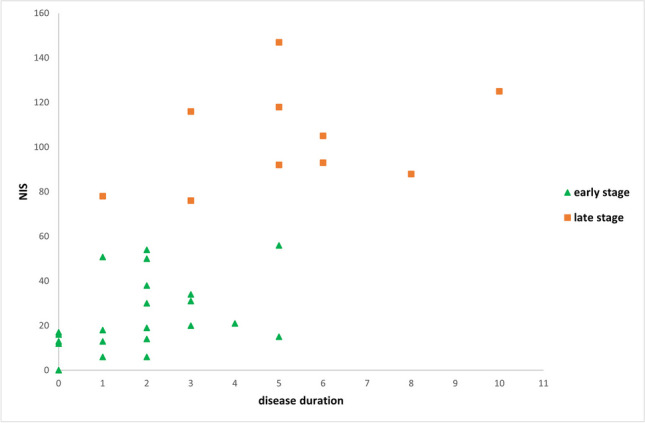
Methods: We retrospectively revised the first electrophysiological findings of ATTRv patients, and we categorized the neuropathy based on nerve conduction slowing, type of involved fibres and distribution pattern of PNS involvement. Cluster analysis was performed to evaluate the prevalence of neuropathy features between the early and late stage of disease, based on disease duration and disability burden assessed by NIS.
Results: We recruited 33 patients (27 males) with mean age 63.9 ± 10.8 years, mean disease duration 2.8 ± 2.4 years and mean NIS 47.6 ± 41.8. Overall, the frequency analysis showed that the most common features of ATTRv neuropathy included the categories of axonal, sensory-motor and neuronopathic-like pattern. This electrophysiological pattern of PNS involvement was constant in patients in late stage of disease, whereas ATTRv patients in early stage of disease displayed variable electrophysiological pattern of PNS involvement.
Discussion: Our findings demonstrated that ATTRv neuropathy may present at first NCS in a variable way, and it changes over the course of disease. Such heterogeneity makes the suspicion of ATTRv even more challenging at the time of first electrophysiological examination.
Keywords: Amyloidosis; Early-stage disease; Heterogeneous neuropathy; TTR-related neuropathy.
© 2023. The Author(s).
Conflict of interest statement
S.T. received personal fees for scientific events from Alnylam Pharmaceuticals, Amicus Therapeutics and Takeda and travel grants to attend scientific meetings from Akcea Therapeutics; D.S. received a travel grant to attend scientific meetings from SOBI; F.M. received personal fees for scientific events from Alfa-Sigma, Alnylam Pharmaceuticals and Akcea Therapeutics and has received a travel grant to attend scientific meetings from CSL Behring.
Figures
References
-
- Gertz M, Adams D, Ando Y, Beirão JM, Bokhari S, Coelho T, Comenzo RL, Damy T, Dorbala S, Drachman BM, Fontana M, Gillmore JD, Grogan M, Hawkins PN, Lousada I, Kristen AV, Ruberg FL, Suhr OB, Maurer MS, Nativi-Nicolau J, Quarta CC, Rapezzi C, Witteles R, Merlini G. Avoiding misdiagnosis: expert consensus recommendations for the suspicion and diagnosis of transthyretin amyloidosis for the general practitioner. BMC Fam Pract. 2020;21(1):198. doi: 10.1186/s12875-020-01252-4. - DOI - PMC - PubMed
-
- Van den Bergh PYK, van Doorn PA, Hadden RDM, Avau B, Vankrunkelsven P, Allen JA, Attarian S, Blomkwist-Markens PH, Cornblath DR, Eftimov F, Goedee HS, Harbo T, Kuwabara S, Lewis RA, Lunn MP, Nobile-Orazio E, Querol L, Rajabally YA, Sommer C, Topaloglu HA (2021) European Academy of Neurology/Peripheral Nerve Society guideline on diagnosis and treatment of chronic inflammatory demyelinating polyradiculoneuropathy: report of a joint task force-second revision. J Peripher Nerv Syst 26(3):242–268. 10.1111/jns.12455. Erratum in: J Peripher Nerv Syst. 2022;27(1):94. Erratum in: Eur J Neurol. 2022;29(4):1288
MeSH terms
Substances
Supplementary concepts
LinkOut - more resources
Full Text Sources
Research Materials
Miscellaneous
