


Federated causal inference based on real-world observational data sources: application to a SARS-CoV-2 vaccine effectiveness assessment
- PMID: 37872541
- PMCID: PMC10594731
- DOI: 10.1186/s12874-023-02068-3
Federated causal inference based on real-world observational data sources: application to a SARS-CoV-2 vaccine effectiveness assessment
Abstract
Introduction: Causal inference helps researchers and policy-makers to evaluate public health interventions. When comparing interventions or public health programs by leveraging observational sensitive individual-level data from populations crossing jurisdictional borders, a federated approach (as opposed to a pooling data approach) can be used. Approaching causal inference by re-using routinely collected observational data across different regions in a federated manner, is challenging and guidance is currently lacking. With the aim of filling this gap and allowing a rapid response in the case of a next pandemic, a methodological framework to develop studies attempting causal inference using federated cross-national sensitive observational data, is described and showcased within the European BeYond-COVID project.
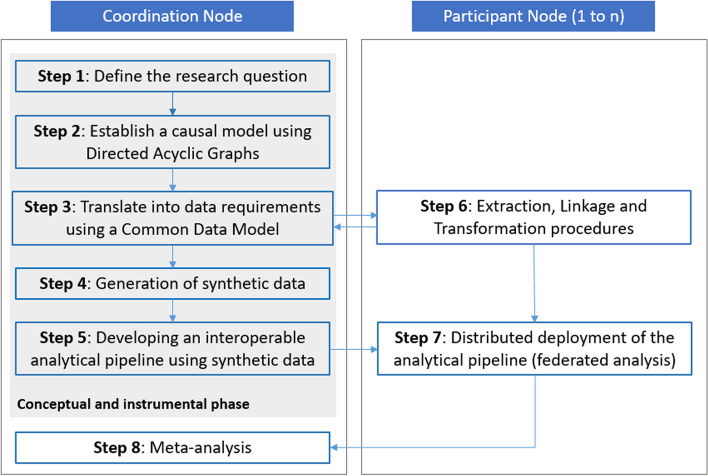
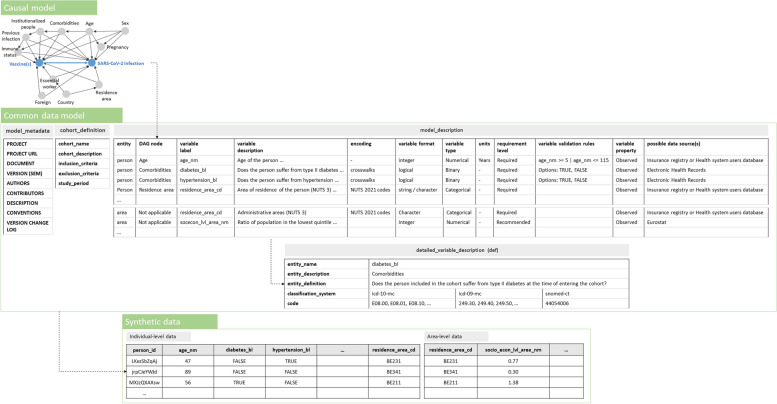
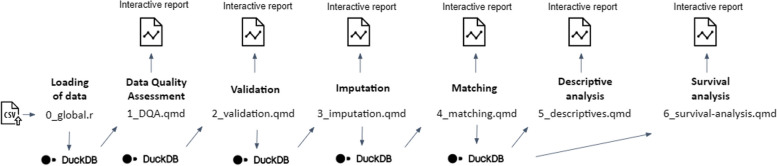
Methods: A framework for approaching federated causal inference by re-using routinely collected observational data across different regions, based on principles of legal, organizational, semantic and technical interoperability, is proposed. The framework includes step-by-step guidance, from defining a research question, to establishing a causal model, identifying and specifying data requirements in a common data model, generating synthetic data, and developing an interoperable and reproducible analytical pipeline for distributed deployment. The conceptual and instrumental phase of the framework was demonstrated and an analytical pipeline implementing federated causal inference was prototyped using open-source software in preparation for the assessment of real-world effectiveness of SARS-CoV-2 primary vaccination in preventing infection in populations spanning different countries, integrating a data quality assessment, imputation of missing values, matching of exposed to unexposed individuals based on confounders identified in the causal model and a survival analysis within the matched population.
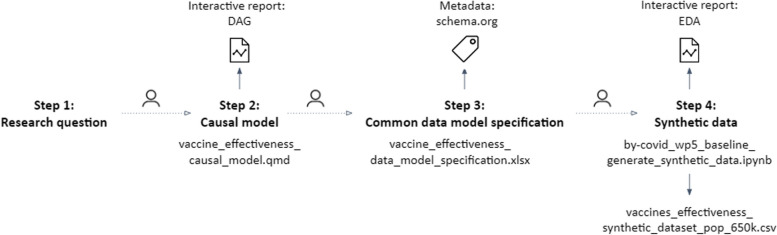
Results: The conceptual and instrumental phase of the proposed methodological framework was successfully demonstrated within the BY-COVID project. Different Findable, Accessible, Interoperable and Reusable (FAIR) research objects were produced, such as a study protocol, a data management plan, a common data model, a synthetic dataset and an interoperable analytical pipeline.
Conclusions: The framework provides a systematic approach to address federated cross-national policy-relevant causal research questions based on sensitive population, health and care data in a privacy-preserving and interoperable way. The methodology and derived research objects can be re-used and contribute to pandemic preparedness.
Keywords: COVID-19; Causal inference; Comparative effectiveness; Federated analysis; Pandemic preparedness; Real-world data; Vaccines.
© 2023. BioMed Central Ltd., part of Springer Nature.
Conflict of interest statement
The authors declare no competing interests.
Figures
References
-
- Hernán MA, Robins JM. Causal inference: what if. 1. Boca Raton: Chapman & Hall/CRC; 2020.
Publication types
MeSH terms
Substances
LinkOut - more resources
Full Text Sources
Medical
Miscellaneous
