. 2024 Jun;81(3):271-279.
doi: 10.1177/10775587231207668. Epub 2023 Oct 23.

State-Level Adverse Outcomes Among Long-Term Services and Supports Users With Alzheimer's Disease and Related Dementias

Affiliations

State-Level Adverse Outcomes Among Long-Term Services and Supports Users With Alzheimer's Disease and Related Dementias

Hyunjee Kim et al. Med Care Res Rev. 2024 Jun.

Abstract

Home- and community-based services (HCBS) users, on average, experience hospitalizations more frequently than nursing facility residents. However, little is known about state-level variation in such adverse events among these groups. Using 2018 Medicare and Medicaid claims for dual-eligible beneficiaries with Alzheimer's disease and related dementias, we described hospitalization and emergency department (ED) visit rates among HCBS users and nursing facility residents and observed substantial state-level variation. In addition, consistent with prior evidence, we found more frequent hospitalizations and ED visits among HCBS users than nursing facility residents. The magnitude of this difference varied considerably across states, and the degree of variation was greatest among beneficiaries with six or more comorbid conditions. Our findings represent a crucial initial exploration of the state-level variation in adverse events among HCBS users and nursing facility residents, paving the way for further investigations into factors that contribute to this variability.

Keywords: LTSS; dementia; dual-eligibles.


Conflict of interest statement

Declaration of Conflicting InterestsThe author(s) declared no potential conflicts of interest with respect to the research, authorship, and/or publication of this article.

Figures
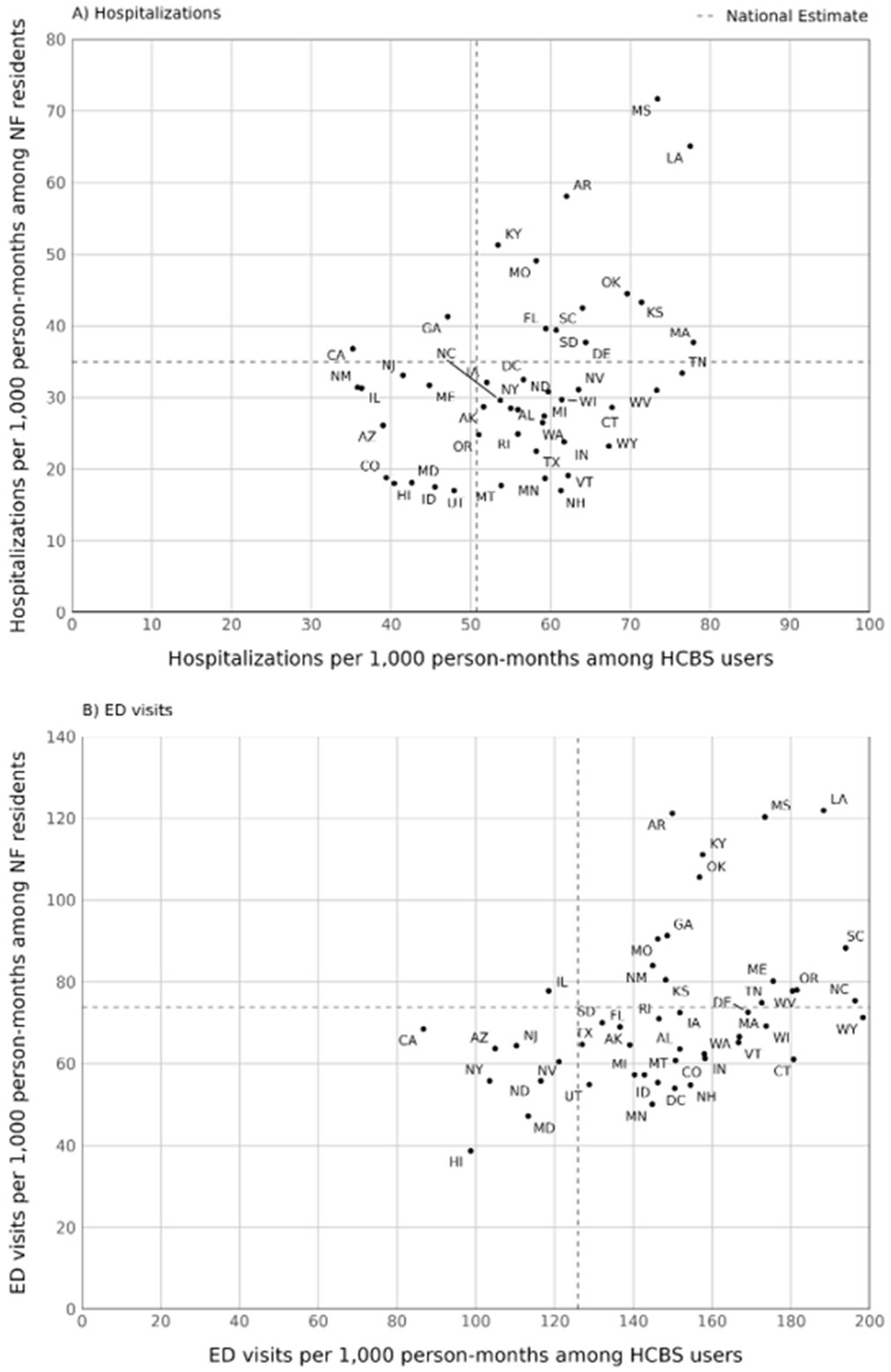
Figure 1:
Figure 1:
State–level variation in (A) hospitalization rates and (B) ED visit rates for home– and community–based service (HCBS) users and nursing facility (NF) residents.Note axis scales differ across panels. Rates are adjusted for age, sex, race/ethnicity, time since first documented dementia, comorbid condition count, acute myocardial infarction, anemia, asthma, atrial fibrillation, benign prostatic hyperplasia, cancer (breast, colorectal, endometrial, lung, prostate, and urologic), cataract, chronic kidney disease, chronic obstructive pulmonary disease, congenstive heart failure, depressive mood disorders, diabetes, glaucoma, hip/pelvic fracture, hyperlipidemia, hypertension, hypothyroidism, ischemic heart disease, osteoporosis, rheumatoid and osteoarthritis, and stroke.
Figure 2:
Figure 2:
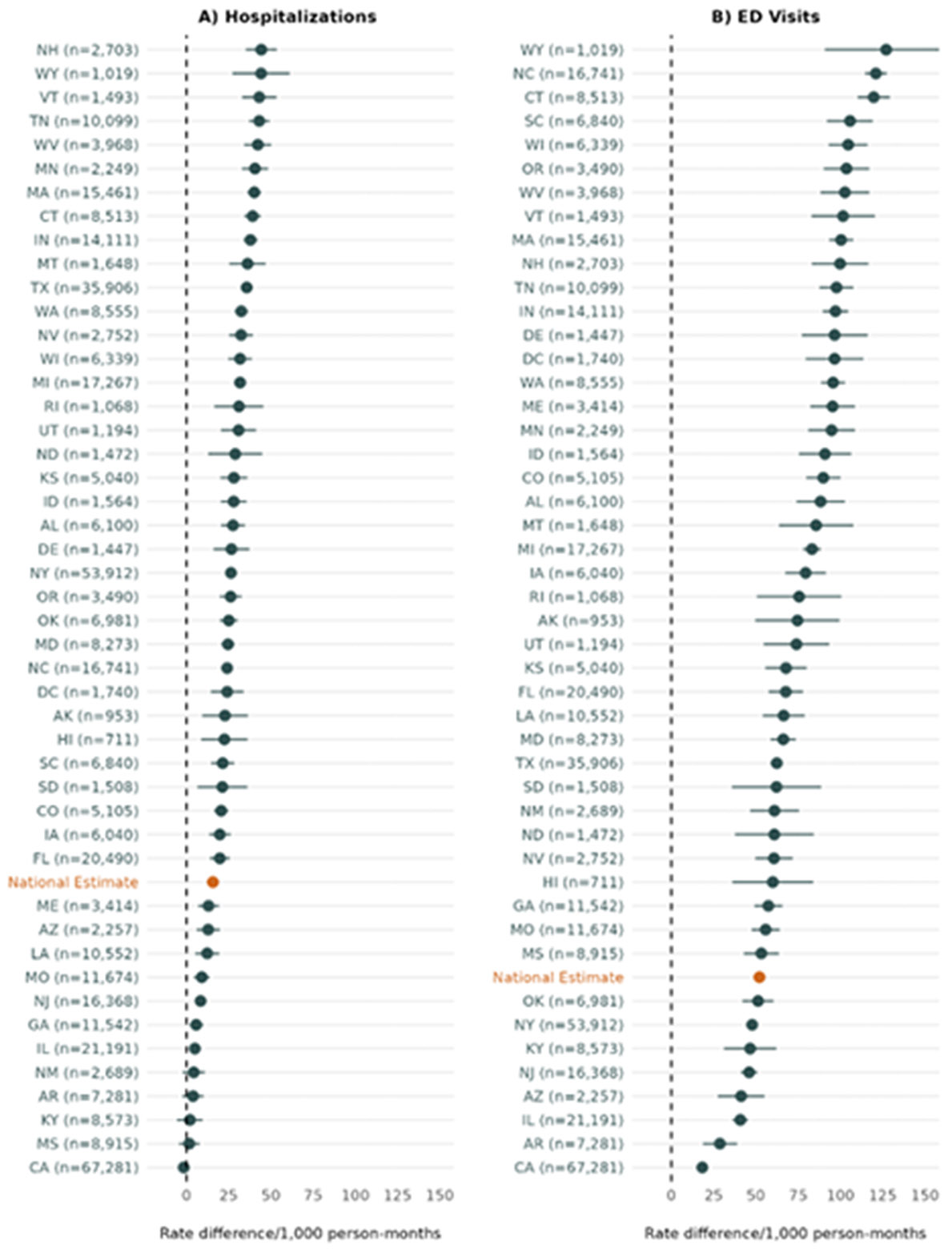
State–level difference in (A) hospitalization and (B) ED visit rates between home– and community–based service (HCBS) users and nursing facility residents. Rate difference > 0 indicates rate is higher among HCBS users compared to nursing facility residents. Horizontal bar is 95% confidence interval. Rates are adjusted for age, sex, race/ethnicity, time since first documented dementia, comorbid condition count, acute myocardial infarction, anemia, asthma, atrial fibrillation, benign prostatic hyperplasia, cancer (breast, colorectal, endometrial, lung, prostate, and urologic), cataract, chronic kidney disease, chronic obstructive pulmonary disease, congenstive heart failure, depressive mood disorders, diabetes, glaucoma, hip/pelvic fracture, hyperlipidemia, hypertension, hypothyroidism, ischemic heart disease, osteoporosis, rheumatoid and osteoarthritis, and stroke.
Figure 3:
Figure 3:
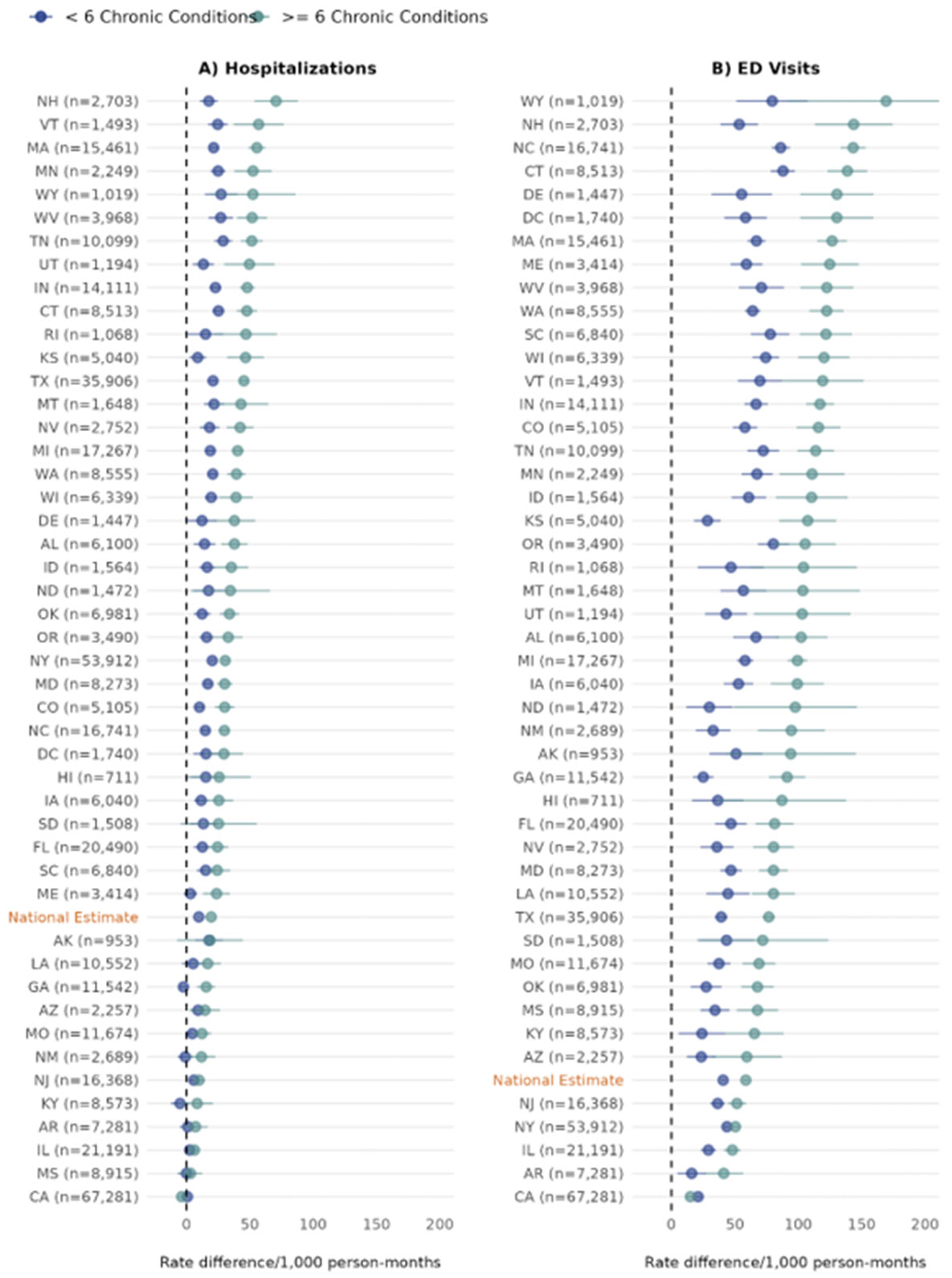
State–level difference in (A) hospitalization and (B) ED visit rates between home– and community-based service (HCBS) users and nursing facility residents by comorbidity status. Rate difference > 0 indicates rate is higher among HCBS users compared to nursing facility residents. Horizontal bar is 95% confidence interval. Rates are adjusted for age, sex, race/ethnicity, time since first documented dementia, comorbid condition count, acute myocardial infarction, anemia, asthma, atrial fibrillation, benign prostatic hyperplasia, cancer (breast, colorectal, endometrial, lung, prostate, and urologic), cataract, chronic kidney disease, chronic obstructive pulmonary disease, congenstive heart failure, depressive mood disorders, diabetes, glaucoma, hip/pelvic fracture, hyperlipidemia, hypertension, hypothyroidism, ischemic heart disease, osteoporosis, rheumatoid and osteoarthritis, and stroke.

References

    1. Alzheimer’s Association. (2022). Factsheet: Medicaid and seniors with Alzheimer’s. https://alzimpact.org/media/serve/id/5ab115bad5065
    1. American Council on Aging. (2021, February 17). What is Nursing Home Level of Care & Its Importance to Medicaid Eligibility. https://www.medicaidplanningassistance.org/nursing-home-level-of-care/
    1. Castle NG, Degenholtz H, & Engberg J (2005). State Variability in Indicators of Quality of Care in Nursing Facilities. The Journals of Gerontology: Series A, 60(9), 1173–1179. 10.1093/gerona/60.9.1173 - DOI - PubMed
    1. Chronic Conditions Data Warehouse. (2019). Condition Categories. https://www.ccwdata.org/web/guest/condition-categories
    1. Chronic Conditions Data Warehouse. (2023). Condition Categories. https://www2.ccwdata.org/web/guest/condition-categories

MeSH terms