[Preprint]. 2023 Oct 12:2023.10.12.562082.
doi: 10.1101/2023.10.12.562082.

Initiation of a ZAKα-dependent Ribotoxic Stress Response by the Innate Immunity Endoribonuclease RNase L

Affiliations

Initiation of a ZAKα-dependent Ribotoxic Stress Response by the Innate Immunity Endoribonuclease RNase L

Jiajia Xi et al. bioRxiv. .

Update in

Abstract

RNase L is a regulated endoribonuclease in higher vertebrates that functions in antiviral innate immunity. Interferons induce OAS enzymes that sense double-stranded RNA of viral origin leading to synthesis of 2',5'-oligoadenylate (2-5A) activators of RNase L. However, it is unknown precisely how RNase L inhibits viral infections. To isolate effects of RNase L from other effects of double-stranded RNA or virus, 2-5A was directly introduced into cells. Here we report that RNase L activation by 2-5A causes a ribotoxic stress response that requires the ribosome-associated MAP3K, ZAKα. Subsequently, the stress-activated protein kinases (SAPK) JNK and p38α are phosphorylated. RNase L activation profoundly altered the transcriptome by widespread depletion of mRNAs associated with different cellular functions, but also by SAPK-dependent induction of inflammatory genes. Our findings show that 2-5A is a ribotoxic stressor that causes RNA damage through RNase L triggering a ZAKα kinase cascade leading to proinflammatory signaling and apoptosis.

Keywords: 2–5A; Innate immunity; RNase L; ZAKα; ribotoxic stress response.


Figures

Figure 1.
Figure 1.. Activation of RNase L by 2–5A leads to ZAKα-dependent SAPK phosphorylation and cell death.
(A) Dose- and (B) time-dependent induction of RNase L activity by 2–5A in WT BMMs as determined by rRNA cleavages. (C) RNase L mediated rRNA cleavage in WT BMM, but not in RNase L KO BMMs, by transfection with 2–5A (20 μM) for 3 h in comparison to mock- or A3-transfection controls. (D) Cell survival as determined by real-time imaging of stained WT or RNase L KO BMMs that were either mock transfected or transfected with 2–5A (20 μM). (E) Total and phosphorylated JNK, p38α, and ERK 1/2, and RNase L and β-actin in 2–5A-transfected WT BMM and RNase L KO BMM as determined by Western blotting. (F) Levels of ZAKα, total and phosphorylated JNK and p38α, and α-tubulin in WT BMM and ZAK KO BMM transfected with 2–5A (20 μM) or A3 (20 μM) for 2 h as determined by Western blotting. Lower panel shows intact and cleaved rRNA as determined in an RNA chip (Agilent). (G) Levels of total and phosphorylated JNK and p38α and β-actin in WT BMM treated with DMSO or ZAK inhibitior (ZAKi) compound 3h in either mock-transfected or 2–5A-transfected (20 μM) WT BMM for 2 h as determined by Western blotting. Lower panel, intact and cleaved rRNA in an RNA chip (Agilent).
Figure 2.
Figure 2.. RNase L activation by 2–5A modulates the transcriptome of BMM, decreasing or increasing levels of different mRNAs.
(A) Euclidean distance of gene expression between treatment groups as a measure of sequence divergence. The matrix of distances between each pair of samples is represented by a dendrogram, while the scale of sample-to-sample distances is represented in different shades of blue. (B) Shared DEGs in mock-, 2–5A- or A3-transfected WT or RNase L KO BMMs. The Venn diagram depicts transcript changes shared or unique between each comparison. (C) Heatmaps of mock-, 2–5A, and A3-transfected WT and RL KO BMM. The color bar (upper right) indicates the Z-score. (D) Volcano plot of 2–5A down- and up-regulated gene sets from WT BMMs transcriptomes. (E) Heatmap of “TNF-α signaling via NF-κB” Hallmark gene set from mock- and 2–5A-transfected WT and RL KO BMM. Inserts: Z-score (upper left) and adjusted p values (padj) (right insert). RL KO, RNase L KO.
Figure 3.
Figure 3.. Regulation of transcript levels in mock- or 2–5A-transfected WT and RL KO BMM.
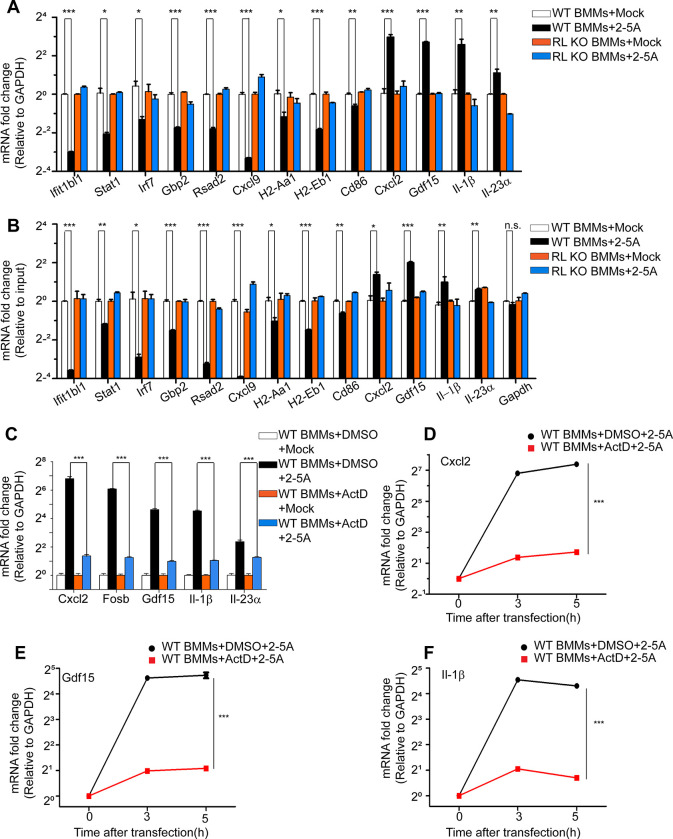
(A, B) Levels of select up- and down-regulated transcripts in mock- and 2–5A-transfected (20 μM for 3 h) WT and RL KO BMM normalized to (A) GAPDH mRNA levels or to (B) input RNA levels as determined by qRT-PCR. (C-F) Actinomycin D inhibited 2–5A-induction (20 μM for 3 h) of select transcripts in WT BMM as determined by qRT-PCR. Actinomycin D (5 μg per ml) or DMSO, was added to cells 30 min prior to transfections. Relative transcript levels were monitored by qRT-PCR. Experiments performed with three replicates were repeated at least twice. Significance was determined by unpaired Student t-test. ***, p<0.001; **, p<0.01; *, p<0.05. ActD, actinomycin D; RL KO, RNase L KO.
Figure 4.
Figure 4.. Comparison of representative dsRNA- and 2–5A-induced or -repressed transcripts.
(A) Cleavage of rRNA in WT BMM, but not in RNase L KO BMM, in response to poly(I):poly(C) (pIC) (1 μg per ml, 3 h) or 2–5A (20 μM, 3 h) as determined by analysis on an RNA chip (Agilent). (B-K). Relative levels of different transcripts (as indicated) with transfection of pIC (1 μg per ml, 3 h) or 2–5A (20 μM, 3 h) as determined by qRT-PCR. ***, p<0.001; **, p<0.01.
Figure 5.
Figure 5.. Effects of p38α, JNK, AP-1 and ZAK inhibitors or ZAK knockout on 2–5A induction of transcripts in WT BMM.
(A) Inhibition of p38α, JNK, and c-Jun phosphorylation by small molecule inhibitors in 2–5A-transfected WT BMM as determined by Western blotting. Inhibitors, or DMSO, were added to cells for 2 h prior to transfections with 2–5A (20 μM for an additional 3 h). (B-D) Effects of inhibitors of (B) p38α, (C) JNK, and (D) AP-1 on transcript levels after 2–5A transfection in WT BMM. (E) 2–5A induction (20 μM, 3 h) of transcript levels in WT and ZAK KO BMM. (F) Effects of ZAK inhibitor (compound 3h) on induction of transcript levels in WT BMM. Significance was determined by unpaired Student t-test. ***, p<0.001; **, p<0.01; *, p<0.05.
Figure 6.
Figure 6.. ZAKα is required for the ribotoxic stress response in human THP-1 monocytic cells.
(A) Transcript levels in mock- and 2–5A-transfected (20 μM for 3h) WT and RL KO THP-1 cells normalized to SON DNA and RNA binding protein (SON) mRNA levels. Data are from three separate experiments, each performed three times. Significance was determined by unpaired Student t-test. ***, p<0.001. (B) Western blot of WT, RL KO, and WT vector control THP-1 cells probed with antibody against human RNase L or β-actin. (C,D) Levels of total and phosphorylated JNK and p38α, and of RNase L and β-actin in (C) WT and ZAK KO THP-1 cells, or (D) WT and RL KO THP-1 cells that were mock-transfected, or transfected with 2–5A (20 μM, 2 h) or treated with anisomycin (5 μg per ml, 1 h) as determined in Western blots. RL KO, RNase L KO.
Figure 7.
Figure 7.. Involvement of ZAKα in JNK/p38α phosphorylation, gene regulation and apoptosis triggered by 2–5A activation of RNase L in A549 cells.
(A) ZAKα phosphorylation in response to 2–5A transfection (20 μM, 2 h) or anisomycin (5 μg per ml, 1 h) in the presence or absence of ZAKα inhibitor compounds 3 h (10 μM) or 6 h (10 μM) of WT A549 cells as determined by gel mobility shift assay. Western blots were also probed with antibodies against total and phosphorylated p38α and JNK, and β-actin. (B) Western blots for total and cleaved PARP and total and phosphorylated p38α and JNK in mock-transfected and 2–5A-transfected (20 μM, 16 h) WT, RL KO, ZAK KO and RL&ZAK DKO A549 cells. (C,D). Levels of (C) GDF15 and (D) IL-23α transcripts relative to GAPDH transcript levels in WT, RL KO, ZAK KO and RL&ZAK DKO A549 cells after mock- or 2–5A-transfection (20 μM, 3 h) as determined by qRT-PCR. [Results were reproduced in two separated experiments, each in triplicate]. Significance was determined by unpaired Student t-tests. (E-H) Cell survival curves for WT, RL KO, ZAK KO, RL&ZAK DKO A549 cells (as indicated) that were mock- or 2–5A-transfected (20 μM 2–5A). For comparisons between different treatment groups, the same reference data sets for WT, RL KO, and RL&ZAK DKO are included in different panels. Cell viability was determined by real-time imaging of cells simultaneous stained for total cells and dead cells. Significance was determined by two-way ANOVA. ***, p<0.001; ns, not significant.
Figure 8.
Figure 8.. The ribotoxic stress response mediated by the OAS-RNase L pathway through ZAKα signaling.
OASs 1–3 produce 2–5A in response to virus dsRNA or host dsRNA. 2–5A activates RNase L which cleaves mRNA in polysomes. Ribosomes collisions then occurs at the 3’ ends of cleaved RNAs lacking a stop codon, triggering ZAKα activation. Subsequently, ZAKα phosphorylates MAP2Ks that phosphorylate JNK and p38α leading to inflammatory signaling and apoptosis.

References

    1. Vind A.C., Genzor A.V., and Bekker-Jensen S. (2020). Ribosomal stress-surveillance: three pathways is a magic number. Nucleic Acids Res 48, 10648–10661. 10.1093/nar/gkaa757. - DOI - PMC - PubMed
    1. Iordanov M.S., Pribnow D., Magun J.L., Dinh T.H., Pearson J.A., Chen S.L., and Magun B.E. (1997). Ribotoxic stress response: activation of the stress-activated protein kinase JNK1 by inhibitors of the peptidyl transferase reaction and by sequence-specific RNA damage to the alpha-sarcin/ricin loop in the 28S rRNA. Mol Cell Biol 17, 3373–3381. - PMC - PubMed
    1. Vind A.C., Snieckute G., Blasius M., Tiedje C., Krogh N., Bekker-Jensen D.B., Andersen K.L., Nordgaard C., Tollenaere M.A.X., Lund A.H., et al. (2020). ZAKalpha Recognizes Stalled Ribosomes through Partially Redundant Sensor Domains. Mol Cell 78, 700–713 e707. 10.1016/j.molcel.2020.03.021. - DOI - PubMed
    1. Wu C.C., Peterson A., Zinshteyn B., Regot S., and Green R. (2020). Ribosome Collisions Trigger General Stress Responses to Regulate Cell Fate. Cell 182, 404–416 e414. 10.1016/j.cell.2020.06.006. - DOI - PMC - PubMed
    1. Iordanov M.S., Pribnow D., Magun J.L., Dinh T.H., Pearson J.A., and Magun B.E. (1998). Ultraviolet radiation triggers the ribotoxic stress response in mammalian cells. J Biol Chem 273, 15794–15803. - PubMed

Publication types