


HYPER: pre-clinical device for spatially-confined magnetic particle hyperthermia
- PMID: 37875265
- PMCID: PMC10624165
- DOI: 10.1080/02656736.2023.2272067
HYPER: pre-clinical device for spatially-confined magnetic particle hyperthermia
Abstract
Purpose: Magnetic particle hyperthermia is an approved cancer treatment that harnesses thermal energy generated by magnetic nanoparticles when they are exposed to an alternating magnetic field (AMF). Thermal stress is either directly cytotoxic or increases the susceptibility of cancer cells to standard therapies, such as radiation. As with other thermal therapies, the challenge with nanoparticle hyperthermia is controlling energy delivery. Here, we describe the design and implementation of a prototype pre-clinical device, called HYPER, that achieves spatially confined nanoparticle heating within a user-selected volume and location.
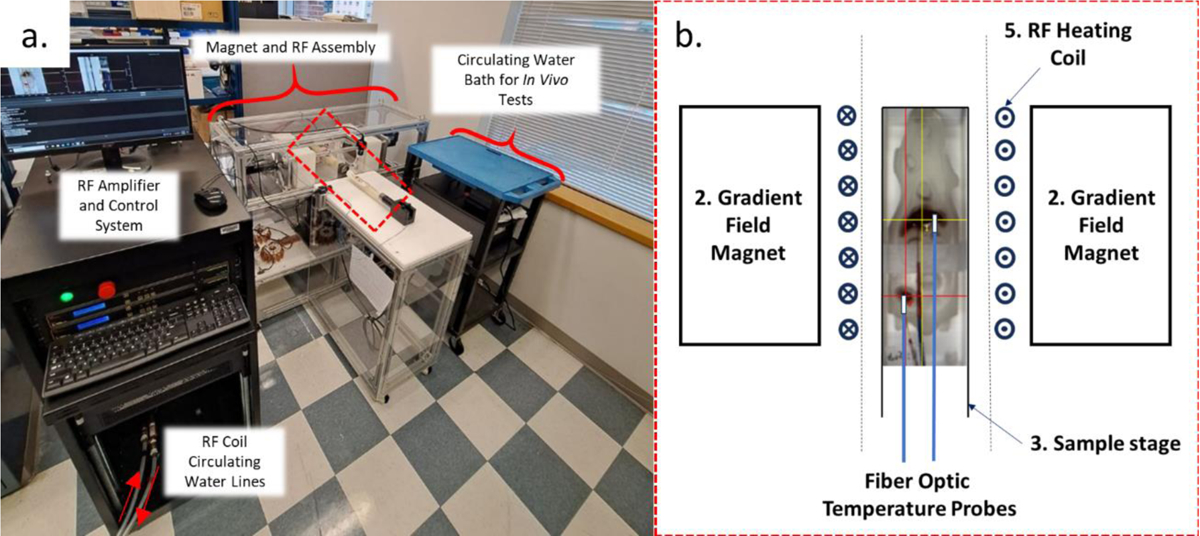
Design: Spatial control of nanoparticle heating was achieved by placing an AMF generating coil (340 kHz, 0-15 mT), between two opposing permanent magnets. The relative positions between the magnets determined the magnetic field gradient (0.7 T/m-2.3 T/m), which in turn governed the volume of the field free region (FFR) between them (0.8-35 cm3). Both the gradient value and position of the FFR within the AMF ([-14, 14]x, [-18, 18]y, [-30, 30]z) mm are values selected by the user via the graphical user interface (GUI). The software then controls linear actuators that move the static magnets to adjust the position of the FFR in 3D space based on user input. Within the FFR, the nanoparticles generate hysteresis heating; however, outside the FFR where the static field is non-negligible, the nanoparticles are unable to generate hysteresis loss power.
Verification: We verified the performance of the HYPER to design specifications by independently heating two nanoparticle-rich areas of a phantom placed within the volume occupied by the AMF heating coil.
Keywords: Magnetic particle hyperthermia; design verification; spatially confined heating.
Conflict of interest statement
Conflict of Interest
P.G. is a stockholder and CEO/CTO of Magnetic Insight, a company that develops and manufactures MPI scanners and MPI/MFH combination devices. R.I. is an inventor listed on several nanoparticle patents. All patents are assigned to either The Johns Hopkins University or Aduro Biosciences, Inc. R.I. is a member of the Scientific Advisory Board of Imagion Biosystems. All other authors report no other conflicts of interest.
Figures




References
-
- Attaluri A; Kandala SK; Zhou HM; Wabler M; DeWeese TL; Ivkov R Magnetic nanoparticle hyperthermia for treating locally advanced unresectable and borderline resectable pancreatic cancers: the role of tumor size and eddy-current heating. International Journal of Hyperthermia 2020, 37 (3), 108–119. DOI: 10.1080/02656736.2020.1798514. - DOI - PMC - PubMed
-
- Sharma A; Ozayral S; Caserto JS; ten Cate R; Anders NM; Barnett JD; Kandala SK; Henderson E; Stewart J; Liapi E; et al. Increased uptake of doxorubicin by cells undergoing heat stress does not explain its synergistic cytotoxicity with hyperthermia. International Journal of Hyperthermia 2019, 36 (1), 712–720. DOI: 10.1080/02656736.2019.1631494. - DOI - PMC - PubMed
-
- Johannsen M; Gneueckow U; Thiesen B; Taymoorian K; Cho CH; Waldofner N; Scholz R; Jordan A; Loening SA; Wust P Thermotherapy of prostate cancer using magnetic nanoparticles: Feasibility, imaging, and three-dimensional temperature distribution. European Urology 2007, 52 (6), 1653–1662. DOI: 10.1016/j.eururo.2006.11.023. - DOI - PubMed
-
- Maier-Hauff K; Ulrich F; Nestler D; Niehoff H; Wust P; Thiesen B; Orawa H; Budach V; Jordan A Efficacy and safety of intratumoral thermotherapy using magnetic iron-oxide nanoparticles combined with external beam radiotherapy on patients with recurrent glioblastoma multiforme. Journal of Neuro-Oncology 2011, 103 (2), 317–324. DOI: 10.1007/s11060-010-0389-0. - DOI - PMC - PubMed
Publication types
MeSH terms
Substances
Grants and funding
LinkOut - more resources
Full Text Sources
Other Literature Sources
Research Materials
