. 2023 Oct 24;13(1):18199.
doi: 10.1038/s41598-023-45364-0.

Continuous therapy response references for BCR::ABL1 monitoring in pediatric chronic myeloid leukemia

Affiliations

Continuous therapy response references for BCR::ABL1 monitoring in pediatric chronic myeloid leukemia

Christian Volz et al. Sci Rep. .

Abstract

Response to tyrosine kinase inhibitor (TKI) therapy in patients with chronic myeloid leukemia (CML) is monitored by quantification of BCR::ABL1 transcript levels. Milestones for assessing optimal treatment response have been defined in adult CML patients and are applied to children and adolescents although it is questionable whether transferability to pediatric patients is appropriate regarding genetic and clinical differences. Therefore, we analyzed the molecular response kinetics to TKI therapy in 129 pediatric CML patients and investigated whether response assessment based on continuous references can support an early individual therapy adjustment. We applied a moving quantiles approach to establish a high-resolution response target curve and contrasted the median responses in all patients with the median of the ideal target curve obtained from a subgroup of optimal responders. The high-resolution response target curve of the optimal responder group presents a valuable tool for continuous therapy monitoring of individual pediatric CML patients in addition to the fixed milestones. By further comparing BCR::ABL1 transcript levels with BCR::ABL1 fusion gene copy numbers, it is also possible to model the differential dynamics of BCR::ABL1 expression and cell number under therapy. The developed methodology can be transferred to other biomarkers for continuous therapy monitoring.


Conflict of interest statement

The authors declare no competing interests.

Figures
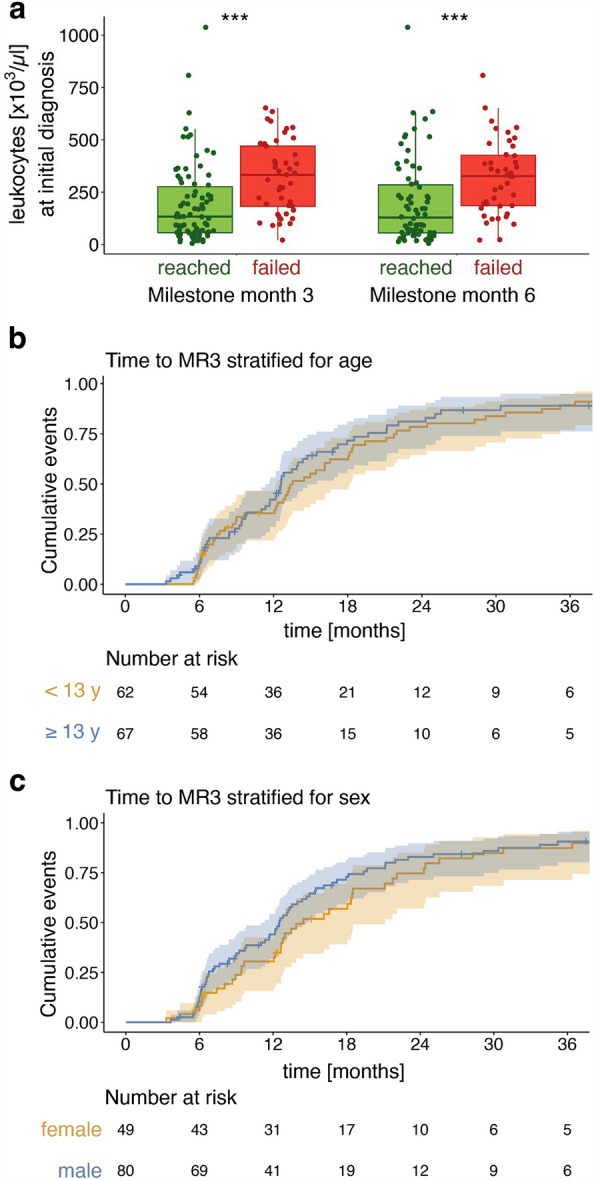
Figure 1
Figure 1
Prognostic influence of patient characteristics and initial leukocyte count. (a) Leukocyte count at diagnosis in pediatric CML patients who reach ELN milestones at months 3 and 6 compared to those who miss them. ***p < 0.001 (U test) (b) Time in months to reach MR3 stratified for age (cut off ≥ 13 years) and sex (c). y years.
Figure 2
Figure 2
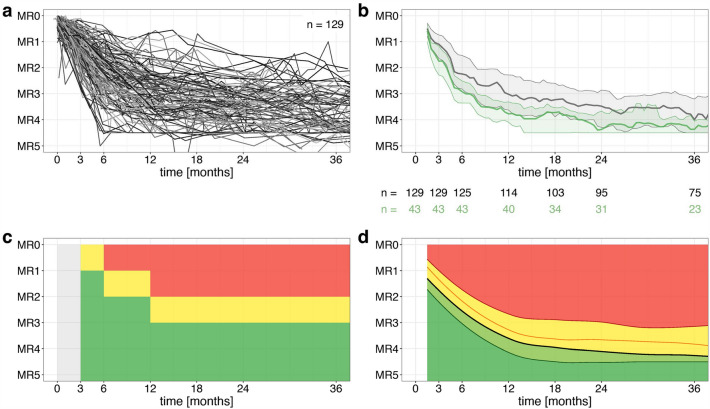
Moving quantiles analyses for calculation of continuous references for pediatric-specific BCR::ABL1 transcript monitoring. (a) Monitoring of individual BCR::ABL1 transcript levels of all patients during TKI. (b) Moving quantiles based on BCR::ABL1 transcript numbers of all patients (gray) or optimal responders (green) plotted over the first 3 years of TKI therapy. The dark-colored lines represent the median (50-Q.). Light-colored lines present the 25-Q. and the 75-Q. (c) Visualization of ELN criteria over the first 3 years of TKI therapy. The green area marks optimal therapy response, the yellow area indicates warning and the red area represents therapy failure. (d) Continuous references based on moving quantiles analyses of optimal responders over the first 3 years of TKI therapy. The smoothed graphs illustrate the 25-Q. (green line), 50-Q. (grey line), 75-Q. (orange line) and 95-Q. (red line). The light and dark green areas represent an above-average MR (optimal response), the yellow area a slightly below-average MR (observation range), and the red area a non-optimal MR (poor response). Q. quantile.
Figure 3
Figure 3
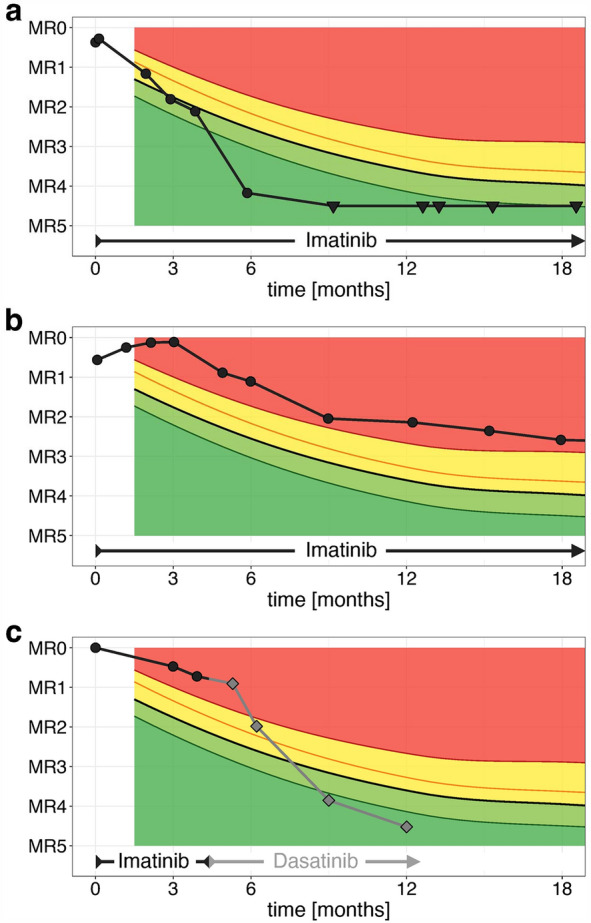
Monitoring patients’ individual therapy response by plotting their MR course over 18 months against the continuous references of the optimal responders. (a) a male patient (4 years old at diagnosis, e14a2 transcript) with uninterrupted imatinib therapy (b) a female patient (15 years old at diagnosis, e13a2 + e14a2 transcript) with uninterrupted imatinib therapy, and (c) a male patient (13 years old at diagnosis, e13a2 transcript) with imatinib therapy for 131 days and a subsequent TKI switch to dasatinib. Black circles represent measurements under the imatinib treatment; grey squares represent measurements under the dasatinib treatment. Triangles indicate non-detectable BCR::ABL1 transcript levels.
Figure 4
Figure 4
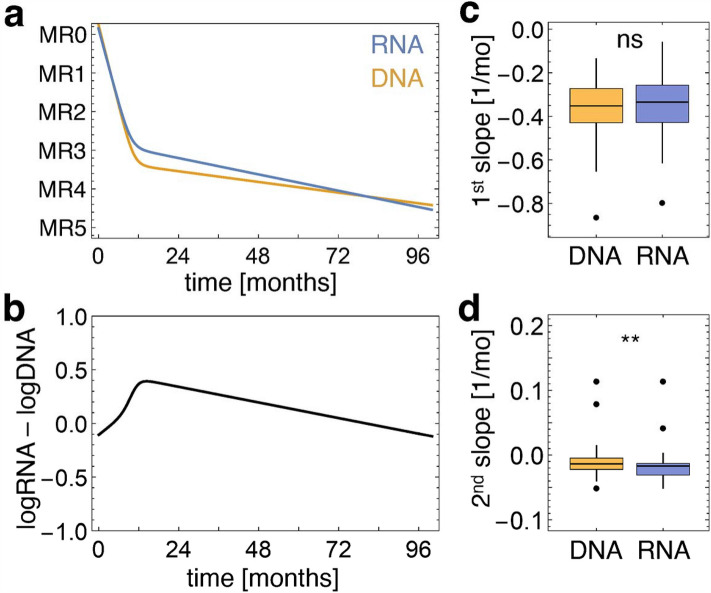
Bi-exponential modeling for the comparison of BCR::ABL1 transcript levels and fusion gene numbers during TKI treatment over 5 years. (a) Comparison of RNA (blue) and DNA (orange) molecular response kinetics plotted over 96 months of therapy as bi-exponential graphs based on a population-based non-linear mixed effect model. (b) Difference of logarithmic transcript and fusion gene level (log10 RNA–log10 DNA) over 96 months adapted from the modeled bi-exponential kinetics for RNA- and DNA-based molecular response. (c) Slope α and slope β (d) of the RNA bi-exponential graph (blue) compared to the DNA bi-exponential graph (orange). ns not significant, **p < 0.01 (paired t-test).

References

    1. Champagne MA, et al. Imatinib mesylate (STI571) for treatment of children with Philadelphia chromosome-positive leukemia: Results from a children’s oncology group phase 1 study. Blood. 2004;104:2655–2660. doi: 10.1182/blood-2003-09-3032. - DOI - PubMed
    1. Millot F, et al. Imatinib is effective in children with previously untreated chronic myelogenous leukemia in early chronic phase: Results of the French national phase IV trial. J. Clin. Oncol. 2011;29:2827–2832. doi: 10.1200/JCO.2010.32.7114. - DOI - PubMed
    1. Millot F, et al. Imatinib mesylate is effective in children with chronic myelogenous Leukemia in late chronic and advanced phase and in relapse after stem cell transplantation. Leukemia. 2006;20:187–192. doi: 10.1038/sj.leu.2404051. - DOI - PubMed
    1. Suttorp M, et al. Front-line imatinib treatment in children and adolescents with chronic myeloid leukemia: Results from a phase III trial. Leukemia. 2018;32:1657–1669. doi: 10.1038/s41375-018-0179-9. - DOI - PubMed
    1. Hijiya N, Suttorp M. How i treat chronic myeloid leukemia in children and adolescents. Blood. 2019;133:2374–2384. doi: 10.1182/blood.2018882233. - DOI - PubMed

Publication types

MeSH terms

Substances