


Overprescription of antibiotics for treating hospitalized COVID-19 patients: A systematic review & meta-analysis
- PMID: 37876436
- PMCID: PMC10590847
- DOI: 10.1016/j.heliyon.2023.e20563
Overprescription of antibiotics for treating hospitalized COVID-19 patients: A systematic review & meta-analysis
Abstract
Background: Empirical use of antibiotics was reported throughout the coronavirus disease of 2019 (COVID-19) pandemic; however, evidence of bacterial coinfection or secondary bacterial infection among COVID-19 patients was sparse. Antibiotic overprescription for COVID-19 patients without confirmed bacterial coinfection can increase antimicrobial resistance (AMR). The objective of this study is to assess the appropriateness of antibiotic use during COVID-19 by summarizing the frequency of antibiotic use among hospitalized COVID-19 and the frequency of antibiotic use in patients with COVID-19.
Methods: A systematic search was conducted of the Embase, Medline, Web of Science, and Cochrane Library databases by generating search terms using the concepts of "COVID-19," "Bacterial Coinfection," "Secondary bacterial infection," and "Antimicrobial resistance" to identify studies reporting antibiotic prescription for hospitalized COVID-19 patients with or without bacterial coinfection. We excluded studies on outpatients, studies informed infection due to mechanical ventilation, and randomized controlled trials. The pooled estimate of the percentage of the total and confirmed appropriate antibiotic prescriptions provided to hospitalized COVID-19 patients was generated using a random effect meta-analysis with inverse variance weighting. The study protocol registration DOI is osf.io/d3fpm.
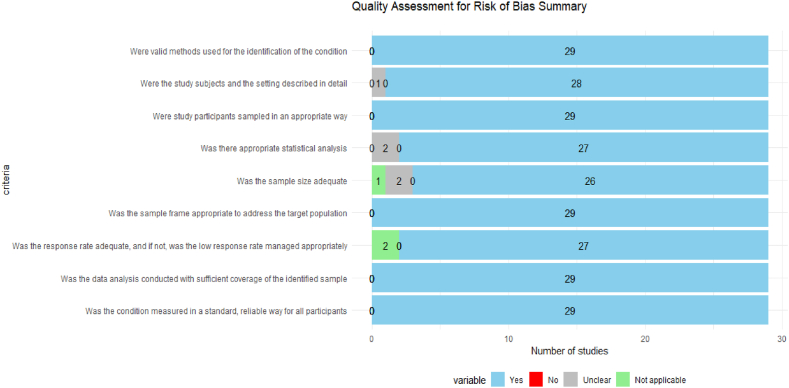
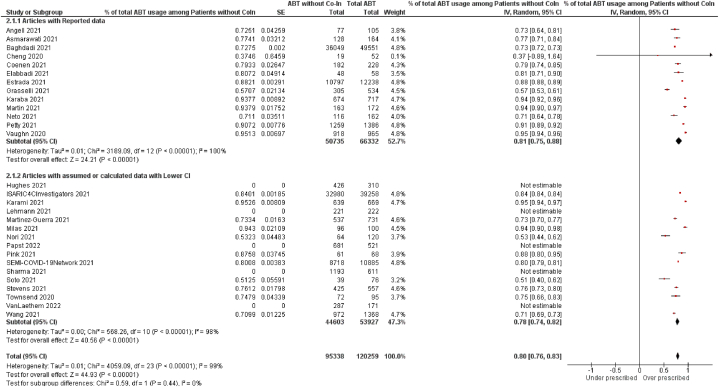
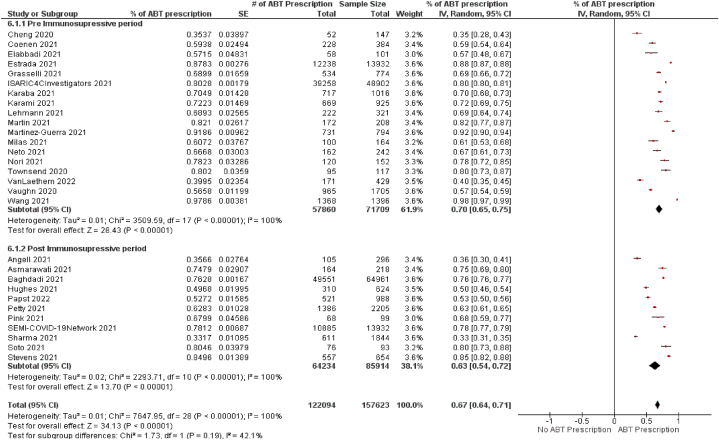
Results: Of 157,623 participants from 29 studies (11 countries, 45 % women) included in our review, antibiotics were prescribed to 67 % of participants (CI 64 %-71 %, P < 0·001), of which 80 % (CI 76 %-83 %, P < 0·001) of prescriptions were for COVID-19 patients without confirmed bacterial coinfections. Antibiotic overprescription varied during different periods of the pandemic and between High-Income and Upper and Lower Middle-Income Countries. We found heterogeneity among the studies (I2 = 100 %). The risk of bias analysis showed that 100 % of the included studies had the proper sample framing, and we are at low risk of bias due to sampling.
Discussion: We find greater than expected use of antibiotics to treat hospitalized COVID-19 patients without bacterial coinfections, which may contribute to AMR globally. Concrete guidelines for using antibiotics to treat COVID-19 patients, strict monitoring, and administering Antimicrobial Stewardship are needed to prevent overprescription.
© 2023 The Authors.
Conflict of interest statement
The authors declare the following financial interests/personal relationships which may be considered as potential competing interests: Z. Chagla has advised and/or received speaker from Merck, Pfizer, Moderna, AstraZeneca, Gilead, GSK, Roche, and Avir. He has received research grants from 10.13039/100004334Merck, 10.13039/100005564Gilead, and 10.13039/100004337Roche.R. J. de Souza has served as an external resource person to the World Health Organization's Nutrition Guidelines Advisory Group on trans fats, saturated fats, and polyunsaturated fats. The WHO paid for his travel and accommodation to attend meetings from 2012 to 2017 to present and discuss this work. He has presented updates of this work to the WHO in 2022. He has also done contract research for the Canadian Institutes of Health Research's Institute of Nutrition, Metabolism, and Diabetes, Health Canada, and the World Health Organization for which he received remuneration. He has received speaker's fees from the 10.13039/501100003579University of Toronto, and McMaster Children's Hospital. He has served as an independent director of the Helderleigh Foundation (Canada). He serves as a member of the Nutrition Science Advisory Committee to Health Canada (Government of Canada), co-chair of the Method working group of the ADA/EASD Precision Medicine in Diabetes group, and is a co-opted member of the Scientific Advisory Committee on Nutrition (SACN) Subgroup on the Framework for the Evaluation of Evidence (Public Health England). He has held grants from the 10.13039/501100000024Canadian Institutes of Health Research, 10.13039/501100000203Canadian Foundation for Dietetic Research, Population Health Research Institute, and 10.13039/100008360Hamilton Health Sciences Corporation as a principal investigator, and is a co-investigator on several funded team grants from the 10.13039/501100000024Canadian Institutes of Health Research.M. Munir, F. Rabbi, A. Mayhew, and L. Banfield report no competing interests.
Figures
References
-
- WHO . 2021. “Antimicrobial Resistance,” World Health Organization.https://www.who.int/news-room/fact-sheets/detail/antimicrobial-resistance
-
- WHO . World Health Organization; 2022. Therapeutics and COVID-19 : Living Guideline.https://www.who.int/publications/i/item/WHO-2019-nCoV-therapeutics-2022.3 [Online]. Available: - PubMed
-
- NIH . National Institutes of Health; 2022. Coronavirus Disease 2019 (COVID-19) Treatment Guidelines.https://www.covid19treatmentguidelines.nih.gov/ - PubMed
LinkOut - more resources
Full Text Sources
