Cellular Senescence in Human Skin Aging: Leveraging Senotherapeutics
- PMID: 37879300
- PMCID: PMC10873061
- DOI: 10.1159/000534756
Cellular Senescence in Human Skin Aging: Leveraging Senotherapeutics
Abstract
Background: As the largest organ in the human body, the skin is continuously exposed to intrinsic and extrinsic stimuli that impact its functionality and morphology with aging. Skin aging entails dysregulation of skin cells and loss, fragmentation, or fragility of extracellular matrix fibers that are manifested macroscopically by wrinkling, laxity, and pigmentary abnormalities. Age-related skin changes are the focus of many surgical and nonsurgical treatments aimed at improving overall skin appearance and health.
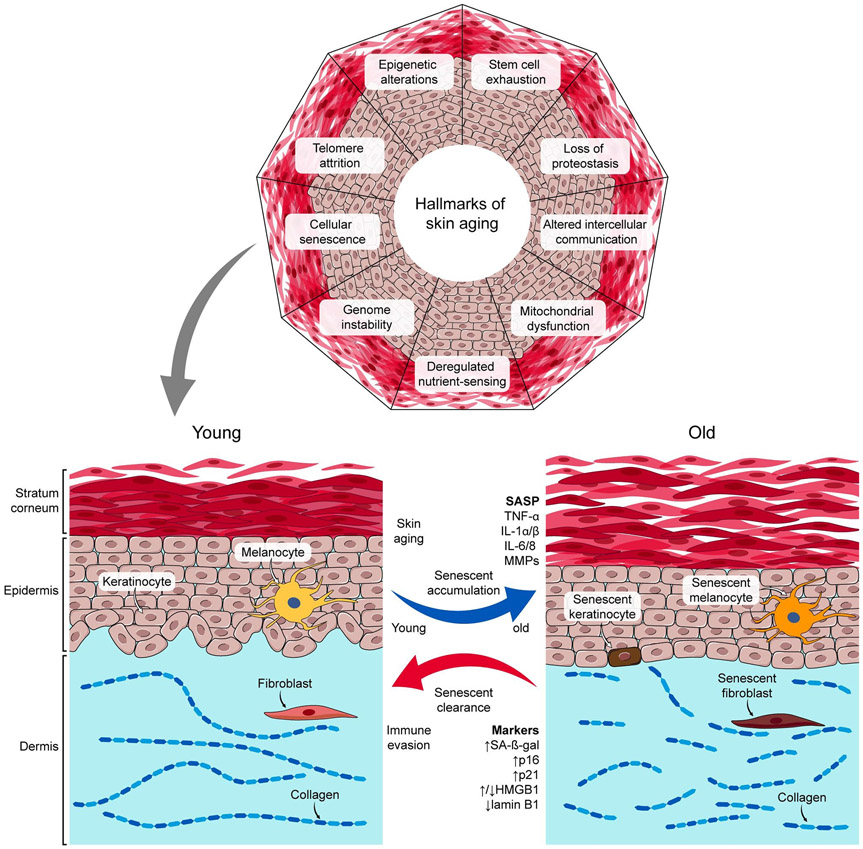
Summary: As a hallmark of aging, cellular senescence, an essentially irreversible cell cycle arrest with apoptosis resistance and a secretory phenotype, manifests across skin layers by affecting epidermal and dermal cells. Knowledge of skin-specific senescent cells, such as melanocytes (epidermal aging) and fibroblasts (dermal aging), will promote our understanding of age-related skin changes and how to optimize patient outcomes in esthetic procedures.
Key messages: This review provides an overview of skin aging in the context of cellular senescence and discusses senolytic intervention strategies to selectively target skin senescent cells that contribute to premature skin aging.
Keywords: Age-related changes; Cellular senescence; Dermal senescence; Epidermal senescence; Skin aging.
© 2023 S. Karger AG, Basel.
Conflict of interest statement
Conflict of Interest Statement
Patents on senolytic drugs to J.L.K. and T.T. are held by Mayo Clinic. S.P.W. has a nonrelevant financial interest in Rion LLC. The authors have no financial interest to declare in relation to the content of this article. This research has been reviewed by the Mayo Clinic Conflict of Interest Review Board and was conducted in compliance with Mayo Clinic conflict of interest policies.
Figures
References
-
- Gruber F, Kremslehner C, Eckhart L, Tschachler E. Cell aging and cellular senescence in skin aging - Recent advances in fibroblast and keratinocyte biology. Exp Gerontol. 2020;130:110780. - PubMed
-
- Halprin KM. Epidermal "turnover time"--a re-examination. Br J Dermatol. 1972;86(1):14–9. - PubMed
-
- Ho CY, Dreesen O. Faces of cellular senescence in skin aging. Mech Ageing Dev. 2021;198:111525. - PubMed
Publication types
MeSH terms
Substances
Grants and funding
LinkOut - more resources
Full Text Sources
Medical
Research Materials