Review
. 2023 Oct 20:16:4763-4776.
doi: 10.2147/JIR.S428425. eCollection 2023.

Mesenchymal Stem Cell Transplantation: Neuroprotection and Nerve Regeneration After Spinal Cord Injury

Affiliations
Review

Mesenchymal Stem Cell Transplantation: Neuroprotection and Nerve Regeneration After Spinal Cord Injury

Si-Yu Chen et al. J Inflamm Res. .

Abstract

Spinal Cord Injury (SCI), with its morbidity characteristics of high disability rate and high mortality rate, is a disease that is highly destructive to both the physiology and psychology of the patient, and for which there is still a lack of effective treatment. Following spinal cord injury, a cascade of secondary injury reactions known as ischemia, peripheral inflammatory cell infiltration, oxidative stress, etc. create a microenvironment that is unfavorable to neural recovery and ultimately results in apoptosis and necrosis of neurons and glial cells. Mesenchymal stem cell (MSC) transplantation has emerged as a more promising therapeutic options in recent years. MSC can promote spinal cord injury repair through a variety of mechanisms, including immunomodulation, neuroprotection, and nerve regeneration, giving patients with spinal cord injury hope. In this paper, it is discussed the neuroprotection and nerve regeneration components of MSCs' therapeutic method for treating spinal cord injuries.

Keywords: mesenchymal stem cell; nerve regeneration; neuroinflammation; neuroprotection; spinal cord injury.


Conflict of interest statement

The authors declare that there is no conflict of interest regarding the publication of this paper.

Figures
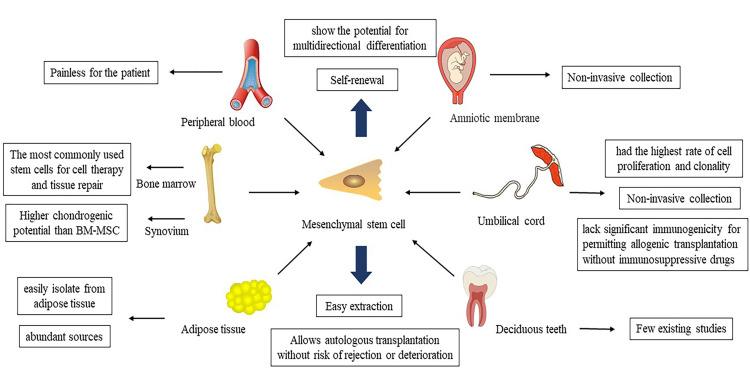
Figure 1
Figure 1
Mesenchymal stem cells of various origins: Peripheral blood, Bone marrow, Adipose tissue, Amniotic membrane, Umbilical cord, Deciduous teeth, et al. Mesenchymal stem cells are capable of self-renewal and multidirectional differentiation, and different sources of MSCs have some different advantages.
Figure 2
Figure 2
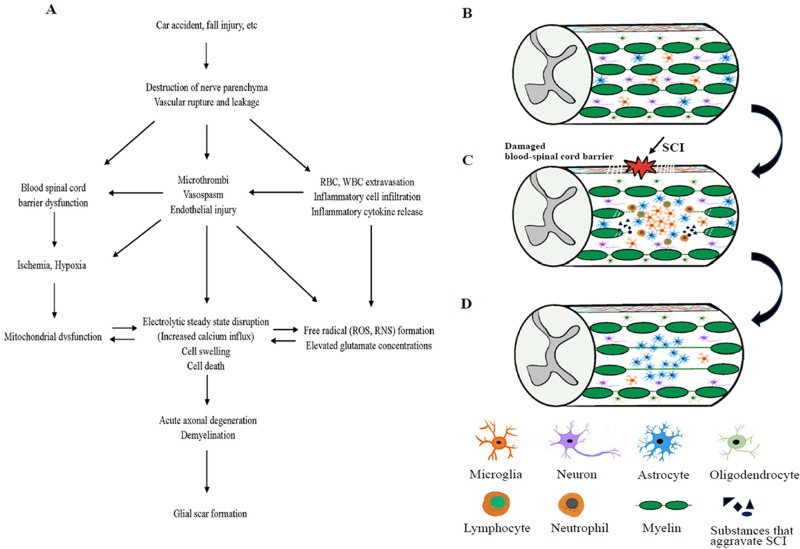
(A) Pathogenesis of spinal cord injury. (B) Normal spinal cord tissue. (C) When a spinal cord injury occurs, the nerve parenchyma and glial structures are damaged, neutrophils, macrophages/microglia, lymphocytes, etc. infiltrate the injured area, and the concentration of compounds that aggravate spinal cord injury (inflammatory cytokines, reactive oxygen species, tissue-degrading enzymes, etc.) rises. (D) Formation of glial Scar.
Figure 3
Figure 3
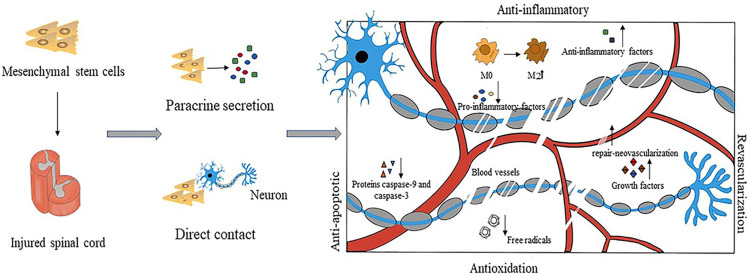
MSCs exhibit anti-inflammatory (promoting the polarization of M2 macrophages, decreasing the expression of pro-inflammatory factors such as IL-7, IFN-, and TNF-, and increasing the expression of anti-inflammatory factors such as IL-4 and IL-13); antioxidant (scavenging free radicals, enhancing host antioxidant defense, and altering cellular bioenergetics); anti-apoptosis (secretion of various protective factors, reduction of caspase-9 and caspase-3 protein levels, etc.); promotion of revascularization (secretion of various growth factors, increase in the density of repair-neovascularization).

References

    1. Sterner RC, Sterner RM. Immune response following traumatic spinal cord injury: pathophysiology and therapies. Front Immunol. 2022;13:1084101. doi: 10.3389/fimmu.2022.1084101 - DOI - PMC - PubMed
    1. Chen C, Qiao X, Liu W, Fekete C, Reinhardt JD. Epidemiology of spinal cord injury in China: a systematic review of the Chinese and English literature. Spinal Cord. 2022;60(12):1050–1061. doi: 10.1038/s41393-022-00826-6 - DOI - PubMed
    1. Borg SJ, Geraghty T, Arora M, et al. Employment outcomes following spinal cord injury: a population- based cross-sectional study in Australia. Spinal Cord. 2021;59(10):1120–1131. doi: 10.1038/s41393-021-00639-z - DOI - PubMed
    1. Xia Y, Zhu J, Yang R, Wang H, Li Y, Fu C. Mesenchymal stem cells in the treatment of spinal cord injury: mechanisms, current advances and future challenges. Front Immunol. 2023;14:1141601. doi: 10.3389/fimmu.2023.1141601 - DOI - PMC - PubMed
    1. Dias DO, Kalkitsas J, Kelahmetoglu Y, et al. Pericyte-derived fibrotic scarring is conserved across diverse central nervous system lesions. Nat Commun. 2021;12(1):5501. doi: 10.1038/s41467-021-25585-5 - DOI - PMC - PubMed