. 2023 Dec 12;11(6):e0317623.
doi: 10.1128/spectrum.03176-23. Epub 2023 Oct 26.

Comparison of phage-derived recombinases for genetic manipulation of Pseudomonas species

Affiliations

Comparison of phage-derived recombinases for genetic manipulation of Pseudomonas species

Madison J Kalb et al. Microbiol Spectr. .

Abstract

The Pseudomonas genus contains many members currently being investigated for applications in biodegradation, biopesticides, biocontrol, and synthetic biology. Though several strains have been identified with beneficial properties, chromosomal manipulations to further improve these strains for commercial applications have been limited due to the lack of efficient genetic tools that have been tested across this genus. Here, we test the recombineering efficiencies of five phage-derived recombinases across three biotechnologically relevant Pseudomonas strains: P. putida KT2440, P. protegens Pf-5, and P. protegens CHA0. These results demonstrate a method to generate targeted mutations quickly and efficiently across these strains, ideally introducing a method that can be implemented across the Pseudomonas genus and a strategy that may be applied to develop analogous systems in other nonmodel bacteria.

Keywords: Pseudomonas; SSAPs; homologous recombination; plant growth promoting rhizobacteria; recombineering.


Conflict of interest statement

The authors declare no conflict of interest.

Figures
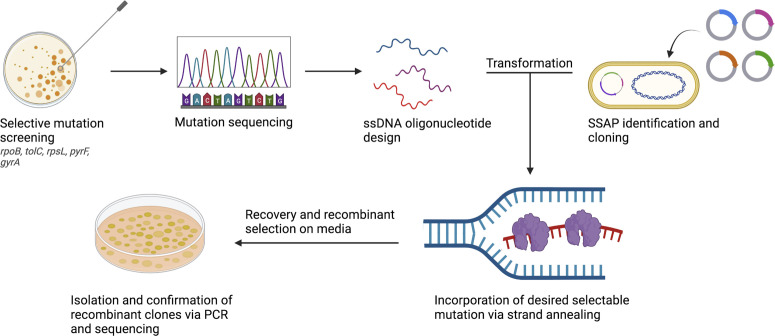
Fig 1
Fig 1
Overview of experimental setup. To determine recombineering efficiencies across different strains and conditions, we screened our Pseudomonas strains for rifampicin-resistance (RifR) encoding mutations by sequencing Clusters I and II of rpoB. We then designed ssDNA oligonucleotides encoding our screened mutations with 40-base-pair homology arms and introduced them into log-phase cultures expressing individual SSAP candidates. Efficiency of recombineering was calculated by normalizing number of RifR colonies to number of viable cells after recovery. Confirmation of intended mutation was performed using the PCR and Sanger sequencing. This figure was generated using BioRender.
Fig 2
Fig 2
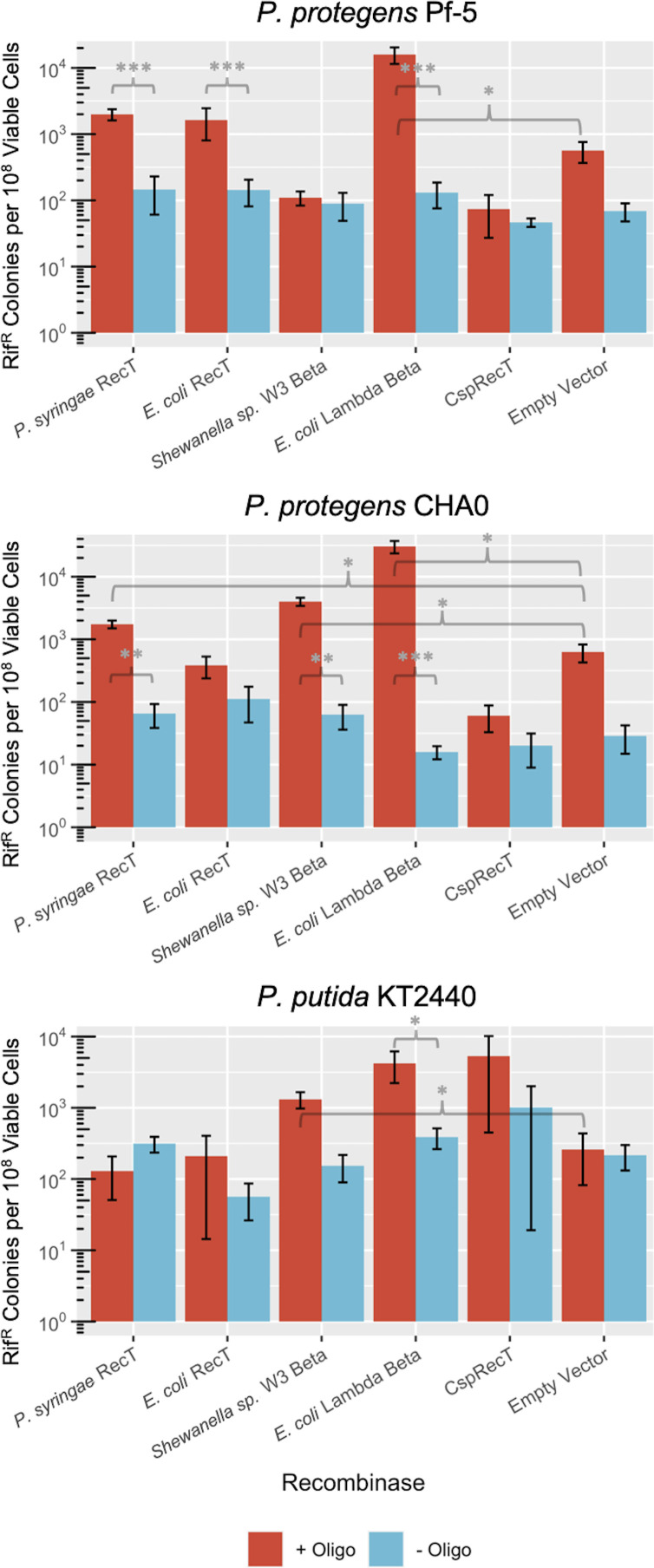
Comparison of SSAPs across Pseudomonas spp. Log phase cultures of (A) P. protegens Pf-5, (B) P. protegens CHA0, and (C) P. putida KT2440 expressing five candidate SSAPs or empty vector (pBBR1-MCS2) were electroporated with 15 µg of oligonucleotide encoding a D521P point mutation in rpoB, and the cell mixture recovered for 3.5 h in LB before plating on rifampicin. RifR colonies and total viable colonies were counted after 2 d of growth. Significance values are indicated for a Mann-Whitney U test between two groups, where *P < 0.05; **P < 0.01; ***P < 0.001; and; ns, not significant.
Fig 3
Fig 3
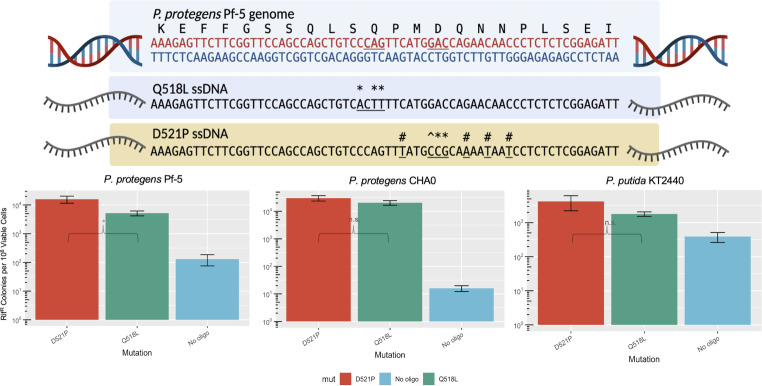
Comparison of rpoB point mutations across Pseudomonas spp. (A) ssDNA design of the Q518L and D521P point mutations. Single base-pair mutations and codon changes are underlined. Individual base-pair mutations are further denoted by *, #, and ^, where * indicates a transversion, # indicates a transition, and ^ indicates a rarely detected C:C mismatch. Log phase cultures of (B) P. protegens Pf-5, (C) P. protegens CHA0, and (D) P. putida KT2440 expressing E. coli λ Red Beta were electroporated with 15 µg of oligonucleotide encoding a D521P point mutation or Q518L in rpoB. Significance values are indicated for a Mann-Whitney U test between two groups, where *P < 0.05; **P < 0.01; ***P < 0.001; and; ns, not significant.
Fig 4
Fig 4
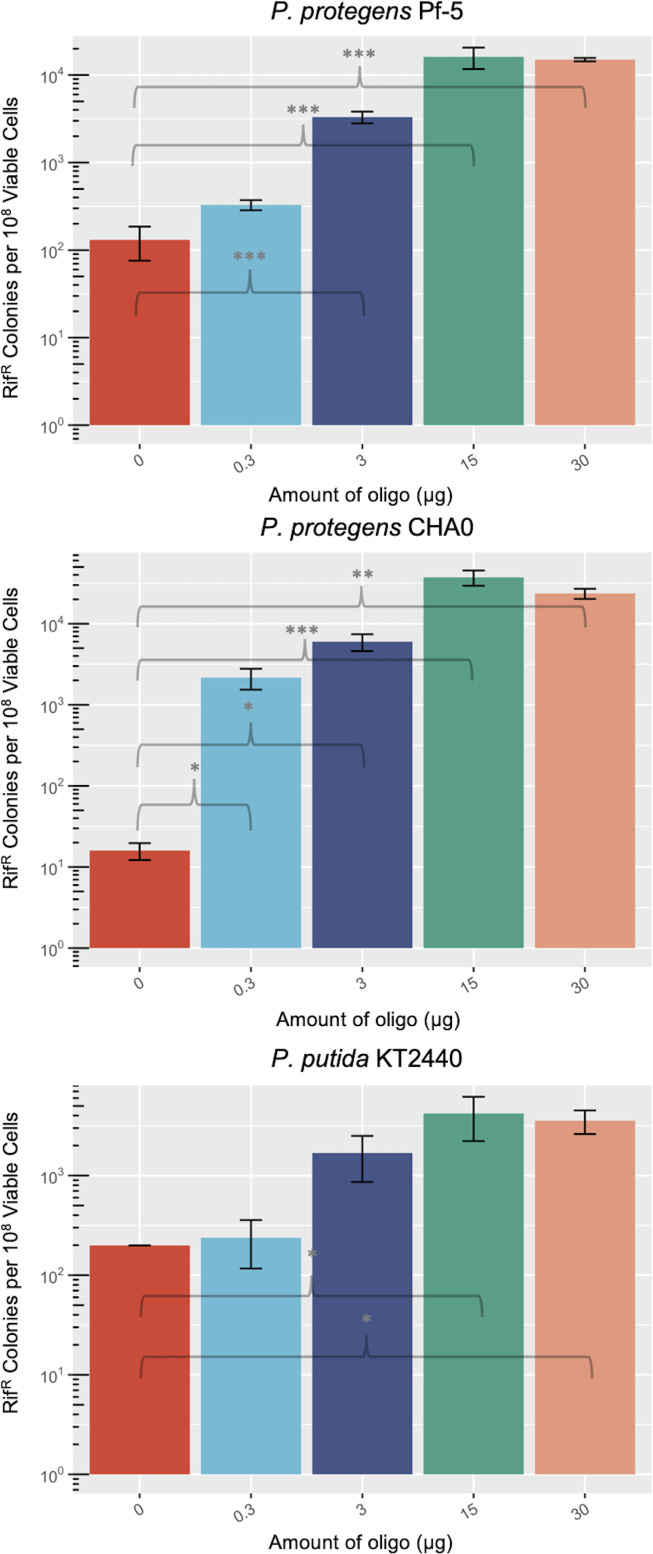
Effect of ssDNA amount on recombineering efficiency. Log phase cultures of P. protegens Pf-5, P. protegens CHA0, and P. putida KT2440 expressing E. coli λ Red Beta were electroporated with 0, 0.3, 3, 15, or 30 µg of oligonucleotide encoding a D521P point mutation in rpoB, and the cell mixture recovered for 3.5 h in LB before plating on rifampicin. RifR colonies and total viable colonies were counted after 2 d of growth. Significance values are indicated for a Mann-Whitney U test between two groups, where *P < 0.05; **P < 0.01; ***P < 0.001; and; ns, not significant.

References

    1. Court DL, Sawitzke JA, Thomason LC. 2002. Genetic engineering using homologous recombination. Annu Rev Genet 36:361–388. doi:10.1146/annurev.genet.36.061102.093104 - DOI - PubMed
    1. Mosberg JA, Lajoie MJ, Church GM. 2010. Lambda red Recombineering in Escherichia coli occurs through a fully single-stranded intermediate. Genetics 186:791–799. doi:10.1534/genetics.110.120782 - DOI - PMC - PubMed
    1. Corts A, Thomason LC, Costantino N, Court DL. 2022. Recombineering in non-model bacteria. Curr Protoc 2:e605. doi:10.1002/cpz1.605 - DOI - PMC - PubMed
    1. Pines G, Freed EF, Winkler JD, Gill RT. 2015. Bacterial recombineering: genome engineering via phage-based homologous recombination. ACS Synth Biol 4:1176–1185. doi:10.1021/acssynbio.5b00009 - DOI - PubMed
    1. Thomason LC, Costantino N, Court DL. 2016. Examining a DNA replication requirement for bacteriophage λ red and RAC prophage recet-promoted recombination in Escherichia coli. mBio 7:e01443-16. doi:10.1128/mBio.01443-16 - DOI - PMC - PubMed

MeSH terms

LinkOut - more resources