Review
. 2023 Dec 15;19(3):2267295.
doi: 10.1080/21645515.2023.2267295. Epub 2023 Oct 26.

Using the power of innate immunoprofiling to understand vaccine design, infection, and immunity

Affiliations
Review

Using the power of innate immunoprofiling to understand vaccine design, infection, and immunity

Jennifer Connors et al. Hum Vaccin Immunother. .

Abstract

In the field of immunology, a systems biology approach is crucial to understanding the immune response to infection and vaccination considering the complex interplay between genetic, epigenetic, and environmental factors. Significant progress has been made in understanding the innate immune response, including cell players and critical signaling pathways, but many questions remain unanswered, including how the innate immune response dictates host/pathogen responses and responses to vaccines. To complicate things further, it is becoming increasingly clear that the innate immune response is not a linear pathway but is formed from complex networks and interactions. To further our understanding of the crosstalk and complexities, systems-level analyses and expanded experimental technologies are now needed. In this review, we discuss the most recent immunoprofiling techniques and discuss systems approaches to studying the global innate immune landscape which will inform on the development of personalized medicine and innovative vaccine strategies.

Keywords: CyTOF; GWAS; MIBI; O-Link; RNA sequencing; Systems immunology; bioinformatics; infectious disease; innate immune cells; innate immune profiling; luminex; mesoscale; metabolomics; multi-color flow cytometry; multiplex cytokine profiling; phospho-flow; vaccinology.


Conflict of interest statement

No potential conflict of interest was reported by the author(s).

Figures
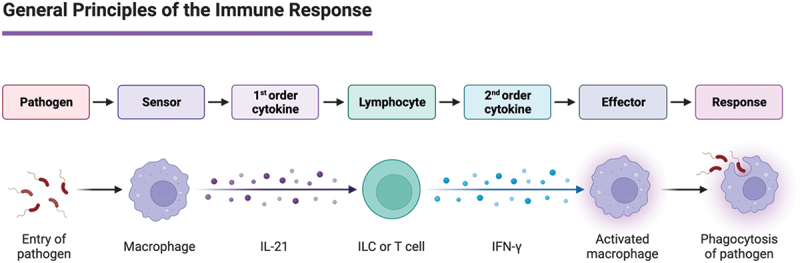
Figure 1.
Figure 1.
The immune system encompasses a unique population of cells and proteins that work together to protect the body from non-self-entities. The immune system in simple terms has two lines of defense: innate and adaptive immunity. The immune system has two basic lines of defense: innate and adaptive immunity. Innate immunity is antigen dependent, involving recognition of a non-self-antigen determined via unique structural or functional features of infectious agents. After recognition, the innate cells will initiate cytokine production to recruit more specific innate cells or initiate the antigen dependent adaptive immune system. Second order cytokines are produced from this interaction like IFN-γ leading to effector function like phagocytosis of the pathogen. Innate and adaptive immunity do not operate as separate mechanisms of host defense but rather complement each other.
Figure 2.
Figure 2.
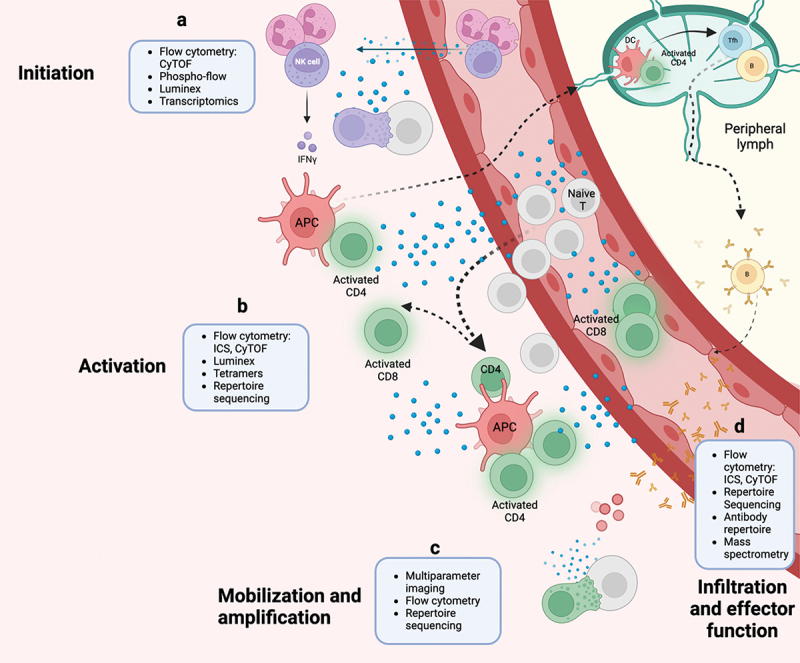
Systems innate immunology can be studied utilizing a variety of techniques combined with bioinformatic analyses. These analyses can not only be applied to different samples (ie peripheral blood, endotracheal aspirates, lymph node biopsies) but also to samples taken at different time points during infection, disease, or vaccination. (a) Innate cell subsets and their function have been characterized at early time points by flow cytometry, cytometry by time-of-flight (CyTOF), flow cytometry of phosphorylated proteins (phospho-flow), bead-based multiplex kit (Luminex) or other immunoassay like mesoscale discovery (MSD), and transcriptomics like RNA-seq to reveal inflammatory mediators and subsequent pathways in early infection or vaccination timepoints. (b) Innate initiation and activation of 1st order cytokines can be classified by phenotype and functional capability using flow cytometry for both surface and intracellular receptor expression along with effector proteins like cytokines and cytotoxic granules. Many of these effector proteins can also be detected by Luminex or MSD technology which can detect up to 80 analytes in a single sample. (c) Activated cells of the adaptive immune system can then be probed for antigen specificity by TCR or BCR repertoire sequencing, flow cytometry utilizing tetramer technology for peptide presentation, and multiparameter imaging. (d) These techniques are currently being expanded to cover tissue biopsies that will inform on the local microenvironment and infiltrating cell populations. APC, antigen-presenting cell; DC, dendritic cell; B, B cell; CD4, CD4+ T cell; NK, natural killer cell; T, T cell; ICS, intracellular cytokine staining; CD8, CD8+ T cell; Tfh, T follicular helper cell.

References

    1. Brodin P, Davis MM.. Human immune system variation. Nat Rev Immunol. 2017;17(1):21–14. doi:10.1038/nri.2016.125. - DOI - PMC - PubMed
    1. Tay A, Pavesi A, Yazdi SR, Lim CT, Warkiani ME. Advances in microfluidics in combating infectious diseases. Biotechnol Adv. 2016;34(4):404–21. doi:10.1016/j.biotechadv.2016.02.002. - DOI - PMC - PubMed
    1. Davis MM, Tato CM, Furman D. Systems immunology: just getting started. Nat Immunol. 2017;18(7):725–32. doi:10.1038/ni.3768. - DOI - PMC - PubMed
    1. Yan J, Risacher SL, Shen L, Saykin AJ. Network approaches to systems biology analysis of complex disease: integrative methods for multi-omics data. Brief Bioinform. 2018;19(6):1370–81. doi:10.1093/bib/bbx066. - DOI - PMC - PubMed
    1. Hasin Y, Seldin M, Lusis A. Multi-omics approaches to disease. Genome Biol. 2017;18(1):83. doi:10.1186/s13059-017-1215-1. - DOI - PMC - PubMed