[Preprint]. 2023 Oct 10:rs.3.rs-2493867.
doi: 10.21203/rs.3.rs-2493867/v1.

Viral activation and ecological restructuring characterize a microbiome axis of spaceflight-associated immune activation

Affiliations

Viral activation and ecological restructuring characterize a microbiome axis of spaceflight-associated immune activation

Braden T Tierney et al. Res Sq. .

Update in

  • Longitudinal multi-omics analysis of host microbiome architecture and immune responses during short-term spaceflight.
    Tierney BT, Kim J, Overbey EG, Ryon KA, Foox J, Sierra MA, Bhattacharya C, Damle N, Najjar D, Park J, Garcia Medina JS, Houerbi N, Meydan C, Wain Hirschberg J, Qiu J, Kleinman AS, Al-Ghalith GA, MacKay M, Afshin EE, Dhir R, Borg J, Gatt C, Brereton N, Readhead BP, Beyaz S, Venkateswaran KJ, Wiseman K, Moreno J, Boddicker AM, Zhao J, Lajoie BR, Scott RT, Altomare A, Kruglyak S, Levy S, Church GM, Mason CE. Tierney BT, et al. Nat Microbiol. 2024 Jul;9(7):1661-1675. doi: 10.1038/s41564-024-01635-8. Epub 2024 Jun 11. Nat Microbiol. 2024. PMID: 38862604 Free PMC article.

Abstract

Maintenance of astronaut health during spaceflight will require monitoring and potentially modulating their microbiomes, which play a role in some space-derived health disorders. However, documenting the response of microbiota to spaceflight has been difficult thus far due to mission constraints that lead to limited sampling. Here, we executed a six-month longitudinal study centered on a three-day flight to quantify the high-resolution microbiome response to spaceflight. Via paired metagenomics and metatranscriptomics alongside single immune profiling, we resolved a microbiome "architecture" of spaceflight characterized by time-dependent and taxonomically divergent microbiome alterations across 750 samples and ten body sites. We observed pan-phyletic viral activation and signs of persistent changes that, in the oral microbiome, yielded plaque-associated pathobionts with strong associations to immune cell gene expression. Further, we found enrichments of microbial genes associated with antibiotic production, toxin-antitoxin systems, and stress response enriched universally across the body sites. We also used strain-level tracking to measure the potential propagation of microbial species from the crew members to each other and the environment, identifying microbes that were prone to seed the capsule surface and move between the crew. Finally, we identified associations between microbiome and host immune cell shifts, proposing both a microbiome axis of immune changes during flight as well as the sources of some of those changes. In summary, these datasets and methods reveal connections between crew immunology, the microbiome, and their likely drivers and lay the groundwork for future microbiome studies of spaceflight.


Conflict of interest statement

BTT is compensated for consulting with Seed Health and Enzymetrics Biosciences on microbiome study design and holds an ownership stake in the former. RD and GA are employees of Seed Health and additionally hold ownership stakes. CEM is a co-Founder of Onegevity, Twin Orbit, and Cosmica Biosciences. EEA is a consultant for Thorne HealthTech. GC has conflicts. JF and MM are employees of Tempus Labs. KB, JM, AB, JZ, BL, AA, SK, and SL are employees of Element Biosciences, which sequenced a subset of samples used in this study. Unless otherwise mentioned, none of the companies listed had a role in conceiving, executing, or funding the work described here.

Figures
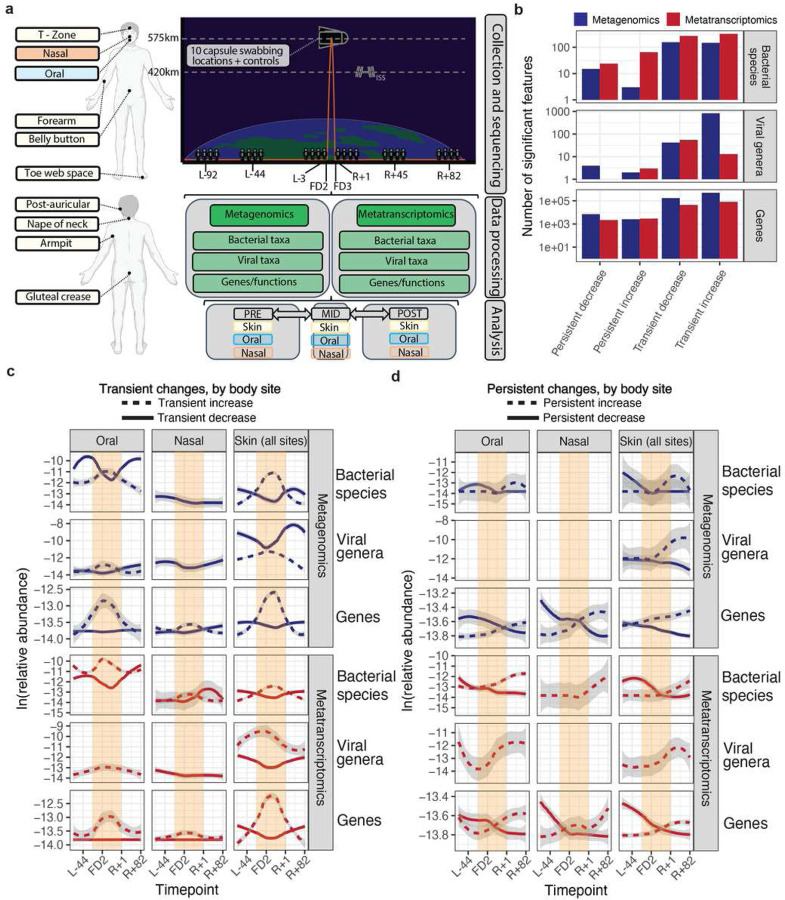
Figure 1:
Figure 1:. Overview of dataset and summary of alpha diversity.
A) Collection and analytic approach. Body swabs were collected from ten different sites, comprising three microbial ecosystems (oral, nasal, skin) around the body at eight different timepoints surrounding launch. These are referred to as L-92, L-44, L-3, FD1, FD2, R+1, R+45, R+82, where “L-” refers to pre-launch, “FD” corresponds to flight day (i.e., mid-flight), “R” refers to recovery (i.e., post-flight). Following collection and paired metagenomic/metatranscriptomic sequencing, samples were processed to extract taxonomic (bacterial viral) and functional features to determine their changes relative to flight with a Microbiome Association Study (MAS). B) The total number of features (species or genes) found to be statistically associated with either pre- or post-flight timepoints across sequencing methods. Features are grouped by the categories laid out in the Methods regarding the nature of their changes relative to flight. C) The time trajectories of transiently increased/decreased significant findings across sequencing type, feature type, and body site (after filtering to remove low priority [i.e., weakly significant]) associations. Blank plots had either no significant findings or none that met the filtering criteria. D) Same as D, except viewing associations that were categorized as potentially persistent after flight.
Figure 2:
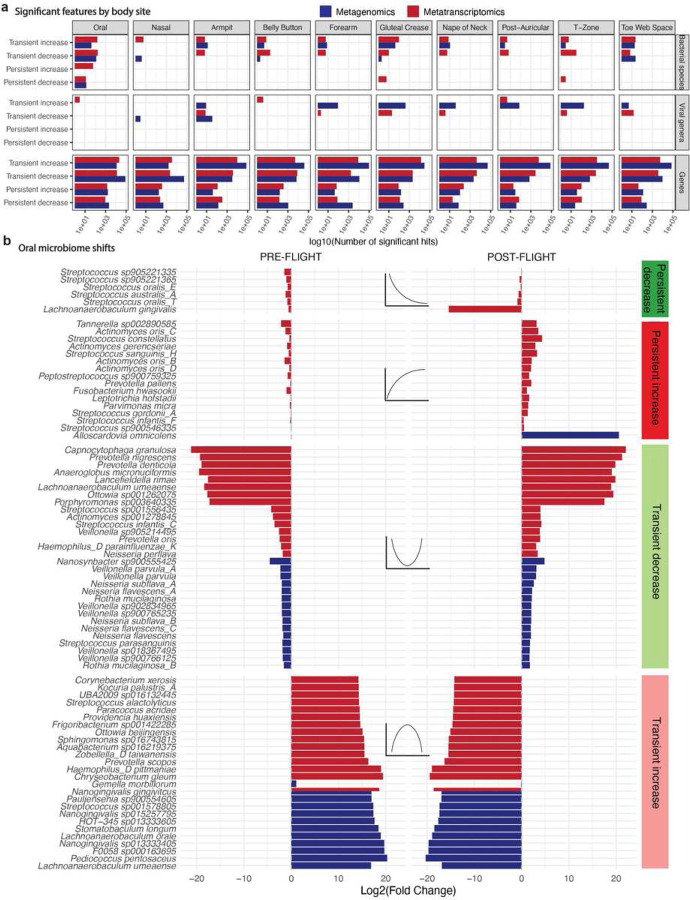
Figure 2:. Site-specific changes and the oral microbiome architecture of spaceflight.
A) Significant features by specific swabbing sites. B) The strongest associations between bacteria and flight for the oral microbiome. X-axes are average L2FC of all pre-flight or post-flight timepoints compared to the average mid-flight abundances for a given taxon.Columns correspond to different association categories that are described visually by the example line plots on top of each one. Dotted, gray, horizontal lines demarcate an L2FC of zero. Plotted taxa were selected by ranking significant features in each category by L2FC and showing up to 10 at once.
Figure 3:
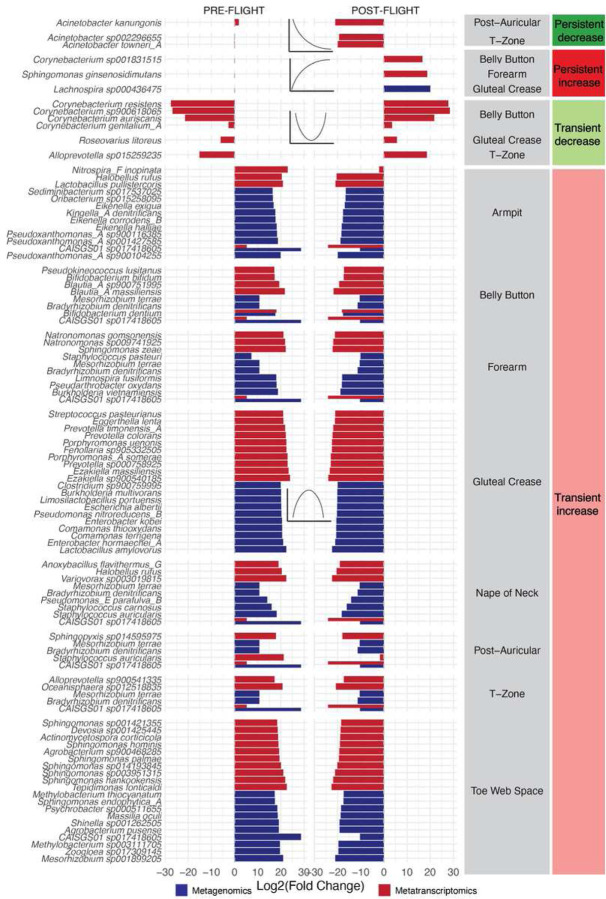
Figure 3:. Strong changes to the skin microbiome during spaceflight.
The strongest associations between bacteria and flight for the skin microbiome. X-axes are average L2FC of all pre or post flight timepoints compared to the average mid-flight abundances for a given taxon. Columns correspond to different association categories that are described visually by the example line plots on top of each one. Dotted, gray, horizontal lines demarcate an L2FC of zero. Plotted taxa were selected by ranking significant features in each category by L2FC and showing up to 10 at once.
Figure 4:
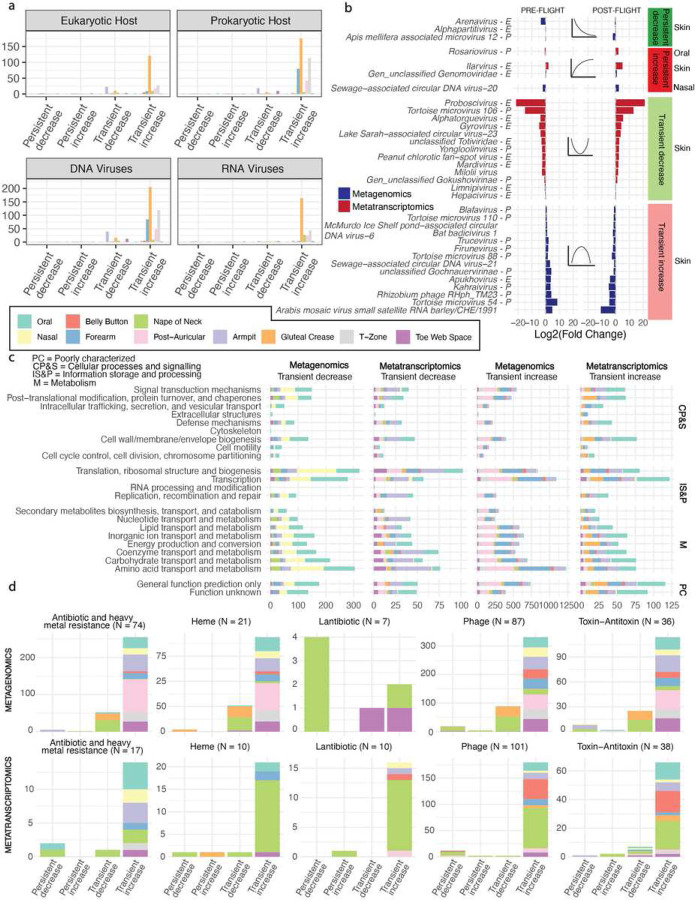
Figure 4:. The viral and functional response of the microbiome to spaceflight
A-B) Host and molecular type of viruses associated with flight, by category. B) The strongest associations between viruses and flight for the skin and oral microbiomes. X-axes are average L2FC of all pre-flight or post-flight timepoints compared to the average mid-flight abundances for a given taxon. Columns correspond to different association categories that are described visually by the example line plots on top of each one. Dotted, gray, horizontal lines demarcate an L2FC of zero. Plotted taxa were selected by ranking significant features in each category by L2FC and showing up to 10 at once. Viral genera are labeled “E” for targeting a eukaryotic host and “P” for targeting a prokaryote. If no definite host is known, no label was assigned. C) COG categories of all genes associated with flight. D) Groups of specific protein products that were associated with flight. The legend in the black box is relevant for all figures where those colors appear.
Figure 5:
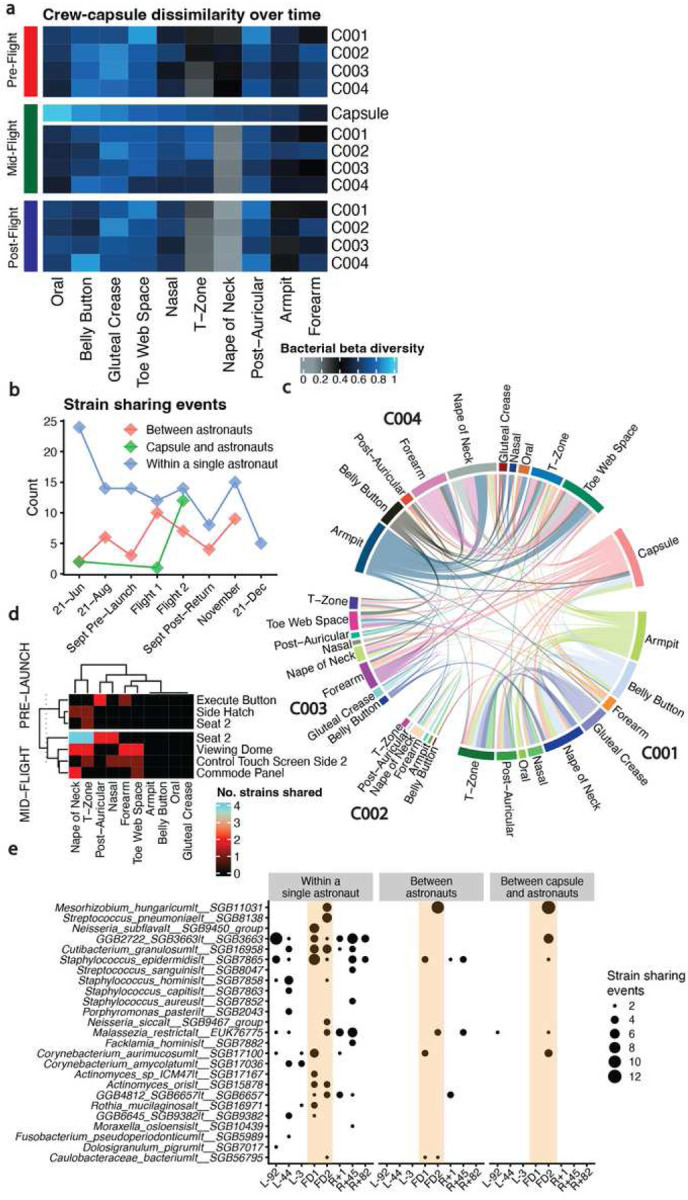
Figure 5:. Microbial propagation through the Dragon Capsule and the crew.
A) Beta diversities for bacterial metagenomics. Heatmap color corresponds to average beta diversity, with black being the midpoint (0.5), blue being totally dissimilar (1.0) and gray being highly similar (0.0). Columns are hierarchically clustered considering all rows. The interpretation for a single cell is, for the crew member annotated on the right-hand side, that body site’s dissimilarity to all other cells in that column (so the Capsule and all other crew samples from the same site). B) The number of strain-sharing events across time, where an event is defined as the detection of the same strain between two different swabbing locations. C) Strain sharing events between the crew and the capsule during the mid-flight timepoints. D) Capsule locations where strain sharing was identified in the training capsule and during flight. E) Organisms with at least two strain sharing events detected within a given timepoint.
Figure 6:
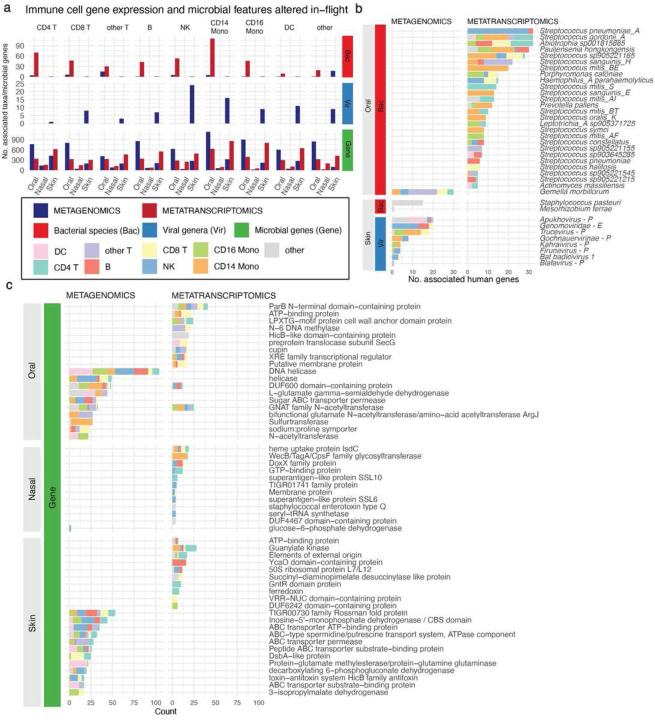
Figure 6:. The landscape of potential immune-microbiome associations related to flight.
A) The total number of microbial features, by type, associated with different immune cell subtypes for those that were long-term increased after flight (left panel) and decreased (right panel). B) The flight-associated (increased in abundance or expression) bacteria and viruses that were associated with the greatest number of host genes. Viral genera are labeled “E” for targeting a eukaryotic host and “P” for targeting a prokaryote. If no definite host is known, no label was assigned. C) The flight-associated microbial genes that were associated with the greatest number of host genes. We sorted for genes within each body site and selected the top 15 with the greatest number of human gene associations. The legend in the black box is relevant for all figures where those colors appear.

References

    1. Jennings R. T., Murphy D. M. F., Ware D. L., Aunon S. M., Moon R. E., Bogomolov V. V., Morgun V. V., Voronkov Y. I., Fife C. E., Boyars M. C. & Ernst R. D. Medical qualification of a commercial spaceflight participant: not your average astronaut. Aviat. Space Environ. Med. 77, 475–484 (2006). - PubMed
    1. Stepanek J., Blue R. S. & Parazynski S. Space Medicine in the Era of Civilian Spaceflight. N. Engl. J. Med. 380, 1053–1060 (2019). - PubMed
    1. Iovino P., Bilancio G., Tortora R., Bucci C., Pascariello A., Siniscalchi M. & Ciacci C. Gastrointestinal function in simulated space flight microgravity. Dig. Liver Dis. 2009, S 140–S 140 (2009).
    1. Smith S. M., Uchakin P. N. & Tobin B. W. Space flight nutrition research: platforms and analogs. Nutrition 18, 926–929 (2002). - PubMed
    1. Turroni S., Magnani M., Kc P., Lesnik P., Vidal H. & Heer M. Gut Microbiome and Space Travelers’ Health: State of the Art and Possible Pro/Prebiotic Strategies for Long-Term Space Missions. Front. Physiol. 11, 553929 (2020). - PMC - PubMed

Publication types

LinkOut - more resources