


Nuclear and Urinary Measurements Show the Efficacy of Sun-Protection Factor 50+ Sunscreen against DNA Photoproducts upon Real-Life Recreational Exposure
- PMID: 37886699
- PMCID: PMC10597780
- DOI: 10.1016/j.xjidi.2023.100227
Nuclear and Urinary Measurements Show the Efficacy of Sun-Protection Factor 50+ Sunscreen against DNA Photoproducts upon Real-Life Recreational Exposure
Abstract
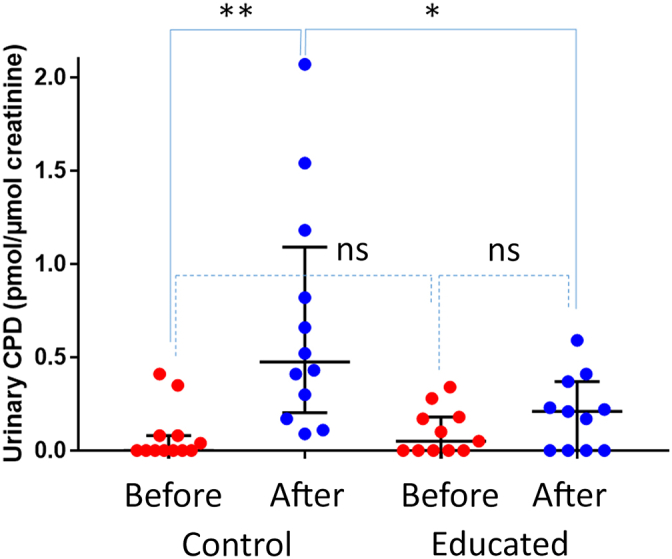
Sunscreens have been shown to protect against UVR-induced DNA damage in human skin under laboratory conditions. We presently extended these observations to real-life conditions in volunteers after their ordinary exposure habits during summer holidays. Volunteers were randomly assigned to a control group and an educated group supplied with a SPF ≥50 sunscreen and receiving instructions for use. A questionnaire was used to determine the extent of exposure. No difference in average solar UVR exposure was found between the two groups. DNA photoprotection was first assessed by, to our knowledge, a previously unreported noninvasive assay on the basis of the quantification of pyrimidine dimers released by DNA repair in urine. Damage was also quantified in the nuclear DNA extracted from the roof of suction blisters collected after recreational exposure. The urinary concentration of photoproducts was significantly higher in the control than in the educated group. The same trend was observed for the level of photoproducts in the DNA from suction blisters. The unambiguous observation of an efficient photoprotection against DNA damage afforded by sunscreen under real-life conditions provides strong support for the efficiency of the sunscreens. In addition, the results validate the use of urinary DNA photoproducts as a noninvasive assay applicable to photoprotection.
© 2023 The Authors.
Figures



References
-
- Ahmad J., Cooke M.S., Hussieni A., Evans M.D., Patel K., Burd R.M., et al. Urinary thymine dimers and 8-oxo-2'-deoxyguanosine in psoriasis. FEBS Lett. 1999;460:549–553. - PubMed
-
- Autier P., Boniol M., Doré J.F. Sunscreen use and increased duration of intentional sun exposure: still a burning issue. Int J Cancer. 2007;121:1–5. - PubMed
-
- Autier P., Boniol M., Severi G., Doré J.F. European Organizatin for Research and Treatment of Cancer Melanoma Co-operative Group. Quantity of sunscreen used by European students. Br J Dermatol. 2001;144:288–291. - PubMed
-
- Bacqueville D., Douki T., Duprat L., Rebelo-Moreira S., Guiraud B., Dromigny H., et al. A new hair follicle-derived human epidermal model for the evaluation of sunscreen genoprotection. J Photochem Photobiol B. 2015;151:31–38. - PubMed
-
- Bacqueville D., Jacques-Jamin C., Dromigny H., Boyer F., Brunel Y., Ferret P.J., et al. Phenylene bis-diphenyltriazine (triAsorB), a new sunfilter protecting the skin against both UVB + UVA and blue light radiations. Photochem Photobiol Sci. 2021;20:1475–1486. - PubMed
LinkOut - more resources
Full Text Sources
