


Elexacaftor/Tezacaftor/Ivacaftor Treatment and Depression-related Events
- PMID: 37890129
- PMCID: PMC10840763
- DOI: 10.1164/rccm.202308-1525OC
Elexacaftor/Tezacaftor/Ivacaftor Treatment and Depression-related Events
Abstract
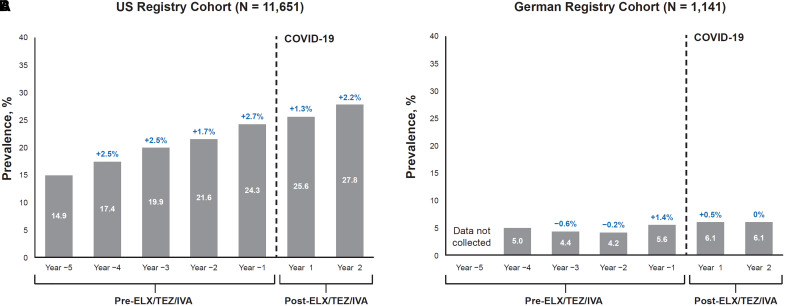
Rationale: Elexacaftor/tezacaftor/ivacaftor (ELX/TEZ/IVA) has been shown to be safe and efficacious in people with cystic fibrosis (pwCF) aged 2 years and older with at least one F508del-CFTR allele or more. After U.S. approval in 2019, reports emerged of depression-related adverse events in pwCF treated with ELX/TEZ/IVA. Objectives: To review available evidence on depression-related events in pwCF treated with ELX/TEZ/IVA in the context of background epidemiology in pwCF. Methods: Safety data from 14 ELX/TEZ/IVA clinical trials and 10 trials of CF transmembrane conductance regulator (CFTR) modulators in which placebo was administered, along with data from CF registries in the United States and Germany and cumulative postmarketing adverse event data from 61,499 pwCF who initiated ELX/TEZ/IVA after initial approval in the United States (October 2019) through October 2022, were reviewed and used to calculate exposure-adjusted rates of depression-related adverse events and prevalence of depression. In addition, a scientific literature review was conducted to identify ELX/TEZ/IVA publications reporting depression-related events or changes in depressive symptoms after treatment initiation. Measurements and Main Results: In clinical trials, the exposure-adjusted rate of any depression-related adverse event was 3.32/100 person years (PY) in the pooled ELX/TEZ/IVA group (n = 1,711) and 3.24/100 PY in the pooled placebo group (n = 1,369). The exposure-adjusted rates of suicidal ideation and suicide attempt were also similar between the pooled ELX/TEZ/IVA group and pooled placebo group (ideation: 0.23/100 PY vs. 0.28/100 PY; attempt: 0.08/100 PY vs. 0.14/100 PY). In the postmarketing setting, the exposure-adjusted reporting rates of depression-related events were low in context of the background prevalence in pwCF (all depression-related events: 1.29/PY; suicidal ideation: 0.12/100 PY; and suicide attempt: 0.05/100 PY). Assessments of individual case reports were confounded by preexisting mental health conditions, intercurrent psychosocial stressors (including coronavirus disease [COVID-19] lockdowns), and the heterogeneous and fluctuating nature of depression. Data from CF registries in the United States and Germany showed that patterns of depression prevalence in pwCF exposed to ELX/TEZ/IVA did not change after treatment initiation. Published studies utilizing the nine-item Patient Health Questionnaire did not show evidence of worsening depression symptoms in pwCF treated with ELX/TEZ/IVA. Conclusions: Our review of data from clinical trials, postmarketing reports, an ongoing registry-based ELX/TEZ/IVA postauthorization safety study, and peer-reviewed literature suggests that depression symptoms and depression-related events reported in pwCF treated with ELX/TEZ/IVA are generally consistent with background epidemiology of these events in the CF population and do not suggest a causal relationship with ELX/TEZ/IVA treatment.
Keywords: CFTR modulator; depression; elexacaftor/tezacaftor/ivacaftor; mental health.
Figures
Comment in
-
Questions and Answers? Depression Symptoms Associated with Elexacaftor/Tezacaftor/Ivacaftor Treatment for Cystic Fibrosis.Am J Respir Crit Care Med. 2024 Feb 1;209(3):239-241. doi: 10.1164/rccm.202311-2159ED. Am J Respir Crit Care Med. 2024. PMID: 38113403 Free PMC article. No abstract available.
References
-
- Riordan JR, Rommens JM, Kerem B, Alon N, Rozmahel R, Grzelczak Z, et al. Identification of the cystic fibrosis gene: cloning and characterization of complementary DNA. Science . 1989;245:1066–1073. - PubMed
-
- Boyle MP, De Boeck K. A new era in the treatment of cystic fibrosis: correction of the underlying CFTR defect. Lancet Respir Med . 2013;1:158–163. - PubMed
Publication types
MeSH terms
Substances
Grants and funding
LinkOut - more resources
Full Text Sources
Medical
