Multicenter Study
. 2023 Oct 27;13(1):18455.
doi: 10.1038/s41598-023-45514-4.

Associations of corticosteroid therapy and tonsillectomy with kidney survival in a multicenter prospective study for IgA nephropathy

Affiliations
Multicenter Study

Associations of corticosteroid therapy and tonsillectomy with kidney survival in a multicenter prospective study for IgA nephropathy

Tetsuya Kawamura et al. Sci Rep. .

Abstract

Efficacy of systemic corticosteroid therapy (CS) for long-term kidney survival in patients with IgA nephropathy (IgAN) is controversial. Therefore, prospective studies evaluating targeted therapies to lymphatic tissues in mucosal immune system responsible for production of nephritogenic IgA have been desired worldwide. Here, we aimed to evaluate the associations of CS and combination therapy of CS and tonsillectomy (CS + Tx) with kidney survival, using database from a nationwide multicenter prospective cohort study on IgAN. Primary outcome was a 50% increase in serum creatinine from baseline or dialysis induction. The analysis included 941 patients (CS/CS + Tx/non-CS 239/364/338), 85 (9.0%) of whom reached outcomes during median follow-up of 5.5 (interquartile range 2.0-8.0) years. On overlap weighting analysis with balanced baseline characteristics, CS and CS + Tx were associated with lower risk of kidney events when compared with non-CS (hazard ratio [HR] 0.51, 95% confidence interval [CI] 0.29-0.88 and HR 0.20, 95%CI 0.09-0.44, respectively). Notably, when compared with the CS, CS + Tx was associated with a lower risk of kidney events (HR 0.40, 95%CI 0.18-0.91). Present study demonstrated, keeping with favorable association of systemic CS with kidney survival, concurrent tonsillectomy as one of targeted interventions to lymphatic tissues may provide additional improvement to kidney survival in patients with IgAN.


Conflict of interest statement

The authors declare no competing interests.

Figures

Figure 1
Figure 1
Patient flowchart. MAP, mean arterial blood pressure; eGFR, estimated glomerular filtration rate; IPW-ATT, inverse probability treatment weighting on the average treatment effect in the population that received CS + Tx; IPW-ATU, inverse probability treatment weighting on the average treatment effect in the non-CS group.
Figure 2
Figure 2
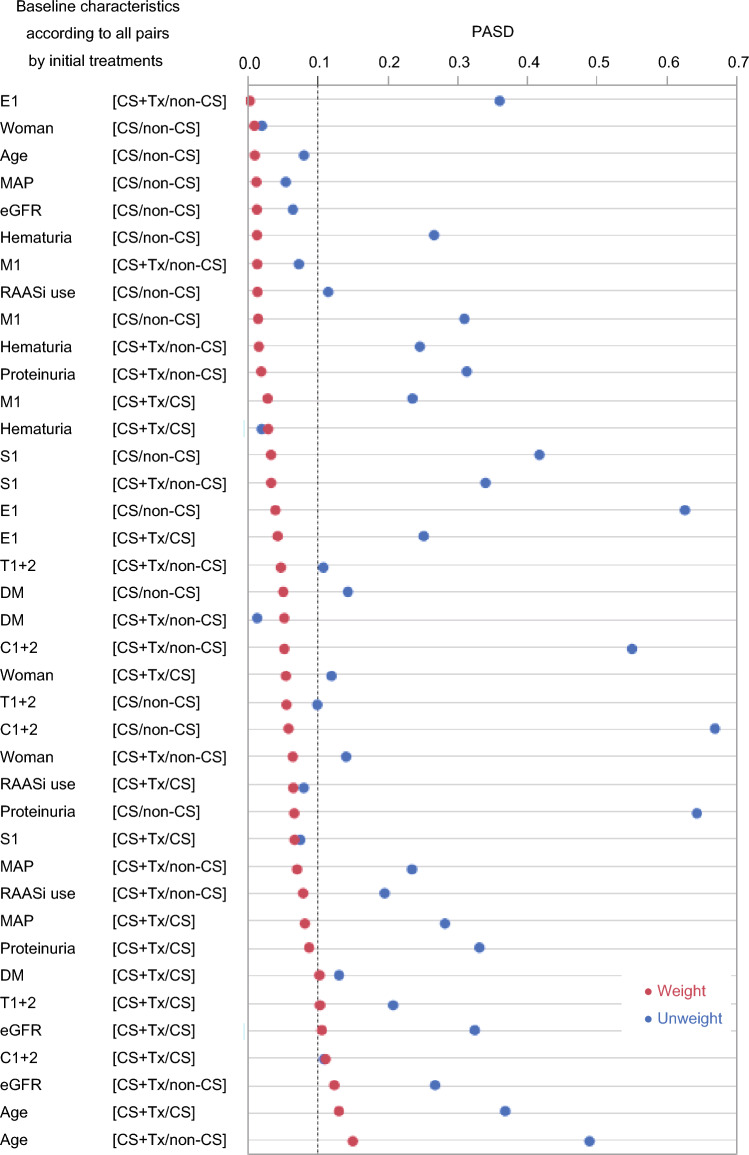
All pairwise absolute standardized differences (PASDs) in baseline characteristics among the initial treatment categories before and after overlap-weighting analysis. Distribution of all baseline characteristics in covariate set 1 according to the treatment groups (non-CS, CS, and CS + Tx) was balanced after overlap-weighting analysis as shown by PASD. The rate of variables showing PASD ≤ 0.1 in covariate set 1 increased from 25.6% in the unweighted analysis to 87.2% in the weighted analysis. The maximums of the pairwise absolute standardized differences in each baseline characteristic are also shown in Table 1. PASD, all pairwise absolute standardized difference; non-CS, non-corticosteroid use; CS corticosteroid monotherapy; CS + Tx, corticosteroid therapy combined with tonsillectomy; MAP, mean arterial blood pressure; eGFR, estimated glomerular filtration rate; M, mesangial hypercellularity score; E, endocapillary hypercellularity score; S, segmental sclerosis score; T, tubulointerstitial fibrosis/atrophy score; C, crescent score; RAASi, renin–angiotensin–aldosterone system inhibitor.
Figure 3
Figure 3
Cumulative incidence estimates, incidence rate, and hazard ratio for kidney outcome in the overlap-weighting analysis. (a) Weighted cumulative incidence estimates by initial treatment categories. The date of kidney biopsy was considered as the index date for all patients. In overall, composite kidney events were defined as > 50% increase in serum creatinine from baseline (among patients aged ≥ 20 years; the number of events [%] was 96.6/849.1 [11.4] in the overlap-weighting analysis) or > 25% reduction in eGFR (among patients aged < 20 years; the number of events [%] was 5.4/94.3 [5.7] in the overlap-weighting analysis). These definitions were used because all patients who received maintenance dialysis during follow-up reached these end points prior to the induction of dialysis. The median observation time by initial treatment categories were 5.5 years (IQR, 2.0–7.5 years) in the non-CS group, 6.0 years (IQR, 3.0–8.0 years) in the CS group, and 5.0 years (IQR, 2.0–7.5 years) in the CS + Tx group. During follow-up, the median initiated time of the treatments was 0.0 years (IQR, 0.0–0.0 years) in the non-CS group, 0.0 years (IQR, 0.0–0.5 years) in the CS group, and 0.0 years (IQR, 0.0–0.5 years) in the CS + Tx group. (b) Weighted incidence rate per 1000 patient-years and weighted hazard ratio by initial treatment categories. Actual data are shown in Table 2. PY, patient-years; HR, hazard ratio; CI, confidence interval; non-CS, non-corticosteroid use; CS, corticosteroid monotherapy; CS + Tx, corticosteroid combined with tonsillectomy.
Figure 4
Figure 4
Stepwise reduction in risk of kidney outcomes, in order, by non-corticosteroid use, corticosteroid monotherapy, and combining corticosteroid with tonsillectomy according to baseline characteristic subgroups. The association between initial treatments and kidney outcomes (already shown in Fig. 3 and Table 2) was not modified by a majority of the baseline characteristic subgroups (p for interaction > 0.1). (a) Clinical subgroup analyses. One significant interaction between hematuria and initial treatment was observed. (b) Pathological subgroup analyses. Two significant interactions between each of endocapillary hypercellularity and crescent and initial treatment were observed. Hazard ratios were not weighted but adjusted with all variables in covariate set 1, except for each stratifying factor. N, number of patients; PY, weighted patient-years; CI, confidence interval; P for interaction, p value for interaction between initial treatments and each of the baseline characteristic subgroups on kidney outcome; non-CS, non-corticosteroid use; CS, corticosteroid monotherapy; CS + Tx, corticosteroid therapy combined with tonsillectomy; MAP, mean arterial pressure; eGFR, estimated glomerular filtration rate; RAASi, renin–angiotensin–aldosterone system inhibitor; M, mesangial hypercellularity; E, endocapillary hypercellularity; S, segmental sclerosis; T tubular atrophy/interstitial fibrosis; C, crescent; ND, not determined because of small sample size.

References

    1. Wyatt RJ, Julian BA. MEdical progress: IgA nephropathy. N. Engl. J. Med. 2013;368(25):2402–24014. doi: 10.1056/NEJMRA1206793/SUPPL_FILE/NEJMRA1206793_DISCLOSURES.PDF. - DOI - PubMed
    1. Rovin BH, Adler SG, Barratt J, et al. KDIGO 2021 clinical practice guideline for the management of glomerular diseases. Kidney Int. 2021;100(4):S1–S276. doi: 10.1016/J.KINT.2021.05.021. - DOI - PubMed
    1. Rauen T, Eitner F, Fitzner C, et al. Intensive supportive care plus immunosuppression in IgA nephropathy. N. Engl. J. Med. 2015;373(23):2225–2236. doi: 10.1056/NEJMoa1415463. - DOI - PubMed
    1. Lv J, Zhang H, Wong MG, et al. Effect of oral methylprednisolone on clinical outcomes in patients with IgA nephropathy: The TESTING randomized clinical trial. JAMA. 2017;318(5):432–442. doi: 10.1001/jama.2017.9362. - DOI - PMC - PubMed
    1. Lv J, Wong MG, Hladunewich MA, et al. Effect of oral methylprednisolone on decline in kidney function or kidney failure in patients with IgA nephropathy: The TESTING randomized clinical trial. JAMA. 2022;327(19):1888–1898. doi: 10.1001/JAMA.2022.5368. - DOI - PMC - PubMed

Publication types

Substances