Review
. 2023 Oct 17;13(10):1468.
doi: 10.3390/brainsci13101468.

The Effect of Beta-Carotene on Cognitive Function: A Systematic Review

Affiliations
Review

The Effect of Beta-Carotene on Cognitive Function: A Systematic Review

Diana Marisol Abrego-Guandique et al. Brain Sci. .

Abstract

β-carotene is a powerful antioxidant and dietary precursor of vitamin A whose role in maintaining mental health and cognitive performance, either alone or in combination with other dietary compounds, has been a topic of recent research. However, its effectiveness is still unclear. This systematic review, conducted according to the PRISMA guideline and assisted by the MySLR platform, addressed this issue. A total of 16 eligible original research articles were identified. Dietary intake or β-carotene serum levels were associated with improved measures of cognitive function in 7 out of 10 epidemiological studies included. In intervention studies, β-carotene consumption alone did not promote better cognitive function in the short term, but only in a long-term intervention with a mean duration of 18 years. However, all but one intervention study suggested the beneficial effects of β-carotene supplementation at doses ranging from 6 mg to 50 mg per day in combination with a multicomplex such as vitamin E, vitamin C, zinc, or selenium for a period of 16 weeks to 20 years. Despite the current limitations, the available evidence suggests a potential association between β-carotene dietary/supplementary intake and the maintenance of cognitive function. The β-carotene most probably does not act alone but in synergy with other micronutrients.

Keywords: cognitive function; diet supplements; synergic effect; β-carotene.


Conflict of interest statement

The authors declare no conflict of interest.

Figures
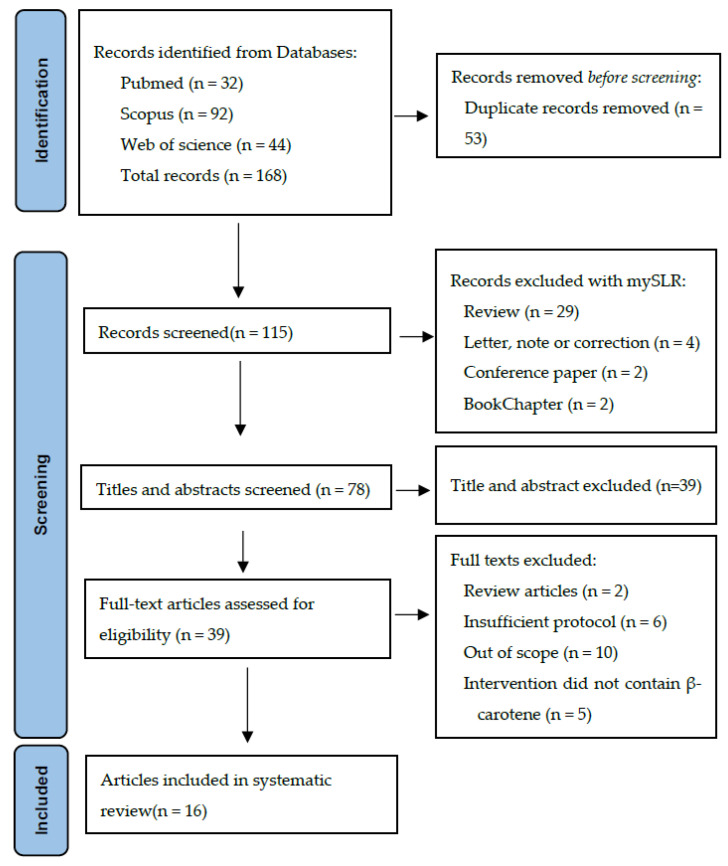
Figure 1
Figure 1
PRISMA flow diagram showing the algorithm for selecting eligible studies.
Figure 2
Figure 2
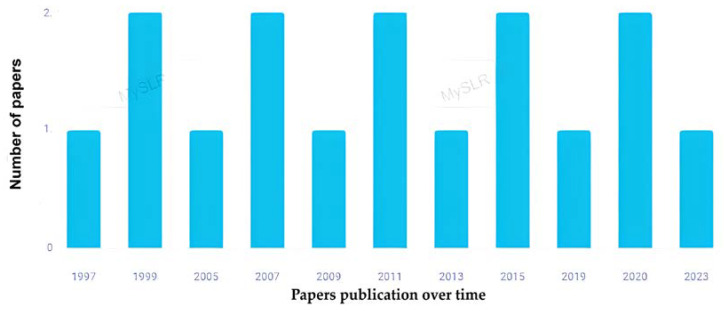
Distribution by year of the studies on the relationship between β-carotene and cognitive function included in the systematic review (n = 16) (created with MySLR).
Figure 3
Figure 3
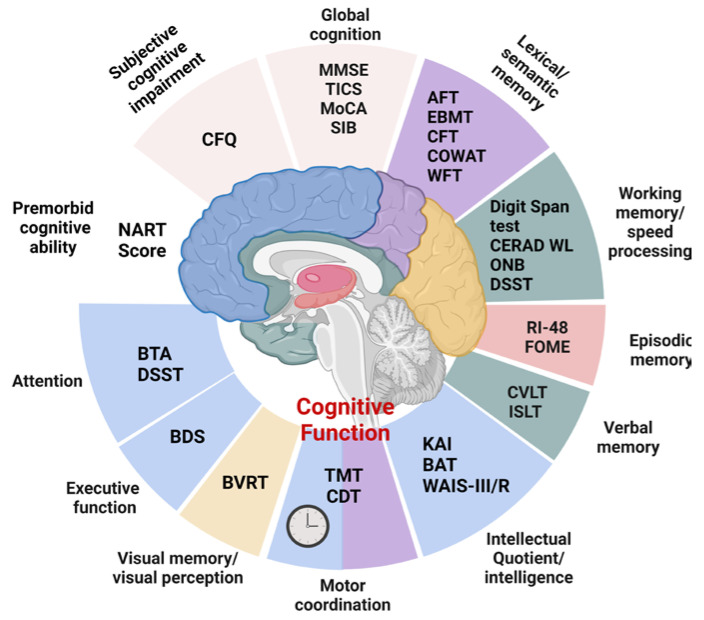
Scheme of the cognitive test batteries and assessment tools used in the systematically revised literature. Global cognition was assessed with the following: MMSE: mini-mental state examination; TICS: Telephone Interview of Cognitive Status; MoCA: Montreal Cognitive Assessment; SIB: Severe Impairment Battery. Lexical/semantic memory was assessed with the following: AFT: Animal Fluency Test; EBMT: East Boston Memory Test; CFT: Category Fluency Test; COWAT: Controlled Oral Word Association Test; WFT: Word Fluency Test. Working memory/speed processing was assessed with the following: the digit span test; CERAD WL: Consortium to Establish a Registry for Alzheimer’s Disease Word Learning; ONB: One Back Task; DSST: Digit Symbol Substitution Test. Episodic memory was assessed with the following: RI-48: Cued Recall Test; FOME: Fuld Object Memory Evaluation. Verbal memory was assessed with the following: CVLT: California Verbal Learning Test; ISLT: International Shopping List Task. Intellectual quotient/intelligence was assessed with the following: KAI: Kurztest fuer Allgemeine Intelligenz; BAT: Berliner Amnesie Test; WAIS-III: Wechsler Adult Intelligence Scale Revised. Motor coordination was assessed with the following: TMT, Trail Making Test; CDT: Clock Drawing Test. Visual memory/visual perception was assessed with the BVRT: Benton Visual Retention Test. Executive function was assessed with the BDS: Behavioral Dyscontrol Scale. Attention was assessed with the following: BTA: Brief Test of Attention; DSST: Digit Symbol Substitution Test. Premorbid cognitive ability was assessed with the NART: National Adult Reading Test. Subjective cognitive impairment was assessed with the CFQ: Cognitive Failures Questionnaire. The visualization was created with BioRender.
Figure 4
Figure 4
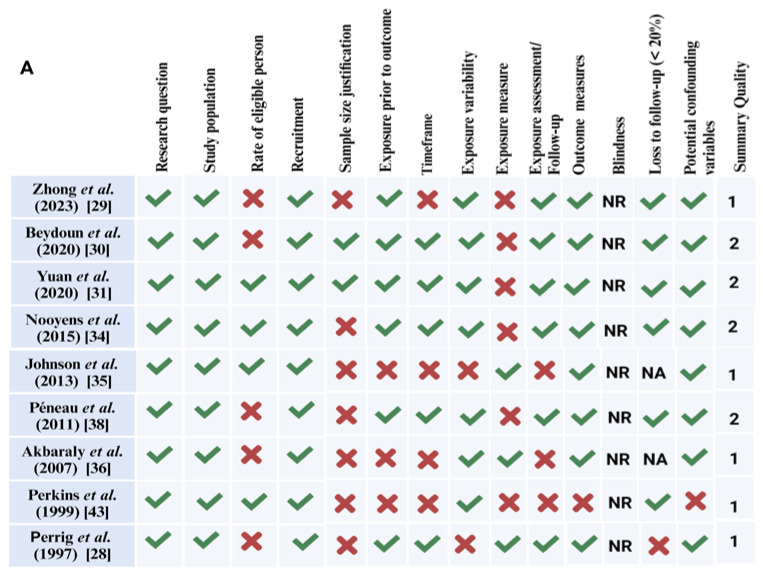
(A) Summary of risk-of-bias assessment according to the National Institutes of Health Quality Assessment Tool for Observational Cohort and Cross-Sectional Studies (NIH, 2014) [44]. (B) Summary Quality Assessment according to Health Quality Controlled Intervention Studies (NIH, 2014). The quality rating is 0 for poor (0–4 out of 14 questions), 1 for fair (5–9 out of 14 questions), or 2 for good (>10 out of 14 questions) [28,29,30,31,32,33,34,35,36,37,38,39,40,41,42,43]. NA: not applicable, NR: not reported; created with BioRender.
Figure 4
Figure 4
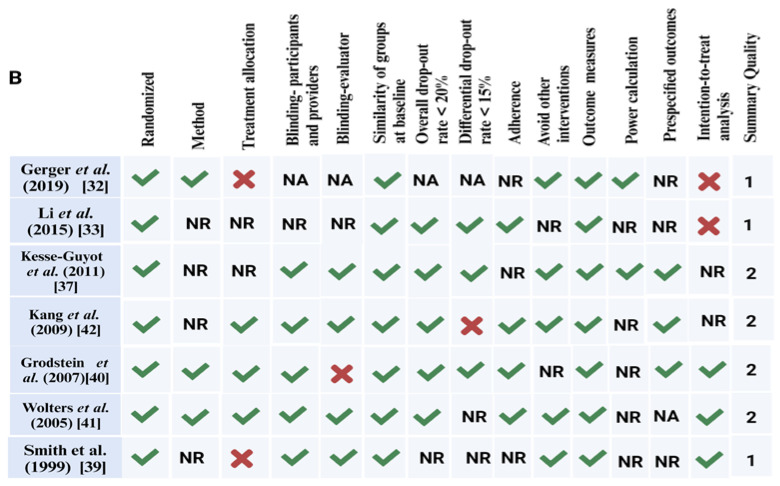
(A) Summary of risk-of-bias assessment according to the National Institutes of Health Quality Assessment Tool for Observational Cohort and Cross-Sectional Studies (NIH, 2014) [44]. (B) Summary Quality Assessment according to Health Quality Controlled Intervention Studies (NIH, 2014). The quality rating is 0 for poor (0–4 out of 14 questions), 1 for fair (5–9 out of 14 questions), or 2 for good (>10 out of 14 questions) [28,29,30,31,32,33,34,35,36,37,38,39,40,41,42,43]. NA: not applicable, NR: not reported; created with BioRender.

References

    1. Robinson M. Encyclopedia of Quality of Life and Well-being Research. Ref. Rev. 2015;29:22. doi: 10.1108/RR-06-2015-0143. - DOI
    1. Birle C., Slavoaca D., Balea M., Livint Popa L., Muresanu I., Stefanescu E., Vacaras V., Dina C., Strilciuc S., Popescu B.O., et al. Cognitive function: Holarchy or holacracy? Neurol. Sci. 2021;42:89–99. doi: 10.1007/s10072-020-04737-3. - DOI - PubMed
    1. Cione E., Abrego Guandique D.M., Caroleo M.C., Luciani F., Colosimo M., Cannataro R. Liver Damage and microRNAs: An Update. Curr. Issues Mol. Biol. 2022;45:78–91. doi: 10.3390/cimb45010006. - DOI - PMC - PubMed
    1. Iannone F., Montesanto A., Cione E., Crocco P., Caroleo M.C., Dato S., Rose G., Passarino G. Expression patterns of muscle-specific miR-133b and miR-206 correlate with nutritional status and sarcopenia. Nutrients. 2020;12:297. doi: 10.3390/nu12020297. - DOI - PMC - PubMed
    1. Van Dijk D.M., Van Rhenen W., Murre J.M.J., Verwijk E. Cognitive functioning, sleep quality, and work performance in non-clinical burnout: The role of working memory. PLoS ONE. 2020;15:e0231906. doi: 10.1371/journal.pone.0231906. - DOI - PMC - PubMed

LinkOut - more resources