. 2023 Oct 23;12(10):1899.
doi: 10.3390/antiox12101899.

Anti-Wrinkling Effect of 3,4,5-tri- O-caffeoylquinic Acid from the Roots of Nymphoides peltata through MAPK/AP-1, NF-κB, and Nrf2 Signaling in UVB-Irradiated HaCaT Cells

Affiliations

Anti-Wrinkling Effect of 3,4,5-tri- O-caffeoylquinic Acid from the Roots of Nymphoides peltata through MAPK/AP-1, NF-κB, and Nrf2 Signaling in UVB-Irradiated HaCaT Cells

Tae-Young Kim et al. Antioxidants (Basel). .

Abstract

Nymphoides peltata has been widely used pharmacologically in traditional Chinese medicine to treat heat strangury and polyuria. The aim of this study was to isolate the bioactive components from N. peltata and evaluate their potential use as antioxidant and anti-wrinkle agents. Phytochemical investigation of the methanolic extract of N. peltata roots led to the isolation of 15 compounds (1-15), which were structurally determined as α-spinasterol (1), 3-O-β-D-glucopyranosyl-oleanolic acid 28-O-β-D-glucuronopyranoside (2), 4-hydroxybenzoic acid (3), protocatechuic acid (4), vanillic acid (5), p-coumaric acid (6), caffeic acid (7), ferulic acid (8), neochlorogenic acid (neo-CQA) (9), chlorogenic acid (CQA) (10), cryptochlorogenic acid (crypto-CQA) (11), isochlorogenic acid B (3,4-DCQA) (12), isochlorogenic acid A (3,5-DCQA) (13), isochlorogenic acid C (4,5-DCQA) (14), and 3,4,5-tri-O-caffeoylquinic acid (TCQA) (15). Of these 15 compounds, compound 2 was a new oleanane saponin, the chemical structure of which was characterized by 1D and 2D nuclear magnetic resonance (NMR) spectroscopic data and high-resolution electrospray ionization mass spectrometry (HRESIMS), as well as chemical reaction. Biological evaluation of the isolated compounds revealed that 3,4,5-tri-O-caffeoylquinic acid (TCQA) significantly improved Nrf2 levels in an Nrf2-ARE reporter HaCaT cell screening assay. TCQA was found to potently inhibit the Nrf2/HO-1 pathway and to possess strong anti-wrinkle activity by modulating the MAPK/NF-κB/AP-1 signaling pathway and thus inhibiting MMP-1 synthesis in HaCaT cells exposed to UVB. Our results suggest that TCQA isolated from N. peltata might be useful for developing effective antioxidant and anti-wrinkle agents.

Keywords: 3,4,5-tri-O-caffeoylquinic acid (TCQA); AP-1; MAPK; MMP-1; NF-κB; Nrf2; Nymphoides peltata; anti-wrinkle; antioxidant.


Conflict of interest statement

The authors declare no conflict of interest.

Figures
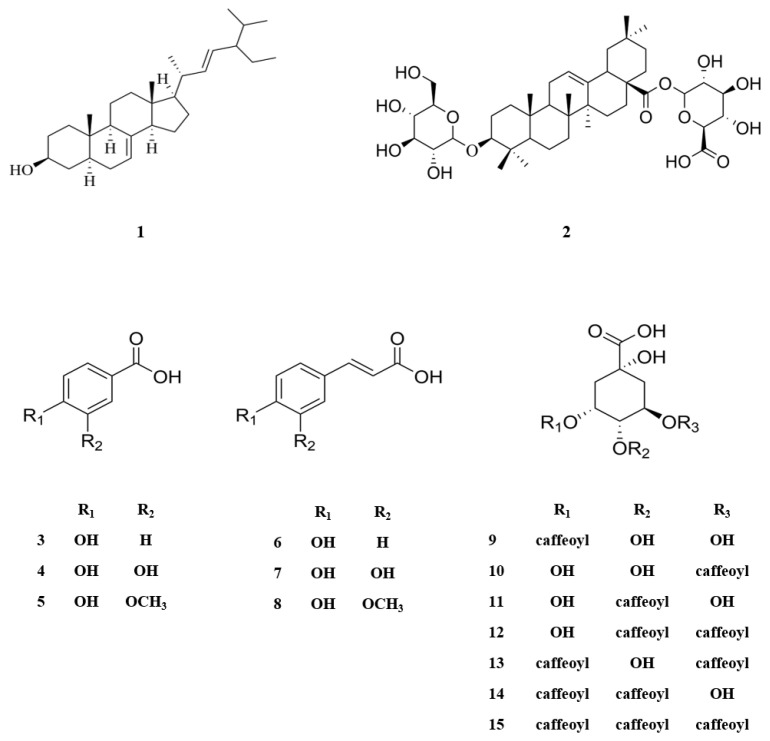
Figure 1
Figure 1
Chemical structures of compounds 115 isolated from N. peltata.
Figure 2
Figure 2
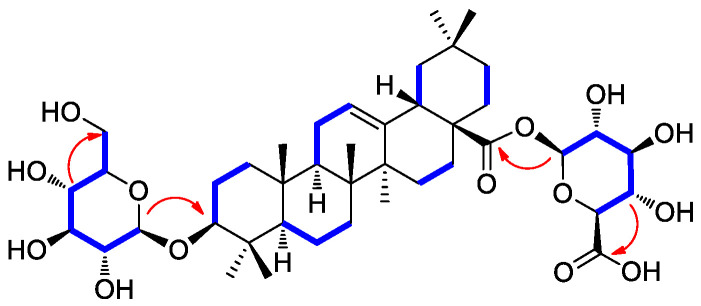
1H-1H COSY (blue lines) and key HMBC correlations (red arrows) of compound 2.
Figure 3
Figure 3
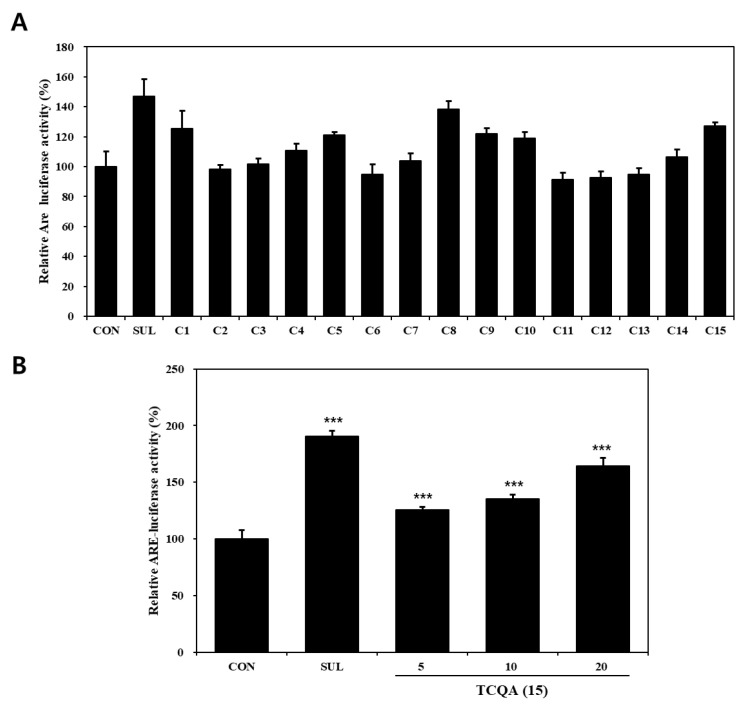
Nrf2–ARE luciferase activities of compounds isolated from N. peltata. Transfected HaCaT cells were treated with (A) each of the fifteen compounds isolated N. peltata (10 μM) or (B) TCQA (5 μM, 10 μM, and 20 μM), and sulforaphane (2 μM) for 24 h. Results are presented as means ± SDs (n = 3). *** p < 0.001 versus CON group; CON: untreated control group; SUL: sulforaphane-treated group; TCQA: TCQA-treated group.
Figure 4
Figure 4
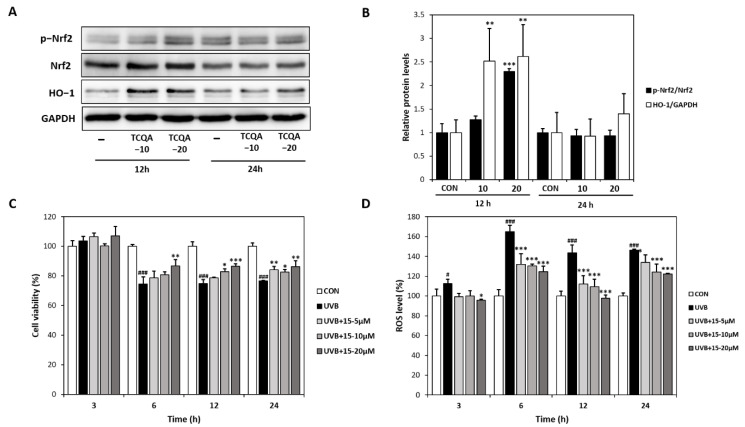
Effects of TCQA on Nrf2 expression, UVB-induced cell viability, and ROS levels in HaCaT cells. (A,B) pNrf2, Nrf2, and HO-1 protein expressions were analyzed by Western blot (normalized vs. GAPDH). (C) Cell viabilities were determined using a CCK-8 assay, and (D) ROS levels were assessed using a DCFDA assay. HaCaT cells were treated with TCQA at 5, 10, or 20 μM and cultured in the absence or presence of UVB for 3, 6, 12, and 24 h. Data are expressed as means ± SDs (n = 2 to 3). # p < 0.05 and ### p < 0.001 versus CON group; * p < 0.05, ** p < 0.01, *** p < 0.001, versus CON or UVB-treated group (UVB). CON: untreated control group; UVB: UVB-treated group; TCQA: TCQA-treated group.
Figure 5
Figure 5
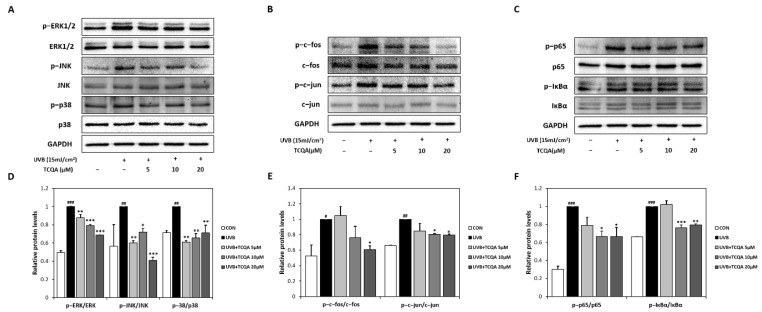
Effect of TCQA on ERK, p38 and JNK/MAPK, c-fos and c-jun/AP-1, and p65 and IκBα/NF-κB transcription activities. After treating cells with the indicated concentrations of TCQA for 24 h. (A,D) ERK, p38, and JNK; (B,E), c-fos and c-jun; and (C,F) p65 and IκBα. The expressions of subunits gene were analyzed by Western blot (normalized vs. GAPDH) in HaCaT cells exposed to UVB. Data are expressed as means ± SDs (n = 2 to 3). # p < 0.05, ## p < 0.01 and ### p < 0.001, versus CON group; * p < 0.05, ** p < 0.01, and *** p < 0.001 versus UVB group. CON: untreated control group; UVB: UVB-treated group; TCQA: TCQA-treated group.
Figure 6
Figure 6
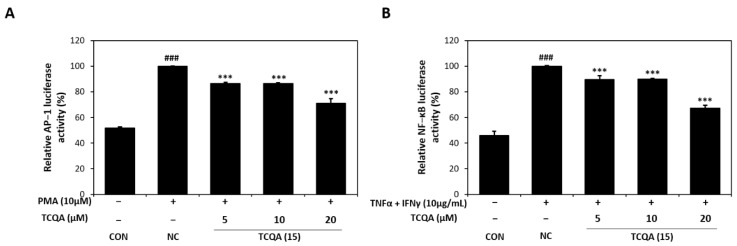
Effect of TCQA on AP-1 and NF-κB luciferase activities. (A) Transactivation of AP-1 or (B) NF-κB was evaluated using luciferase reporter gene assay in PMA or TNF-α/IFN-γ-induced HaCaT cells. Data are expressed as mean ± SD (n = 3). ### p < 0.001, compared with the CON group; *** p < 0.001, versus NC group. CON: untreated control group; NC: PMA or TNF-α and IFN-γ-treated group; TCQA: TCQA-treated group.
Figure 7
Figure 7
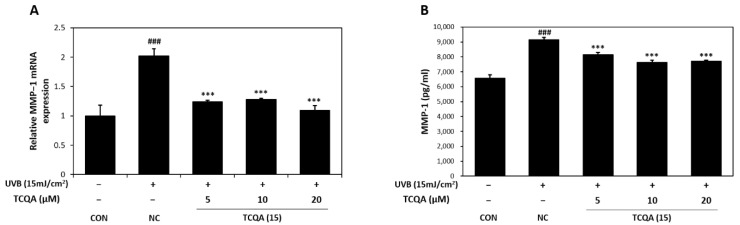
Effect of TCQA on MMP-1 expression. (A) MMP-1 mRNA expression was analyzed in HaCaT cells exposed to UVB by qRT-PCR and (B) the concentration of MMP-1 was assessed using ELISA. Data are expressed as mean ± SD (n = 2 to 3). ### p < 0.001, versus CON group; *** p < 0.001, versus NC group. CON: untreated control group; NC: UVB-treated group; TCQA: TCQA-treated group.

References

    1. Mohd Zaid N.A., Sekar M., Bonam S.R., Gan S.H., Lum P.T., Begum M.Y., Mat Rani N.N.I., Vaijanathappa J., Wu Y.S., Subramaniyan V., et al. Promising Natural Products in New Drug Design, Development, and Therapy for Skin Disorders: An Overview of Scientific Evidence and Understanding Their Mechanism of Action. Drug Des. Dev. Ther. 2022;16:23–66. doi: 10.2147/DDDT.S326332. - DOI - PMC - PubMed
    1. Franco A.C., Aveleira C., Cavadas C. Skin Senescence: Mechanisms and Impact on Whole-Body Aging. Trends Mol. Med. 2022;28:97–109. doi: 10.1016/j.molmed.2021.12.003. - DOI - PubMed
    1. Zhou Y., He L., Zhang N., Ma L., Yao L. Photoprotective Effect of Artemisia sieversiana Ehrhart Essential Oil Against UVB-induced Photoaging in Mice. Photochem. Photobiol. 2022;98:958–968. doi: 10.1111/php.13561. - DOI - PubMed
    1. Tanveer M.A., Rashid H., Tasduq S.A. Molecular Basis of Skin Photoaging and Therapeutic Interventions by Plant-Derived Natural Product Ingredients: A Comprehensive Review. Heliyon. 2023;9:e13580. doi: 10.1016/j.heliyon.2023.e13580. - DOI - PMC - PubMed
    1. Bayo Jimenez M.T., Frenis K., Hahad O., Steven S., Cohen G., Cuadrado A., Münzel T., Daiber A. Protective Actions of Nuclear Factor Erythroid 2-Related Factor 2 (NRF2) and Downstream Pathways against Environmental Stressors. Free Radic. Biol. Med. 2022;187:72–91. doi: 10.1016/j.freeradbiomed.2022.05.016. - DOI - PubMed

LinkOut - more resources