Review
. 2023 Sep 27;13(10):1460.
doi: 10.3390/biom13101460.

Connexins in Cancer, the Possible Role of Connexin46 as a Cancer Stem Cell-Determining Protein

Affiliations
Review

Connexins in Cancer, the Possible Role of Connexin46 as a Cancer Stem Cell-Determining Protein

Isidora M León-Fuentes et al. Biomolecules. .

Abstract

Cancer is a widespread and incurable disease caused by genetic mutations, leading to uncontrolled cell proliferation and metastasis. Connexins (Cx) are transmembrane proteins that facilitate intercellular communication via hemichannels and gap junction channels. Among them, Cx46 is found mostly in the eye lens. However, in pathological conditions, Cx46 has been observed in various types of cancers, such as glioblastoma, melanoma, and breast cancer. It has been demonstrated that elevated Cx46 levels in breast cancer contribute to cellular resistance to hypoxia, and it is an enhancer of cancer aggressiveness supporting a pro-tumoral role. Accordingly, Cx46 is associated with an increase in cancer stem cell phenotype. These cells display radio- and chemoresistance, high proliferative abilities, self-renewal, and differentiation capacities. This review aims to consolidate the knowledge of the relationship between Cx46, its role in forming hemichannels and gap junctions, and its connection with cancer and cancer stem cells.

Keywords: Connexin46; GJA3; breast cancer; cancer stem cells; gap junction channels.


Conflict of interest statement

The authors declare no conflict of interest.

Figures
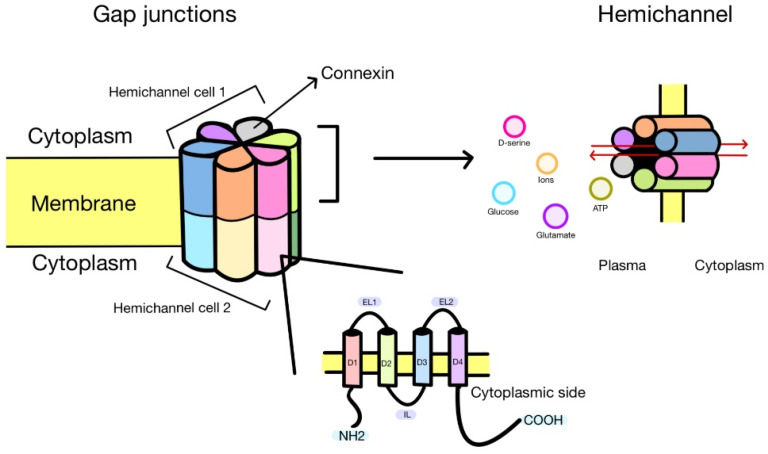
Figure 1
Figure 1
When two hemichannels from different cells come into contact, they form a gap junction channel, facilitating the flow of molecules and ions between these cells. Each hemichannel is composed of six connexins, each consisting of four transmembrane domains and three loops. One loop is intracellular (IL), while the other two are extracellular (EL1–EL2). D1–D4 denote transmembrane segments of a Cxs. Additionally, both the NH2 and COOH terminals face the cytoplasm. Furthermore, each hemichannel allows the bidirectional exchange (red arrows) of ions and molecules between the intracellular and extracellular environments.
Figure 2
Figure 2
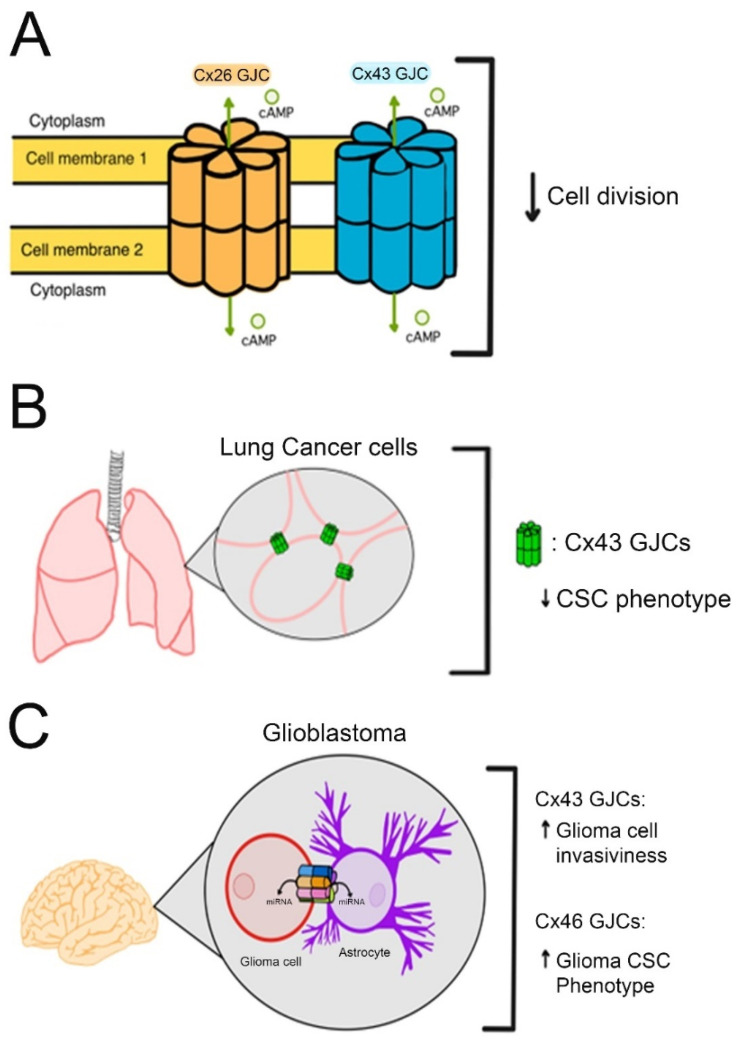
Role of Cx-GJCs in regulating cancer cell aggressiveness. (A) illustrates the relationship between the flow of cyclic adenosine monophosphate (cAMP) via connexin 26 (Cx26) and connexin 43 (Cx43) gap junction channels (GJCs) and its impact on cell division. (B). shows that the formation of Cx43 GJCs in lung cancer cells has an inhibitory effect on the Cancer Stem Cell (CSC) phenotype. (C) However, in glioblastoma, Cx43 GJCs are involved in the increase in glioma cells’ invasiveness capacity by facilitating the exchange of microRNAs (miRNAs) between glioma cells and astrocytes. Additionally, Cx46 GJC seems to enhance CSC phenotype, however, the mechanism remains unknown.
Figure 3
Figure 3
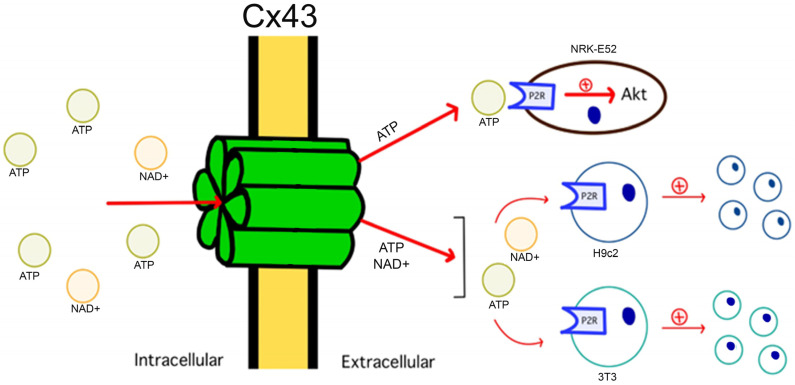
Role of Cx-Hemichannels in cell division regulation via the release of signaling molecule Release. Cx43 hemichannels are regulators of cell division by allowing the controlled release of signaling molecules, such as ATP and NAD+. These molecules, upon reaching the extracellular space, activate specific receptors and initiate signaling cascades, such as those controlled by Akt, which in turn modulates cell proliferation and impacts tissue homeostasis and development.

References

    1. Sung H., Ferlay J., Siegel R.L., Laversanne M., Soerjomataram I., Jemal A., Bray F. Global cancer statistics 2020: GLOBOCAN estimates of incidence and mortality worldwide for 36 cancers in 185 countries. CA Cancer J. Clin. 2021;71:209–249. doi: 10.3322/caac.21660. - DOI - PubMed
    1. Francescangeli F., De Angelis M.L., Rossi R., Cuccu A., Giuliani A., De Maria R., Zeuner A. Dormancy, stemness, and therapy resistance: Interconnected players in cancer evolution. Cancer Metastasis Rev. 2023;42:197–215. doi: 10.1007/s10555-023-10092-4. - DOI - PMC - PubMed
    1. Willers H., Azzoli C.G., Santivasi W.L., Xia F. Basic Mechanisms of Therapeutic Resistance to Radiation and Chemotherapy in Lung Cancer. Cancer J. 2013;19:200. doi: 10.1097/PPO.0b013e318292e4e3. - DOI - PMC - PubMed
    1. Guo J., Li L., Guo B., Liu D., Shi J., Wu C., Chen J., Zhang X., Wu J. Mechanisms of resistance to chemotherapy and radiotherapy in hepatocellular carcinoma. Transl. Cancer Res. 2018;7:765–781. doi: 10.21037/tcr.2018.05.20. - DOI
    1. Said S.S., Ibrahim W.N. Cancer Resistance to Immunotherapy: Comprehensive Insights with Future Perspectives. Pharmaceutics. 2023;15:1143. doi: 10.3390/pharmaceutics15041143. - DOI - PMC - PubMed