


The Hormesis Concept: Strengths and Shortcomings
- PMID: 37892194
- PMCID: PMC10604602
- DOI: 10.3390/biom13101512
The Hormesis Concept: Strengths and Shortcomings
Abstract
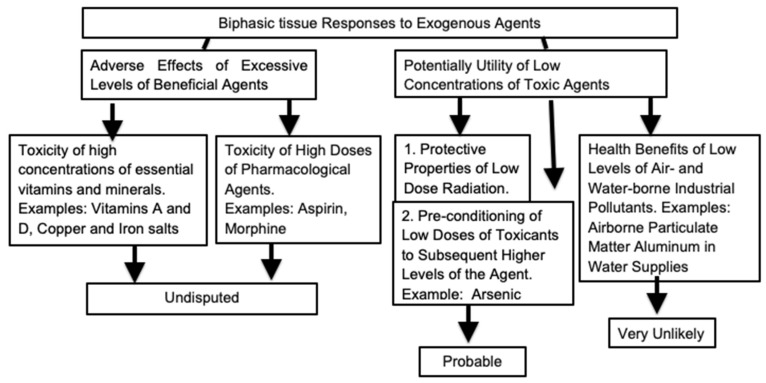
Hormesis implies that the effects of various materials or conditions that organisms are exposed to, may not have linear dose-response characteristics but rather, can be biphasic. Thus the response to a low dose of a stressor may be the opposite to that occurring at higher doses. Such a dual response is postulated for many toxicants and physical conditions and may involve a beneficial adaptive response. Such a non-linear effect is undoubtedly present in many useful pharmacological and nutraceutical agents with can be toxic at high concentrations. This somewhat divisive topic is an area of study that should be objectively studied and not clouded by political and policy considerations. The objective of this review is to examine claims concerning those exposures where hormesis seems to exist and also those where there is no good supporting evidence. The breadth of this phenomenon and potential mechanisms underlying hormetic events are discussed together with their limitations.
Keywords: biphasic; dose response; exposure; hormesis; radiation; toxicity.
Conflict of interest statement
The author declares no conflict of interest.
Figures
References
-
- Schulz H. Ueber hefegifte. Arch. Gesamte Physiol. Menschen Tiere. 1888;42:517–541. doi: 10.1007/BF01669373. - DOI
-
- Overholser B.R., Foster D.R. Opioid pharmacokinetic drug-drug interactions. Am. J. Manag. Care. 2011;17((Suppl. S11)):S276–S287. - PubMed
-
- Shrader-Frechette K. Conceptual analysis and special-interest science: Toxicology and the case of Edward Calabrese. Synthese. 2010;177:449–469. doi: 10.1007/s11229-010-9792-5. - DOI
