


Influence of the Fiber Post Length on the Fracture Strength of Endodontically Treated Teeth
- PMID: 37893515
- PMCID: PMC10608114
- DOI: 10.3390/medicina59101797
Influence of the Fiber Post Length on the Fracture Strength of Endodontically Treated Teeth
Abstract
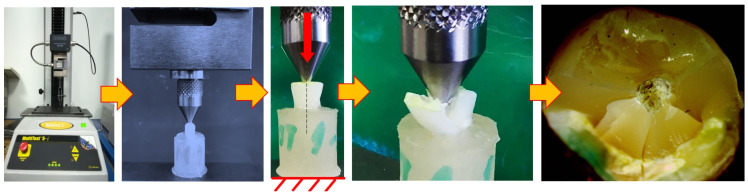
Background and Objectives: Although fiber posts are widely used in the restoration of endodontically treated teeth (ETT), their ideal cementation depth into the root canal is still debated in literature. The aim of the present study was to evaluate whether the different intra-radicular insertion lengths of the fiber posts influence the fracture strength of ETT. Materials and Methods: A total of 10 permanent human lower incisors with straight roots of similar length and volume extracted for periodontal reason were sectioned 2 mm above the cement-enamel junction (CEJ) to a total length of 18 mm and endodontically treated in the same manner, then randomly divided into two groups of five each (Groups 1 and 2, n = 5). Two sound incisors, with no endodontic treatment, were used as the control group (Group 3, n = 2). After one week of storage in a humid environment, spaces for fiber post no. 1 (Reforpost, Angelus, Londrina, PR, Brazil) were prepared in the first two groups at a depth of 5 mm (Group 1) and 7 mm (Group 2), and the fiber posts were adhesively cemented using self-adhesive resin cement (Maxcem Elite, Kerr GmbH, Herzogenrath, Germany). After 7 days, the samples were vertically positioned and fixed in a self-curing transparent acrylic resin, up to 2 mm below the CEJ level, and mechanically tested in compression after another week of storage using a displacement-controlled testing machine up to each sample's fracture. The force-displacement curves were recorded for each sample, the means were calculated for each group and a statistical comparative analysis between groups was conducted. Results: Although no statistically significant differences between groups were observed, the highest mean fracture force (N) was recorded in Group 2 (1099.41 ± 481.89) in comparison to Group 1 (985.09 ± 330.28), even when compared to the sound, non-treated teeth (1045.69 ± 146.19). Conclusions: Within the limitations of this in vitro study, teeth where fiber posts were placed deeper into the root canal (7 mm) recorded slightly higher fracture forces in comparison with shorter lengths (5 mm). However, similar biomechanical performances obtained in the mechanical tests showed no statistical differences between the 7 mm and the 5 mm inserted posts.
Keywords: endodontically treated teeth; fiber post; fracture strength; post length; self-adhesive resin cements.
Conflict of interest statement
The authors declare no conflict of interest.
Figures



References
-
- Jurema A.L.B., Filgueiras A.T., Santos K.A., Bresciani E., Caneppele T.M.F. Effect of intraradicular fiber post on the fracture resistance of endodontically treated and restored anterior teeth: A systematic review and meta-analysis. J. Prosthet. Dent. 2022;128:13–24. doi: 10.1016/j.prosdent.2020.12.013. - DOI - PubMed
MeSH terms
Substances
LinkOut - more resources
Full Text Sources
Research Materials
