Review
. 2023 Oct 13;15(20):4982.
doi: 10.3390/cancers15204982.

The Multifaceted Functions of Prion Protein (PrPC) in Cancer

Affiliations
Review

The Multifaceted Functions of Prion Protein (PrPC) in Cancer

Roland Abi Nahed et al. Cancers (Basel). .

Abstract

The cellular prion protein (PrPC) is a glycoprotein anchored to the cell surface by glycosylphosphatidylinositol (GPI). PrPC is expressed both in the brain and in peripheral tissues. Investigations on PrPC's functions revealed its direct involvement in neurodegenerative and prion diseases, as well as in various physiological processes such as anti-oxidative functions, copper homeostasis, trans-membrane signaling, and cell adhesion. Recent findings have revealed the ectopic expression of PrPC in various cancers including gastric, melanoma, breast, colorectal, pancreatic, as well as rare cancers, where PrPC promotes cellular migration and invasion, tumor growth, and metastasis. Through its downstream signaling, PrPC has also been reported to be involved in resistance to chemotherapy and tumor cell apoptosis. This review summarizes the variance of expression of PrPC in different types of cancers and discusses its roles in their development and progression, as well as its use as a potential target to treat such cancers.

Keywords: cancer; drug resistance; prion protein (PrPC); therapeutic target.


Conflict of interest statement

The authors declare no conflict of interest.

Figures

Figure 4
Figure 4
Potential therapeutic strategies in PrPC-associated cancer. RISC; RNA-induced silencing complex, SiRNA; small interfering RNA, dsRNA; double-stranded RNA. Several small molecules, including Quinacrine, Chlorpromazine, Amphotericin B, Pentosan polysulfate, and Suramin, have been identified as potential inhibitors of PrPC.
Figure 1
Figure 1
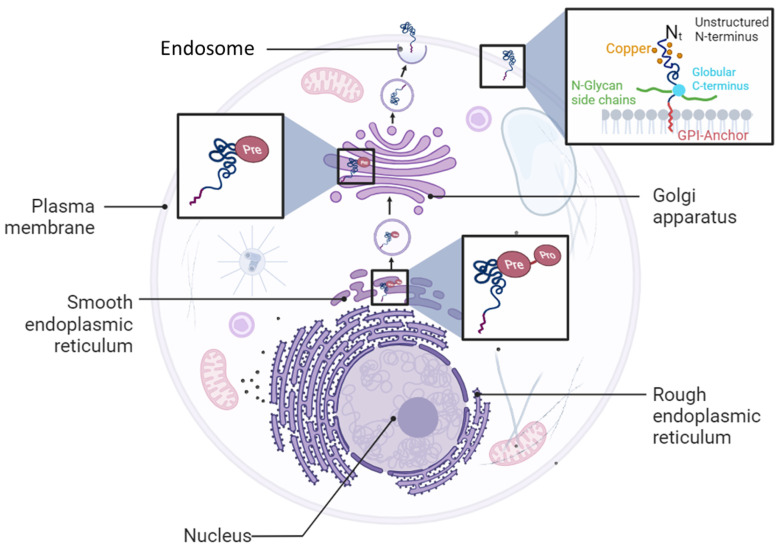
Cellular biosynthetic pathway of PrPC protein. PrPC is synthetized as a pro-pre-protein in the endoplasmic reticulum compartment before trafficking to the Golgi apparatus and plasma membrane where it is anchored as a glycosylphosphatidylinositol (GPI) protein.
Figure 2
Figure 2
Schematic representation of the PrPC protein. Linear representation of the primary sequence of human PrPC showing important protein domains.
Figure 3
Figure 3
Cellular regulatory pathways involving PrPC protein in cancer. The PrPC protein is involved in different cellular tumorigenesis process, where its activities are regulated directly through protein–protein interactions or/and indirectly using different cellular regulatory pathways. P-gp; P-glycoprotein, GLUT-1; Glucose transporter-1; FLNA; Filamin A.

References

    1. Bendheim P.E., Brown H.R., Rudelli R.D., Scala L.J., Goller N.L., Wen G.Y., Kascsak R.J., Cashman N.R., Bolton D.C. Nearly ubiquitous tissue distribution of the scrapie agent precursor protein. Neurology. 1992;42:149–156. doi: 10.1212/WNL.42.1.149. - DOI - PubMed
    1. Bonnon C., Wendeler M.W., Paccaud J.-P., Hauri H.-P. Selective export of human GPI-anchored proteins from the endoplasmic reticulum. Pt 10J. Cell Sci. 2010;123:1705–1715. doi: 10.1242/jcs.062950. - DOI - PubMed
    1. Tanaka S., Maeda Y., Tashima Y., Kinoshita T. Inositol deacylation of glycosylphosphatidylinositol-anchored proteins is mediated by mammalian PGAP1 and yeast Bst1p. J. Biol. Chem. 2004;279:14256–14263. doi: 10.1074/jbc.M313755200. - DOI - PubMed
    1. Campana V., Sarnataro D., Zurzolo C. The highways and byways of prion protein trafficking. Trends Cell Biol. 2005;15:102–111. doi: 10.1016/j.tcb.2004.12.002. - DOI - PubMed
    1. Sarnataro D., Campana V., Paladino S., Stornaiuolo M., Nitsch L., Zurzolo C. PrP(C) association with lipid rafts in the early secretory pathway stabilizes its cellular conformation. Mol. Biol. Cell. 2004;15:4031–4042. doi: 10.1091/mbc.e03-05-0271. - DOI - PMC - PubMed