. 2023 Oct 14;28(20):7092.
doi: 10.3390/molecules28207092.

New 1,2,3-Triazole/1,2,4-triazole Hybrids as Aromatase Inhibitors: Design, Synthesis, and Apoptotic Antiproliferative Activity

Affiliations

New 1,2,3-Triazole/1,2,4-triazole Hybrids as Aromatase Inhibitors: Design, Synthesis, and Apoptotic Antiproliferative Activity

Mohamed T-E Maghraby et al. Molecules. .

Abstract

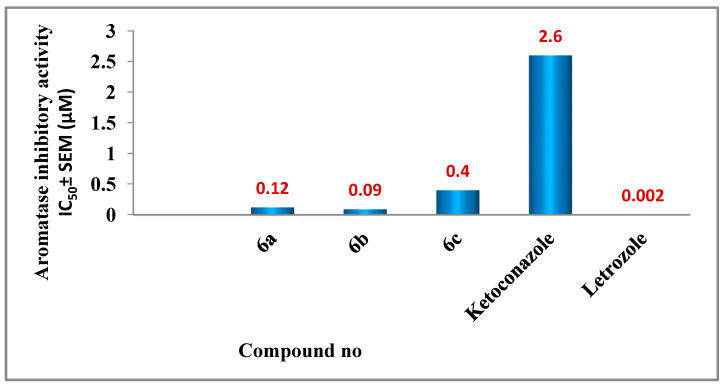
A novel series of 1,2,3-triazole/1,2,4-triazole hybrids 5a, 5b, and 6a-i was designed and synthesized as antiproliferative agents targeting aromatase enzymes. The antiproliferative activity of the new hybrids against four cancer cells was studied using Erlotinib as a control. Compounds 6a and 6b demonstrated the highest antiproliferative activity among these hybrids, with GI50 values of 40 nM and 35 nM, respectively. Compound 6b was the most potent derivative, with a GI50 of 35 nM, comparable to Erlotinib's GI50 of 33 nM. Compound 6b inhibited all cancer cell lines with comparable efficacy to Erlotinib. Compounds 5a, 5b, and 6a-i were tested for inhibitory action against aromatase as a potential target for their antiproliferative activity. Results revealed that compounds 6a and 6b were the most potent aromatase inhibitors, with IC50 values of 0.12 ± 0.01 µM and 0.09 ± 0.01 µM, respectively, being more potent than the reference Ketoconazole (IC50 = 2.6 ± 0.20 µM) but less potent than Letrozole (IC50 = 0.002 ± 0.0002). These findings indicated that compounds 6a and 6b had significant aromatase inhibitory action and are potential antiproliferative candidates. The findings were further linked to molecular docking investigations, which gave models of strong interactions with the aromatase domain for inhibitors with high binding scores.

Keywords: 1,2,3-triazole; 1,2,4-triazole; anticancer; aromatase; viability.


Conflict of interest statement

The authors declare no conflict of interest.

Figures

Figure 1
Figure 1
Structures of SAIs (type I) and NSAIs (type II) aromatase inhibitors.
Figure 2
Figure 2
Structures of compounds I–IV.
Figure 3
Figure 3
Structures of Schiff bases derived from 1,2,4-triazoles VVII.
Figure 4
Figure 4
Structures of new hybrids 5a, 5b, and 6ai.
Scheme 1
Scheme 1
Synthesis of target compounds 5a, 5b, and 6ai.
Scheme 2
Scheme 2
Proposed mechanism for the formation of compounds 5a and 5b.
Figure 5
Figure 5
Antiproliferative activity of compounds 6ai.
Figure 6
Figure 6
Aromatase inhibitory activity of compounds 6ac.
Figure 7
Figure 7
Two- and three-dimensional representation of the interaction of co-crystallized androstenedione with aromatase CP450 domain.
Figure 8
Figure 8
Mode of binding of compound 6a inside aromatase CP450 domain: (a) 2D structure and (b) 3D structure.
Figure 9
Figure 9
Mode of binding of compound 6b inside aromatase CP450 domain: (a) 2D structure and (b) 3D structure.

References

    1. Ghosh D., Lo J., Egbuta C. Recent progress in the discovery of next generation inhibitors of aromatase from the structure–function perspective. J. Med. Chem. 2016;59:5131–5148. doi: 10.1021/acs.jmedchem.5b01281. - DOI - PMC - PubMed
    1. Ahmad I. Recent developments in steroidal and nonsteroidal aromatase inhibitors for the chemoprevention of estrogen-dependent breast cancer. Eur. J. Med. Chem. 2015;102:375–386. doi: 10.1016/j.ejmech.2015.08.010. - DOI - PubMed
    1. Adhikari N., Amin S.A., Saha A., Jha T. Combating breast cancer with non-steroidal aromatase inhibitors (NSAIs): Understanding the chemico-biological interactions through comparative SAR/QSAR study. Eur. J. Med. Chem. 2017;137:365–438. doi: 10.1016/j.ejmech.2017.05.041. - DOI - PubMed
    1. Mohammed Alwan A., Tavakol Afshari J., Afzaljavan F. Significance of the Estrogen Hormone and Single Nucleotide Polymorphisms in the Progression of Breast Cancer among Female. Inst. Razi. Arch. 2022;77:943–958. - PMC - PubMed
    1. Avvaru S.P., Noolvi M.N., Aminbhavi T.M., Chkraborty S., Dash A., Shukla S.S. Aromatase inhibitors evolution as potential class of drugs in the treatment of postmenopausal breast cancer women. Mini Rev. Med. Chem. 2018;18:609–621. doi: 10.2174/1389557517666171101100902. - DOI - PubMed

LinkOut - more resources