


Assessing the In Vitro and In Vivo Performance of L-Carnitine-Loaded Nanoparticles in Combating Obesity
- PMID: 37894594
- PMCID: PMC10609287
- DOI: 10.3390/molecules28207115
Assessing the In Vitro and In Vivo Performance of L-Carnitine-Loaded Nanoparticles in Combating Obesity
Abstract
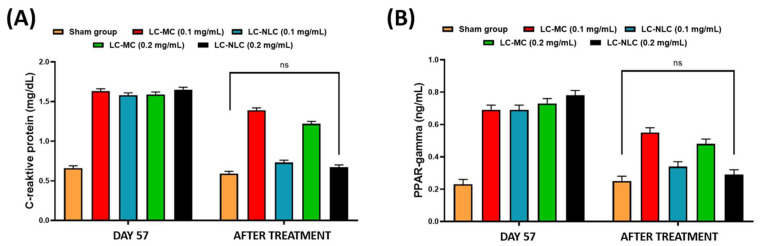
Addressing obesity is a critical health concern of the century, necessitating urgent attention. L-carnitine (LC), an essential water-soluble compound, plays a pivotal role in lipid breakdown via β-oxidation and facilitates the transport of long-chain fatty acids across mitochondrial membranes. However, LC's high hydrophilicity poses challenges to its diffusion through bilayers, resulting in limited bioavailability, a short half-life, and a lack of storage within the body, mandating frequent dosing. In our research, we developed LC-loaded nanoparticle lipid carriers (LC-NLCs) using economically viable and tissue-localized nanostructured lipid carriers (NLCs) to address these limitations. Employing the central composite design model, we optimized the formulation, employing the high-pressure homogenization (HPH) method and incorporating Poloxamer® 407 (surfactant), Compritol® 888 ATO (solid lipid), and oleic acid (liquid oil). A comprehensive assessment of nanoparticle physical attributes was performed, and an open-field test (OFT) was conducted on rats. We employed immunofluorescence assays targeting CRP and PPAR-γ, along with an in vivo rat study utilizing an isolated fat cell line to assess adipogenesis. The optimal formulation, with an average size of 76.4 ± 3.4 nm, was selected due to its significant efficacy in activating the PPAR-γ pathway. Our findings from the OFT revealed noteworthy impacts of LC-NLC formulations (0.1 mg/mL and 0.2 mg/mL) on adipocyte cells, surpassing regular L-carnitine formulations' effects (0.1 mg/mL and 0.2 mg/mL) by 169.26% and 156.63%, respectively (p < 0.05).
Keywords: NLC; carnitine; cell culture; obesity; open-field test.
Conflict of interest statement
The authors declare no conflict of interest.
Figures



References
-
- Federation T.W.O. World Obesity Atlas 2023. [(accessed on 28 May 2023)]. Available online: https://s3-eu-west-1.amazonaws.com/wof-files/World_Obesity_Atlas_2023_Re....
MeSH terms
Substances
Grants and funding
LinkOut - more resources
Full Text Sources
Research Materials
Miscellaneous
