


Dysfunctional and Dysregulated Nitric Oxide Synthases in Cardiovascular Disease: Mechanisms and Therapeutic Potential
- PMID: 37894881
- PMCID: PMC10607291
- DOI: 10.3390/ijms242015200
Dysfunctional and Dysregulated Nitric Oxide Synthases in Cardiovascular Disease: Mechanisms and Therapeutic Potential
Abstract
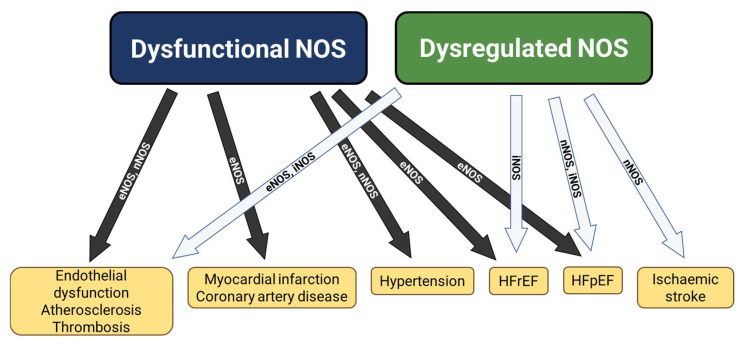
Nitric oxide (NO) plays an important and diverse signalling role in the cardiovascular system, contributing to the regulation of vascular tone, endothelial function, myocardial function, haemostasis, and thrombosis, amongst many other roles. NO is synthesised through the nitric oxide synthase (NOS)-dependent L-arginine-NO pathway, as well as the nitrate-nitrite-NO pathway. The three isoforms of NOS, namely neuronal (NOS1), inducible (NOS2), and endothelial (NOS3), have different localisation and functions in the human body, and are consequently thought to have differing pathophysiological roles. Furthermore, as we continue to develop a deepened understanding of the different roles of NOS isoforms in disease, the possibility of therapeutically modulating NOS activity has emerged. Indeed, impaired (or dysfunctional), as well as overactive (or dysregulated) NOS activity are attractive therapeutic targets in cardiovascular disease. This review aims to describe recent advances in elucidating the physiological role of NOS isoforms within the cardiovascular system, as well as mechanisms of dysfunctional and dysregulated NOS in cardiovascular disease. We then discuss the modulation of NO and NOS activity as a target in the development of novel cardiovascular therapeutics.
Keywords: NOS inhibitor; cardiovascular disease; endothelial NOS; inducible NOS; neuronal NOS; nitric oxide synthase.
Conflict of interest statement
The authors declare no conflict of interest.
Figures
References
Publication types
MeSH terms
Substances
Grants and funding
LinkOut - more resources
Full Text Sources
