Review
. 2023 Oct 19;24(20):15370.
doi: 10.3390/ijms242015370.

Neutrophils' Contribution to Periodontitis and Periodontitis-Associated Cardiovascular Diseases

Affiliations
Review

Neutrophils' Contribution to Periodontitis and Periodontitis-Associated Cardiovascular Diseases

Barbara Bassani et al. Int J Mol Sci. .

Abstract

Neutrophils represent the primary defense against microbial threats playing a pivotal role in maintaining tissue homeostasis. This review examines the multifaceted involvement of neutrophils in periodontitis, a chronic inflammatory condition affecting the supporting structures of teeth summarizing the contribution of neutrophil dysfunction in periodontitis and periodontal-related comorbidities. Periodontitis, a pathological condition promoted by dysbiosis of the oral microbiota, is characterized by the chronic inflammation of the gingiva and subsequent tissue destruction. Neutrophils are among the first immune cells recruited to the site of infection, releasing antimicrobial peptides, enzymes, and reactive oxygen species to eliminate pathogens. The persistent inflammatory state in periodontitis can lead to aberrant neutrophil activation and a sustained release of proinflammatory mediators, finally resulting in tissue damage, bone resorption, and disease progression. Growing evidence now points to the correlation between periodontitis and systemic comorbidities. Indeed, the release of inflammatory mediators, immune complexes, and oxidative stress by neutrophils, bridge the gap between local and systemic immunity, thus highlighting neutrophils as key players in linking periodontal inflammation to chronic conditions, including cardiovascular diseases, diabetes mellitus, and rheumatoid arthritis. This review underscores the crucial role of neutrophils in the pathogenesis of periodontitis and the complex link between neutrophil dysfunction, local inflammation, and systemic comorbidities. A comprehensive understanding of neutrophil contribution to periodontitis development and their impact on periodontal comorbidities holds significant implications for the management of oral health. Furthermore, it highlights the need for the development of novel approaches aimed at limiting the persistent recruitment and activation of neutrophils, also reducing the impact of periodontal inflammation on broader health contexts, offering promising avenues for improved disease management and patient care.

Keywords: atherosclerosis; dental disorders; diabetes; neutrophils; periodontitis.


Conflict of interest statement

The authors declare no competing interest.

Figures

Figure 1
Figure 1
An overview of the pathogenesis of periodontitis in a neutrophil-driven fashion. The acute inflammatory process (angiopholgosis) is initiated by the infiltration of leukocytes, recruited to limit bacterial invasion. Proresolution mediators, induced as a mechanism of host defense, downregulate the recruitment of immune cells and the uptake of apoptotic neutrophils by macrophages to facilitate the clearance of the inflammatory lesion (adequate balance host defense). Periodontitis is characterized by both the dysbiosis of oral microbiota and a persistent proinflammatory state due to the reduced ability to eliminate pathogens, followed by an unresolved lesion state that leads to the immune-cell-mediated self-destruction of periodontal tissues, which results in the chronicization of periodontitis (inadequate host defense balance).
Figure 2
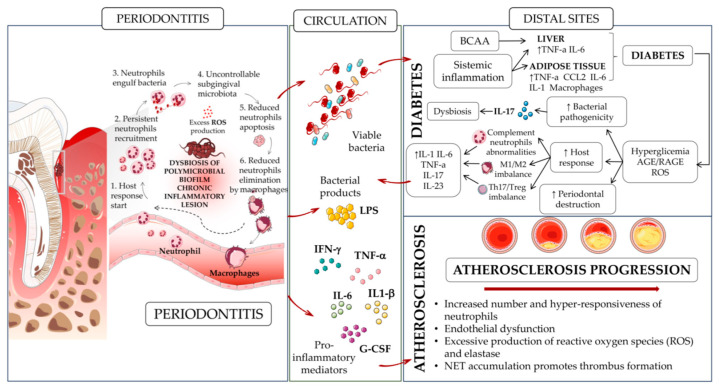
Figure 2
Neutrophils, periodontitis, and other comorbidities. This figure illustrates the major reported associations between periodontitis and systemic diseases, with a focus on diabetes and atherosclerosis. Periodontitis is initiated by the ulceration of the gingival epithelium, bacterial invasion, and influx of immune cells, leading to inflammatory damage sustained by ROS generation, the production of different cytokines (IFNγ, IL-6, IL-1β, G-CSF) in periodontal tissues, and the destruction of the supporting alveolar bone. This chronic inflammatory reaction leads to the leakage of bacterial products, host inflammatory factors, and pathogenic oral bacteria into the bloodstream where they are transported to distal tissue sites. Once in systemic circulation, periodontal-derived products have the potential to adversely affect a multitude of systemic diseases, either directly in situ or, indirectly, via the amplification of the systemic inflammatory response. In vivo studies outlined the correlation between classical human periodontal pathogens (Porphyromonas gingivalis, Fusobacterium nucleatum, and Prevotella intermedia), inflammation, and insulin tolerance in periodontitis-related diabetes and diabetes complications, such as inefficient wound-healing and repair. The same studies also showed that, prior to the onset of bone loss and subsequently to HFD, these conditions are associated with the delayed recruitment of neutrophils and monocytes, leading to compromised clearance of bacteria, in association with a peak of different proinflammatory cytokines/chemokines, such as CXCL1, CXCL2, MCP-1, TNFα, IL-1β, and IL-17A. The increased number and hyper-responsiveness of neutrophils in periodontitis may contribute to various stages of atherosclerotic cardiovascular disease (ASCVD) pathology. Elevated neutrophil counts in peripheral blood have been positively correlated with ASCVD risk in periodontitis patients, suggesting a potential role in increasing ASCVD susceptibility. Also, the overactivation of neutrophils through the exacerbated release of proinflammatory cytokines further supports ASCVD increasing endothelial cell damages/dysfunction, excessive ROS production, and NET-mediated generation of thrombi.

References

    1. Palomino-Segura M., Sicilia J., Ballesteros I., Hidalgo A. Strategies of neutrophil diversification. Nat. Immunol. 2023;24:575–584. doi: 10.1038/s41590-023-01452-x. - DOI - PMC - PubMed
    1. Ng L.G., Ostuni R., Hidalgo A. Heterogeneity of neutrophils. Nat. Rev. Immunol. 2019;19:255–265. doi: 10.1038/s41577-019-0141-8. - DOI - PubMed
    1. Nauseef W.M., Borregaard N. Neutrophils at work. Nat. Immunol. 2014;15:602–611. doi: 10.1038/ni.2921. - DOI - PubMed
    1. Mantovani A., Cassatella M.A., Costantini C., Jaillon S. Neutrophils in the activation and regulation of innate and adaptive immunity. Nat. Rev. Immunol. 2011;11:519–531. doi: 10.1038/nri3024. - DOI - PubMed
    1. Haas S., Trumpp A., Milsom M.D. Causes and Consequences of Hematopoietic Stem Cell Heterogeneity. Cell Stem Cell. 2018;22:627–638. doi: 10.1016/j.stem.2018.04.003. - DOI - PubMed

LinkOut - more resources