


A Spanish Family with Gordon Syndrome Due to a Variant in the Acidic Motif of WNK1
- PMID: 37895227
- PMCID: PMC10606608
- DOI: 10.3390/genes14101878
A Spanish Family with Gordon Syndrome Due to a Variant in the Acidic Motif of WNK1
Abstract
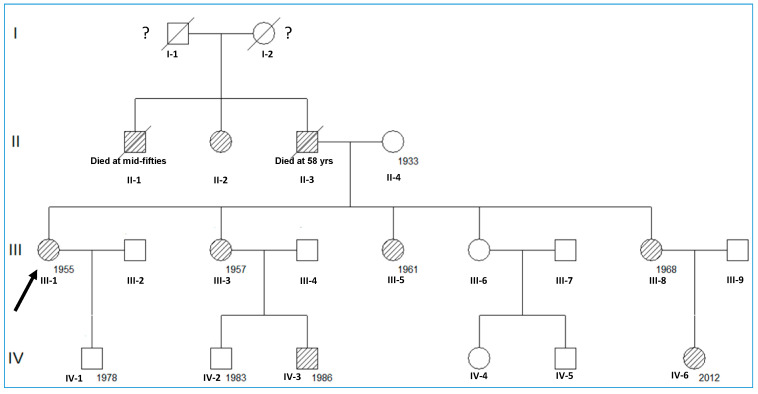
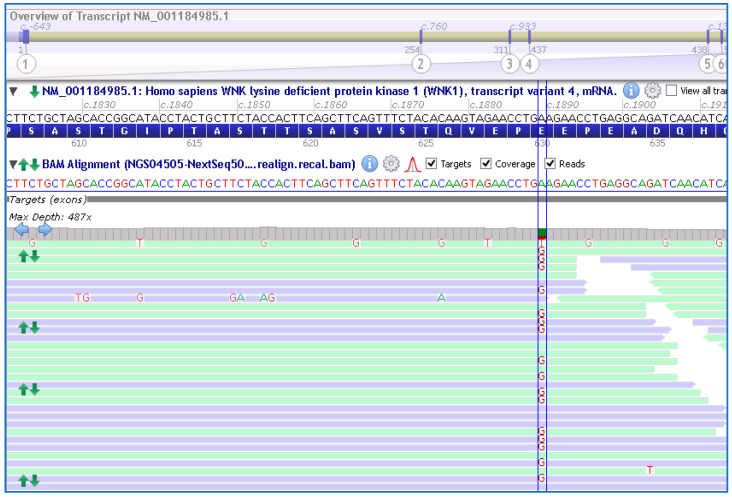
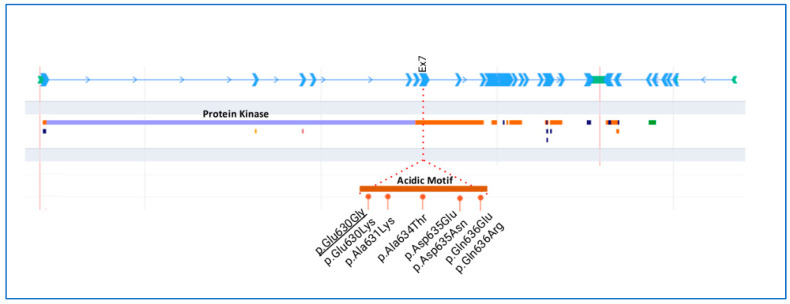
(1) Background: Gordon syndrome (GS) or familial hyperkalemic hypertension is caused by pathogenic variants in the genes WNK1, WNK4, KLHL3, and CUL3. Patients presented with hypertension, hyperkalemia despite average glomerular filtration rate, hyperchloremic metabolic acidosis, and suppressed plasma renin (PR) activity with normal plasma aldosterone (PA) and sometimes failure to thrive. GS is a heterogeneous genetic syndrome, ranging from severe cases in childhood to mild and sometimes asymptomatic cases in mid-adulthood. (2) Methods: We report here a sizeable Spanish family of six patients (four adults and two children) with GS. (3) Results: They carry a novel heterozygous missense variant in exon 7 of WNK1 (p.Glu630Gly). The clinical presentation in the four adults consisted of hypertension (superimposed pre-eclampsia in two cases), hyperkalemia, short stature with low body weight, and isolated hyperkalemia in both children. All patients also presented mild hyperchloremic metabolic acidosis and low PR activity with normal PA levels. Abnormal laboratory findings and hypertension were normalized by dietary salt restriction and low doses of thiazide or indapamide retard. (4) Conclusions: This is the first Spanish family with GS with a novel heterozygous missense variant in WNK1 (p.Glu630Gly) in the region containing the highly conserved acidic motif, which is showing a relatively mild phenotype, and adults diagnosed in mild adulthood. These data support the importance of missense variants in the WNK1 acidic domain in electrolyte balance/metabolism. In addition, findings in this family also suggest that indapamide retard or thiazide may be an adequate long-standing treatment for GS.
Keywords: Gordon syndrome; WNK1 missense variant; familial hyperkalemic hypertension; metabolic acidosis; pseudohypoaldosteronism type II.
Conflict of interest statement
The authors declare no conflict of interest.
Figures
References
Publication types
MeSH terms
Substances
Supplementary concepts
LinkOut - more resources
Full Text Sources
Medical
Research Materials
