. 2023 Oct 12;12(20):3546.
doi: 10.3390/plants12203546.

Historical Assembly of Andean Tree Communities

Affiliations

Historical Assembly of Andean Tree Communities

Sebastián González-Caro et al. Plants (Basel). .

Abstract

Patterns of species diversity have been associated with changes in climate across latitude and elevation. However, the ecological and evolutionary mechanisms underlying these relationships are still actively debated. Here, we present a complementary view of the well-known tropical niche conservatism (TNC) hypothesis, termed the multiple zones of origin (MZO) hypothesis, to explore mechanisms underlying latitudinal and elevational gradients of phylogenetic diversity in tree communities. The TNC hypothesis posits that most lineages originate in warmer, wetter, and less seasonal environments in the tropics and rarely colonize colder, drier, and more seasonal environments outside of the tropical lowlands, leading to higher phylogenetic diversity at lower latitudes and elevations. In contrast, the MZO hypothesis posits that lineages also originate in temperate environments and readily colonize similar environments in the tropical highlands, leading to lower phylogenetic diversity at lower latitudes and elevations. We tested these phylogenetic predictions using a combination of computer simulations and empirical analyses of tree communities in 245 forest plots located in six countries across the tropical and subtropical Andes. We estimated the phylogenetic diversity for each plot and regressed it against elevation and latitude. Our simulated and empirical results provide strong support for the MZO hypothesis. Phylogenetic diversity among co-occurring tree species increased with both latitude and elevation, suggesting an important influence on the historical dispersal of lineages with temperate origins into the tropical highlands. The mixing of different floras was likely favored by the formation of climatically suitable corridors for plant migration due to the Andean uplift. Accounting for the evolutionary history of plant communities helps to advance our knowledge of the drivers of tree community assembly along complex climatic gradients, and thus their likely responses to modern anthropogenic climate change.

Keywords: elevational gradient; historical dispersal; latitudinal gradient; multiple zones of origin hypothesis; niche conservatism; phylogenetic diversity; tropical Andes.


Conflict of interest statement

The authors declare no conflict of interest.

Figures
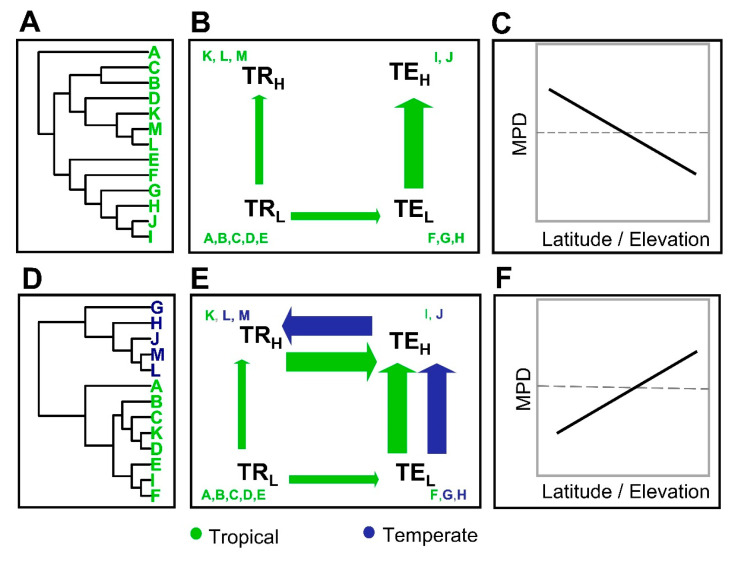
Figure 1
Figure 1
Two hypotheses for the historical assembly of communities across elevations in temperate and tropical latitudes: the tropical niche conservatism hypothesis (TNC; panels AC), and the multiple zones of origin hypotheses (MZO; panels DF). Under both hypotheses, niche conservatism limits adaptive shifts and colonization among regions with different environmental conditions (thin arrows) and facilitates colonization among regions with similar environmental conditions (thick arrows). However, the hypotheses differ in whether colonization results from a single (tropical) or multiple (tropical + temperate) ecological zones of origin. Under the TNC hypothesis, lineages in tropical lowlands (TrL; A, B) have had limited ability to colonize temperate lowlands (TeL) and tropical highlands (TrH). Once lineages have evolved adaptations to temperate lowlands, they can colonize temperate highlands. This hypothesis predicts that phylogenetic diversity decreases with elevation and from tropical to temperate latitudes (C). Under the MZO hypothesis, lineages have originated in both tropical lowlands and temperate lowlands (D,E). Lineages that evolved in tropical lowlands follow the same colonization history as in the first hypothesis. However, lineages that originated in the temperate lowlands were able to colonize the temperate and tropical highlands but had limited colonization of tropical lowlands. This hypothesis predicts that phylogenetic diversity increases with elevation and from tropical to temperate latitudes (F).
Figure 2
Figure 2
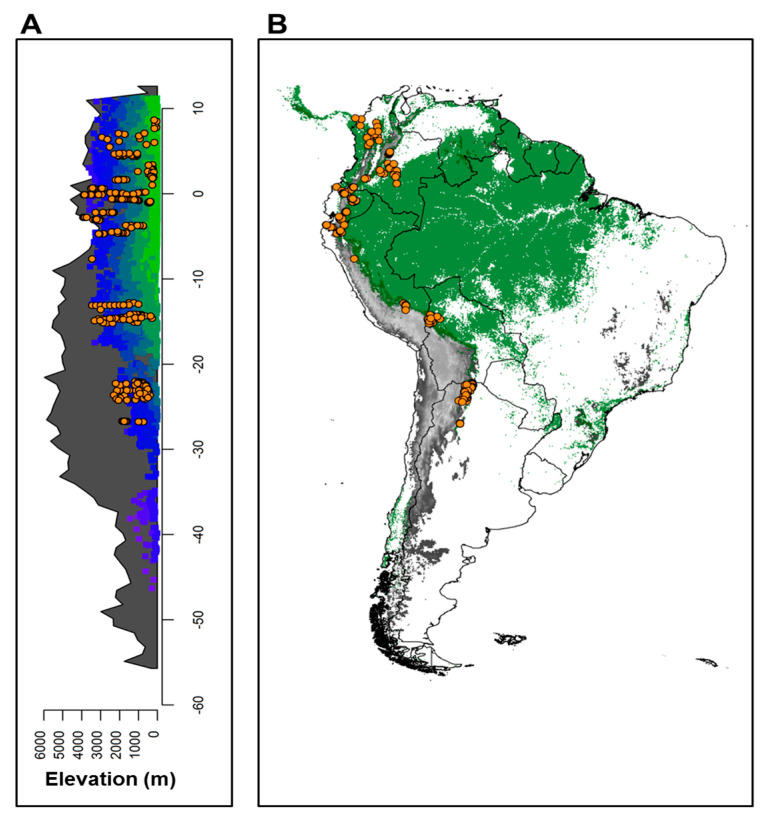
Distribution of 245 forest plots (orange points) along elevational, latitudinal, and environmental gradients in six countries across the subtropical and tropical Andes. (A) Elevational profile of the Andes in South America (gray area). Colored areas reflect the distribution of forests in this profile. Colors are based on the first axis of a principal component analysis from all temperature variables in Worldclim (https://www.worldclim.org/). Green squares represent warmer and less seasonal sites, while blue squares are colder, more seasonal sites. (B) Spatial distribution of plots in South America. Gray areas represent mountains over 1000 m asl, while areas in green show forest-covered areas of South America.
Figure 3
Figure 3
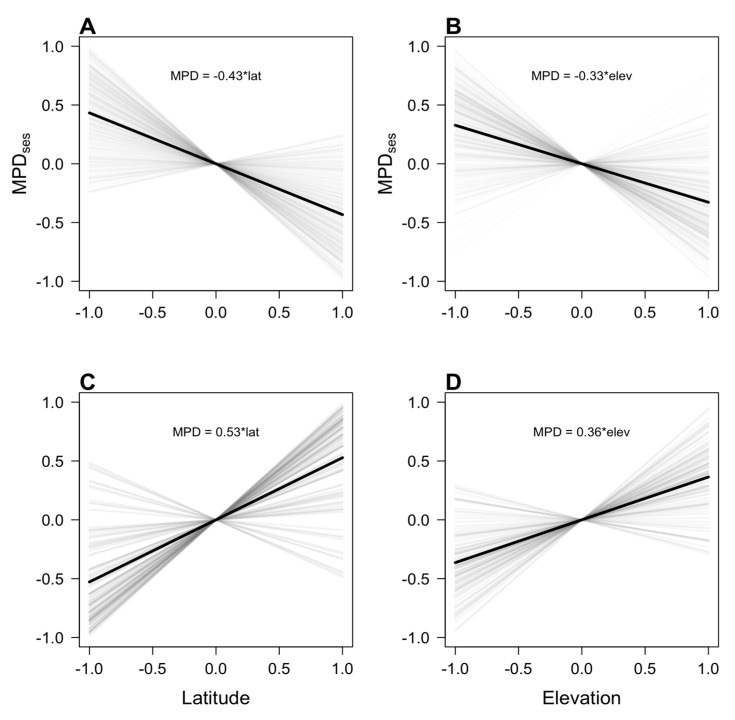
Simulated regression slopes of the relationships mean pairwise phylogenetic distance (MPDses) and latitude or elevation. (A,B) simulations of the tropical niche conservatism hypothesis (TNC). (C,D) simulations of the multiple zones of origin hypothesis (MZO). The black lines show the average regression slope of 1000 simulations and gray lines represent the first and third quantiles from 1000 simulations. The equation is based on the average of regression coefficients.
Figure 4
Figure 4
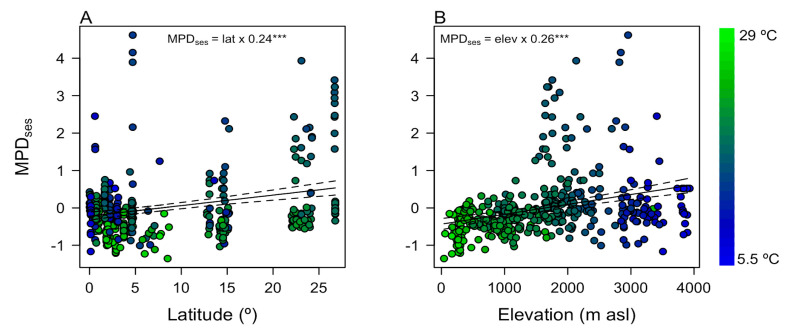
Geographical gradients in phylogenetic diversity of tree communities in 245 forest plots distributed across the Andes (Figure 2). The y-axes show the standardized mean pairwise phylogenetic distance (MPDses) after controlling for plot area (i.e., residuals of a regression between MPDses and plot area). These results demonstrate that phylogenetic diversity increases towards temperate latitudes (A) and higher elevations (B). The black lines show the main effect of latitude or elevation, and the gray broken lines indicate their confidence intervals. Color indicates mean annual temperature in each plot. Asterisks indicate slope significance: *** indicates high significance of p < 0.001.
Figure 5
Figure 5
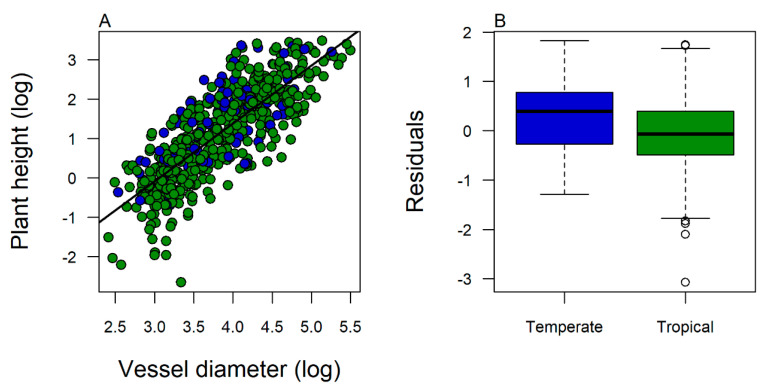
(A) Relationship between plant height and vessel diameter based on the dataset from [43]. The black line indicates the linear regression according to [43]. The biogeographic origin was a significant covariate in the model (F = 11.23; p < 0.001). Green circles represented tropical originated species and blue circles represented temperate originated species. (B) Distribution of residuals of the linear regression model including all data between temperate and tropical species showed significant differences in the expected tree height by vessel diameter between biogeographic origins (t = 3.96, p < 0.001).

References

    1. Humboldt A., von Bonpland A. Essai Sur La Géographie Des Plantes. Chez Levrault Schoell Campagnie Libr.; Paris, France: 1805.
    1. Mittelbach G.G., Schemske D.W., Cornell H.V., Allen A.P., Brown J.M., Bush M.B., Harrison S.P., Hurlbert A.H., Knowlton N., Lessios H.A., et al. Evolution and the Latitudinal Diversity Gradient: Speciation, Extinction and Biogeography. Ecol. Lett. 2007;10:315–331. doi: 10.1111/j.1461-0248.2007.01020.x. - DOI - PubMed
    1. Laiolo P., Pato J., Obeso J.R. Ecological and Evolutionary Drivers of the Elevational Gradient of Diversity. Ecol. Lett. 2018;21:1022–1032. doi: 10.1111/ele.12967. - DOI - PubMed
    1. Etienne R.S., Cabral J.S., Hagen O., Hartig F., Hurlbert A.H., Pellissier L., Pontarp M., Storch D. A Minimal Model for the Latitudinal Diversity Gradient Suggests a Dominant Role for Ecological Limits. Am. Nat. 2019;194:E122–E133. doi: 10.1086/705243. - DOI - PubMed
    1. Kreft H., Jetz W. Global Patterns and Determinants of Vascular Plant Diversity. Proc. Natl. Acad. Sci. USA. 2007;104:5925–5930. doi: 10.1073/pnas.0608361104. - DOI - PMC - PubMed

LinkOut - more resources