


Response Mechanisms of Woody Plants to High-Temperature Stress
- PMID: 37896106
- PMCID: PMC10610489
- DOI: 10.3390/plants12203643
Response Mechanisms of Woody Plants to High-Temperature Stress
Abstract
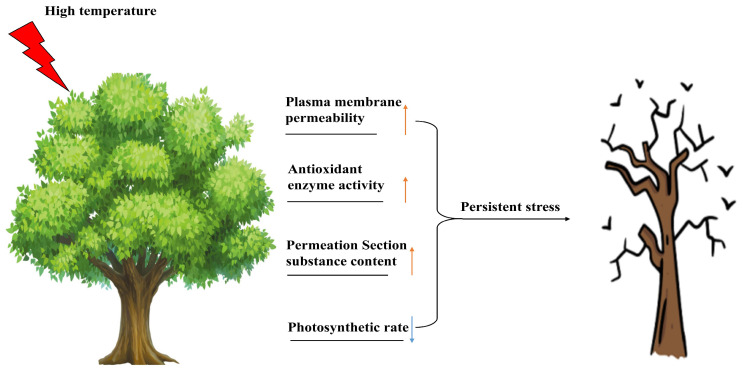
High-temperature stress is the main environmental stress that restricts the growth and development of woody plants, and the growth and development of woody plants are affected by high-temperature stress. The influence of high temperature on woody plants varies with the degree and duration of the high temperature and the species of woody plants. Woody plants have the mechanism of adapting to high temperature, and the mechanism for activating tolerance in woody plants mainly counteracts the biochemical and physiological changes induced by stress by regulating osmotic adjustment substances, antioxidant enzyme activities and transcription control factors. Under high-temperature stress, woody plants ability to perceive high-temperature stimuli and initiate the appropriate physiological, biochemical and genomic changes is the key to determining the survival of woody plants. The gene expression induced by high-temperature stress also greatly improves tolerance. Changes in the morphological structure, physiology, biochemistry and genomics of woody plants are usually used as indicators of high-temperature tolerance. In this paper, the effects of high-temperature stress on seed germination, plant morphology and anatomical structure characteristics, physiological and biochemical indicators, genomics and other aspects of woody plants are reviewed, which provides a reference for the study of the heat-tolerance mechanism of woody plants.
Keywords: genomics; heat-resistant mechanism; high-temperature stress; physiology and biochemistry; woody plants.
Conflict of interest statement
The authors declare no conflict of interest.
Figures


References
-
- Malunguja G.K., Devi A., Kilonzo M., Rubanza C.D. Climate change mitigation through carbon dioxide (CO2) sequestration in community reserved forests of northwest Tanzania. Arch. Agric. Environ. Sci. 2020;5:231–240. doi: 10.26832/24566632.2020.050301. - DOI
-
- Hossain T., Jones D.S., Hartley D.S., Thompson D.N., Langholtz M., Davis M. Nth-plant scenario for forest resources and short rotation woody crops: Biorefineries and depots in the contiguous US. Appl. Energy. 2022;325:119881. doi: 10.1016/j.apenergy.2022.119881. - DOI
-
- Ruelland E., Zachowski A. How plants sense temperature. Environ. Exp. Bot. 2010;69:225–232. doi: 10.1016/j.envexpbot.2010.05.011. - DOI
-
- Choudhary S., Thakur S., Majeed A., Bhardwaj P. Adaptability of Rhododendrons in high altitude habitats. J. For. Res. 2021;32:449–460. doi: 10.1007/s11676-019-01081-x. - DOI
Publication types
Grants and funding
LinkOut - more resources
Full Text Sources
