


Analyzing microbial evolution through gene and genome phylogenies
- PMID: 37897441
- PMCID: PMC11247178
- DOI: 10.1093/biostatistics/kxad025
Analyzing microbial evolution through gene and genome phylogenies
Erratum in
-
Correction.Biostatistics. 2024 Dec 31;26(1):kxae029. doi: 10.1093/biostatistics/kxae029. Biostatistics. 2024. PMID: 39186534 Free PMC article. No abstract available.
Abstract
Microbiome scientists critically need modern tools to explore and analyze microbial evolution. Often this involves studying the evolution of microbial genomes as a whole. However, different genes in a single genome can be subject to different evolutionary pressures, which can result in distinct gene-level evolutionary histories. To address this challenge, we propose to treat estimated gene-level phylogenies as data objects, and present an interactive method for the analysis of a collection of gene phylogenies. We use a local linear approximation of phylogenetic tree space to visualize estimated gene trees as points in low-dimensional Euclidean space, and address important practical limitations of existing related approaches, allowing an intuitive visualization of complex data objects. We demonstrate the utility of our proposed approach through microbial data analyses, including by identifying outlying gene histories in strains of Prevotella, and by contrasting Streptococcus phylogenies estimated using different gene sets. Our method is available as an open-source R package, and assists with estimating, visualizing, and interacting with a collection of bacterial gene phylogenies.
Keywords: Dimension reduction; Microbiome; Non-Euclidean; Statistical genetics; Visualization.
© The Author 2023. Published by Oxford University Press.
Conflict of interest statement
None declared.
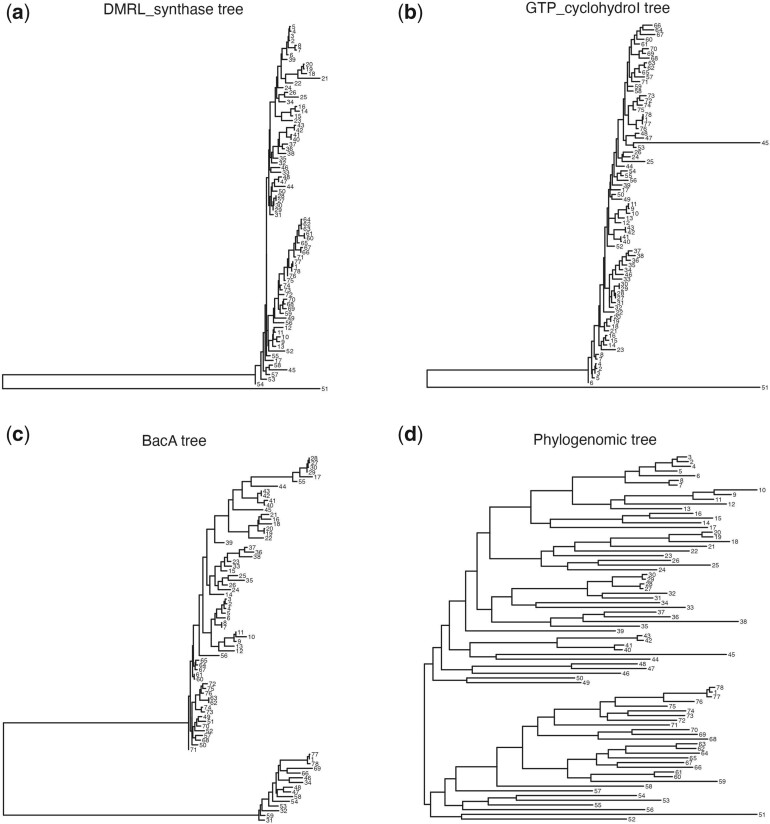
Figures



Update of
-
Analyzing microbial evolution through gene and genome phylogenies.bioRxiv [Preprint]. 2023 Aug 16:2023.08.15.553440. doi: 10.1101/2023.08.15.553440. bioRxiv. 2023. Update in: Biostatistics. 2024 Jul 1;25(3):786-800. doi: 10.1093/biostatistics/kxad025. PMID: 37645842 Free PMC article. Updated. Preprint.
References
-
- Amenta N. and Klingner J. (2002). Case study: Visualizing sets of evolutionary trees. In: IEEE Symposium on Information Visualization, INFOVIS 2002. IEEE, pp. 71–74.
-
- Barden D., Le H. and Owen M. (2018). Limiting behaviour of Fréchet means in the space of phylogenetic trees. Annals of the Institute of Statistical Mathematics 70, 99–129.
-
- Billera L. J., Holmes S. P. and Vogtmann K. (2001). Geometry of the space of phylogenetic trees. Advances in Applied Mathematics 27, 733–767.
MeSH terms
Grants and funding
LinkOut - more resources
Full Text Sources
