


Dementia incidence trend in England and Wales, 2002-19, and projection for dementia burden to 2040: analysis of data from the English Longitudinal Study of Ageing
- PMID: 37898518
- PMCID: PMC10958989
- DOI: 10.1016/S2468-2667(23)00214-1
Dementia incidence trend in England and Wales, 2002-19, and projection for dementia burden to 2040: analysis of data from the English Longitudinal Study of Ageing
Erratum in
-
Correction to Lancet Public Health 2023; 8: e859-67.Lancet Public Health. 2024 Jan;9(1):e15. doi: 10.1016/S2468-2667(23)00309-2. Lancet Public Health. 2024. PMID: 38176837 Free PMC article. No abstract available.
Abstract
Background: Dementia incidence declined in many high-income countries in the 2000s, but evidence on the post-2010 trend is scarce. We aimed to analyse the temporal trend in England and Wales between 2002 and 2019, considering bias and non-linearity.
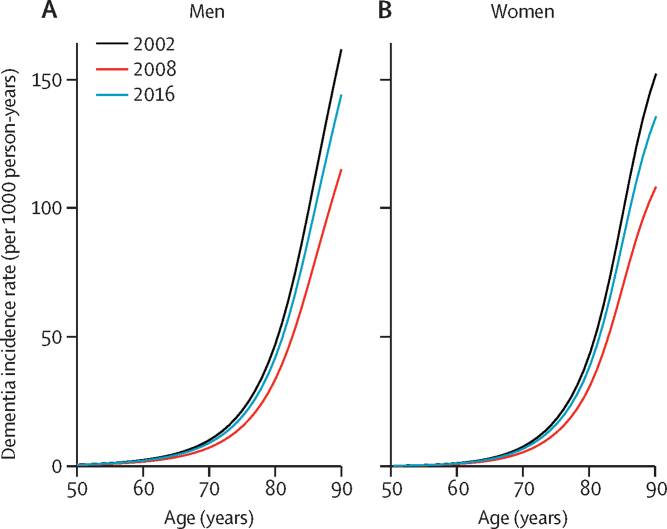
Methods: Population-based panel data representing adults aged 50 years and older from the English Longitudinal Study of Ageing were linked to the mortality register across wave 1 (2002-03) to wave 9 (2018-19) (90 073 person observations). Standard criteria based on cognitive and functional impairment were used to ascertain incident dementia. Crude incidence rates were determined in seven overlapping initially dementia-free subcohorts each followed up for 4 years (ie, 2002-06, 2004-08, 2006-10, 2008-12, 2010-14, 2012-16, and 2014-18). We examined the temporal trend of dementia incidence according to age, sex, and educational attainment. We estimated the trend of dementia incidence adjusted by age and sex with Cox proportional hazards and multistate models. Restricted cubic splines allowed for potential non-linearity in the time trend. A Markov model was used to project future dementia burden considering the estimated incidence trend.
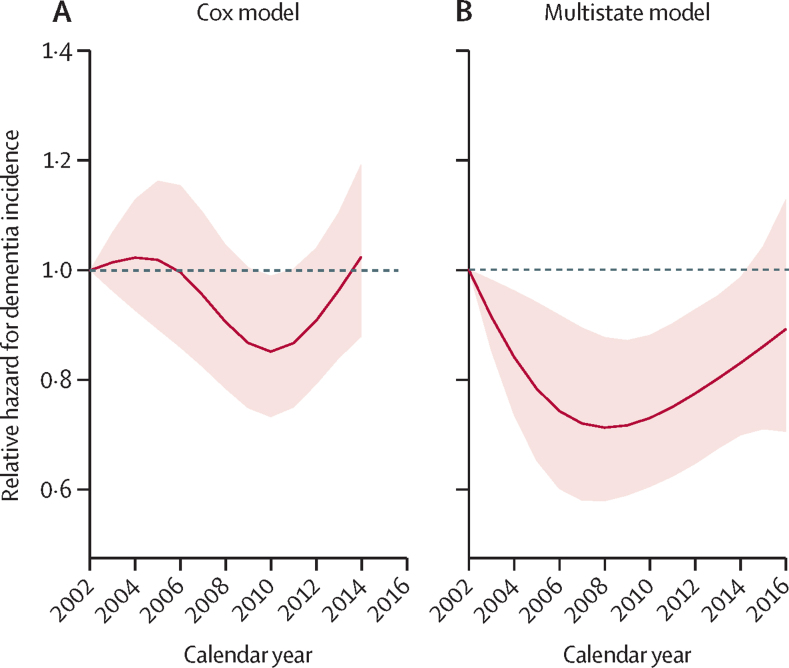
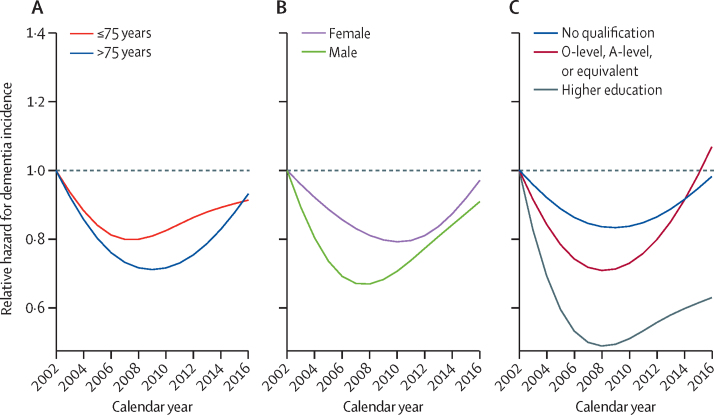
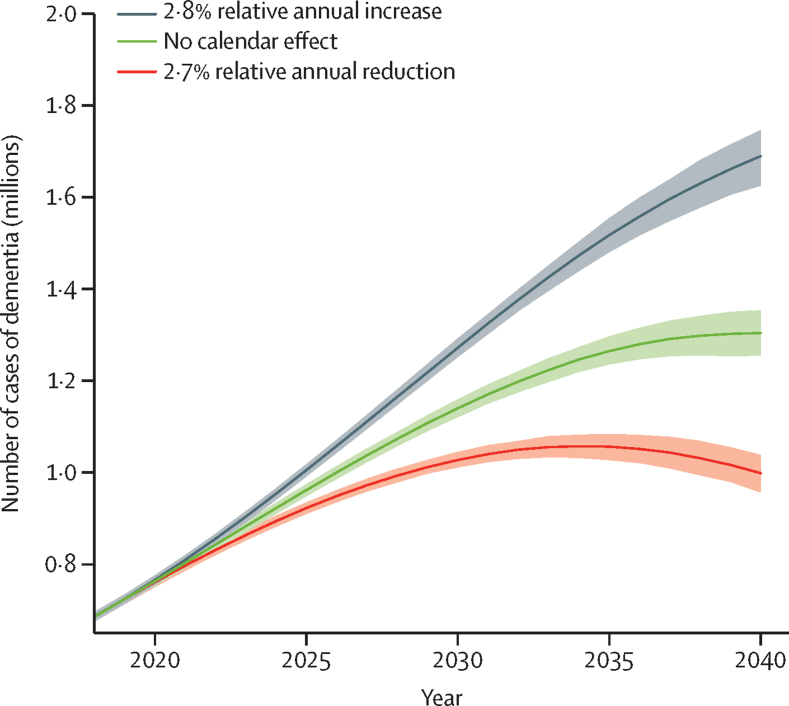
Findings: Incidence rate standardised by age and sex declined from 2002 to 2010 (from 10·7 to 8·6 per 1000 person-years), then increased from 2010 to 2019 (from 8·6 to 11·3 per 1000 person-years). Adjusting for age and sex, and accounting for missing dementia cases due to death, estimated dementia incidence declined by 28·8% from 2002 to 2008 (incidence rate ratio 0·71, 95% CI 0·58-0·88), and increased by 25·2% from 2008 to 2016 (1·25, 1·03-1·54). The group with lower educational attainment had a smaller decline in dementia incidence from 2002 to 2008 and a greater increase after 2008. If the upward incidence trend continued, there would be 1·7 million (1·62-1·75) dementia cases in England and Wales by 2040, 70% more than previously forecast.
Interpretation: Dementia incidence might no longer be declining in England and Wales. If the upward trend since 2008 continues, along with population ageing, the burden on health and social care will be large.
Funding: UK Economic and Social Research Council.
Copyright © 2023 The Author(s). Published by Elsevier Ltd. This is an Open Access article under the CC BY 4.0 license. Published by Elsevier Ltd.. All rights reserved.
Conflict of interest statement
Declaration of interests The authors declare no competing interests.
Figures
Comment in
-
Updating estimated trends in dementia incidence: evidence of increases in England.Lancet Public Health. 2023 Nov;8(11):e830-e831. doi: 10.1016/S2468-2667(23)00222-0. Lancet Public Health. 2023. PMID: 37898511 No abstract available.
References
Publication types
MeSH terms
Grants and funding
LinkOut - more resources
Full Text Sources
Medical
