


Impacts of artificial light at night on the early life history of two ecosystem engineers
- PMID: 37899009
- PMCID: PMC10613533
- DOI: 10.1098/rstb.2022.0363
Impacts of artificial light at night on the early life history of two ecosystem engineers
Abstract
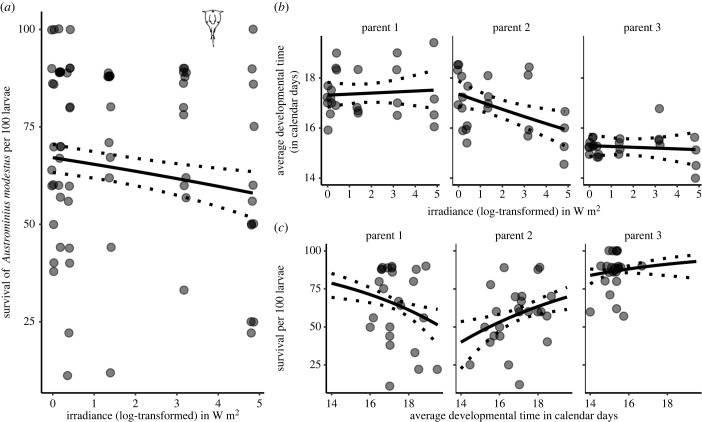
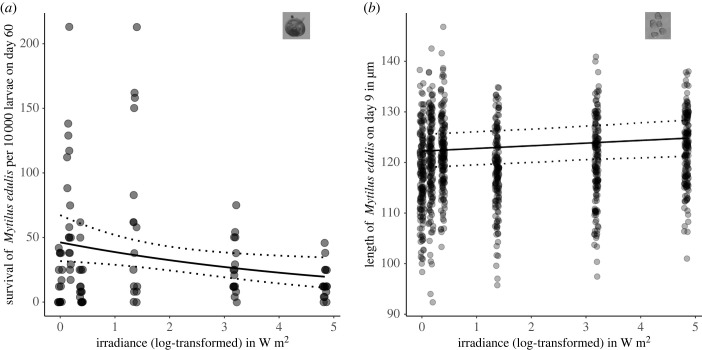
Sessile marine invertebrates play a vital role as ecosystem engineers and in benthic-pelagic coupling. Most benthic fauna develop through larval stages and the importance of natural light cycles for larval biology and ecology is long-established. Natural light-dark cycles regulate two of the largest ocean-scale processes that are fundamental to larvae's life cycle: the timing of broadcast spawning for successful fertilization and diel vertical migration for foraging and predator avoidance. Given the reliance on light and the ecological role of larvae, surprisingly little is known about the impacts of artificial light at night (ALAN) on the early life history of habitat-forming species. We quantified ALAN impacts on larval performance (survival, growth, development) of two cosmopolitan ecosystem engineers in temperate marine ecosystems, the mussel Mytilus edulis and the barnacle Austrominius modestus. Higher ALAN irradiance reduced survival in both species (57% and 13%, respectively). ALAN effects on development and growth were small overall, and different between species, time-points and parentage. Our results show that ALAN adversely affects larval survival and reiterates the importance of paternal influence on offspring performance. ALAN impacts on the early life stages of ecosystem engineering species have implications not only for population viability but also the ecological communities that these species support. This article is part of the theme issue 'Light pollution in complex ecological systems'.
Keywords: development; growth; larvae ecology; light pollution; supply-side ecology; survival.
Conflict of interest statement
We declare we have no competing interests.
Figures
References
-
- Jones CG, Lawton JH, Shachak M. 1994. Organisms as ecosystem engineers. Oikos. 69, 373-386. ( 10.2307/3545850) - DOI
-
- Gutiérrez JL, Jones CG, Strayer DL, Iribarne OO. 2003. Mollusks as ecosystem engineers: the role of shell production in aquatic habitats. Oikos. 101, 79-90. ( 10.1034/j.1600-0706.2003.12322.x) - DOI
-
- Bateman DC, Bishop MJ. 2017. The environmental context and traits of habitat-forming bivalves influence the magnitude of their ecosystem engineering. Mar. Ecol. Prog. Ser. 563, 95-110. ( 10.3354/meps11959) - DOI
-
- Kiljunen M, et al. 2020. Benthic-pelagic coupling and trophic relationships in northern Baltic Sea food webs. Limnol. Oceanogr. 65, 1706-1722. ( 10.1002/lno.11413) - DOI
Publication types
MeSH terms
LinkOut - more resources
Full Text Sources
