


Insect communities under skyglow: diffuse night-time illuminance induces spatio-temporal shifts in movement and predation
- PMID: 37899019
- PMCID: PMC10613549
- DOI: 10.1098/rstb.2022.0359
Insect communities under skyglow: diffuse night-time illuminance induces spatio-temporal shifts in movement and predation
Abstract
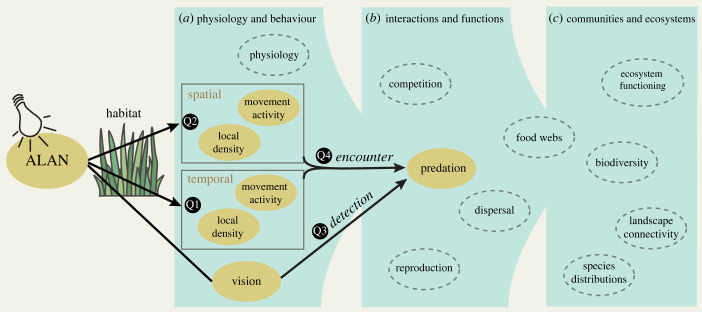
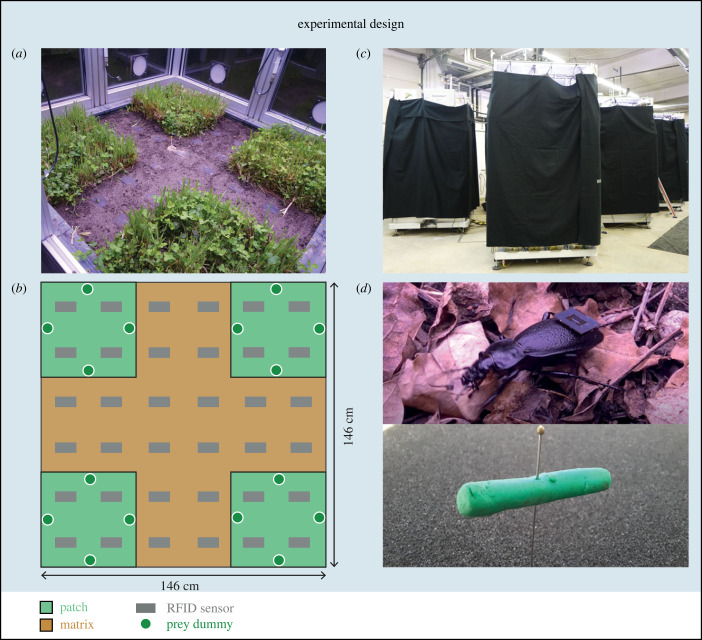
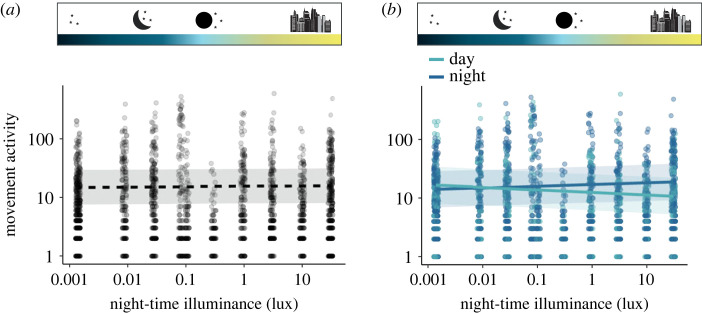
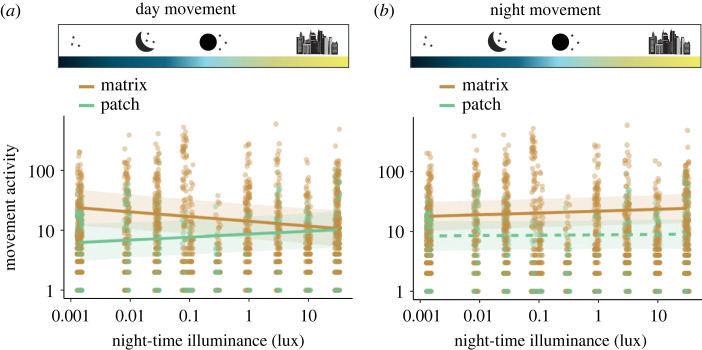
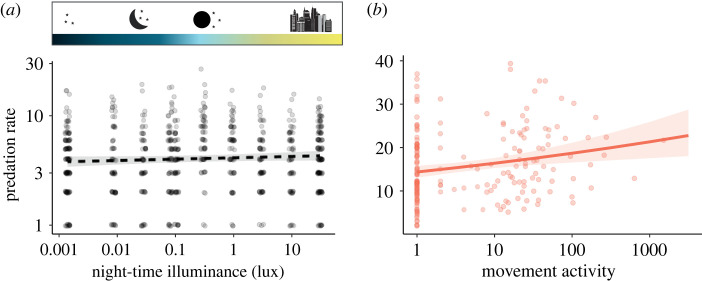
Artificial light at night (ALAN) is predicted to have far-reaching consequences for natural ecosystems given its influence on organismal physiology and behaviour, species interactions and community composition. Movement and predation are fundamental ecological processes that are of critical importance to ecosystem functioning. The natural movements and foraging behaviours of nocturnal invertebrates may be particularly sensitive to the presence of ALAN. However, we still lack evidence of how these processes respond to ALAN within a community context. We assembled insect communities to quantify their movement activity and predation rates during simulated Moon cycles across a gradient of diffuse night-time illuminance including the full range of observed skyglow intensities. Using radio frequency identification, we tracked the movements of insects within a fragmented grassland Ecotron experiment. We additionally quantified predation rates using prey dummies. Our results reveal that even low-intensity skyglow causes a temporal shift in movement activity from day to night, and a spatial shift towards open habitats at night. Changes in movement activity are associated with indirect shifts in predation rates. Spatio-temporal shifts in movement and predation have important implications for ecological networks and ecosystem functioning, highlighting the disruptive potential of ALAN for global biodiversity and the provision of ecosystem services. This article is part of the theme issue 'Light pollution in complex ecological systems'.
Keywords: ALAN; activity pattern; crepuscular; foraging; fragmented landscapes; light pollution.
Conflict of interest statement
We declare we have no competing interests.
Figures
References
-
- Bliss-Ketchum LL, de Rivera CE, Turner BC, Weisbaum DM. 2016. The effect of artificial light on wildlife use of a passage structure. Biol. Conserv. 199, 25-28. ( 10.1016/j.biocon.2016.04.025) - DOI
-
- Laforge A, Pauwels J, Faure B, Bas Y, Kerbiriou C, Fonderflick J, Besnard A. 2019. Reducing light pollution improves connectivity for bats in urban landscapes. Landsc. Ecol. 34, 793-809. ( 10.1007/s10980-019-00803-0) - DOI
Publication types
MeSH terms
Grants and funding
LinkOut - more resources
Full Text Sources
