


Efficacy and safety of semaglutide in non-alcoholic fatty liver disease
- PMID: 37899788
- PMCID: PMC10600803
- DOI: 10.3748/wjg.v29.i37.5327
Efficacy and safety of semaglutide in non-alcoholic fatty liver disease
Abstract
Background: Non-alcoholic fatty liver disease (NAFLD) is the leading cause of chronic liver disease. The prevalence and disease burden of NAFLD are projected to exponentially increase resulting in significant healthcare expenditures and lower health-related quality of life. To date, there are no approved pharmacotherapies for NAFLD or non-alcoholic steatohepatitis (NASH). Semaglutide has glycemic and weight loss benefits that may be advantageous for patients with NAFLD.
Aim: To investigate the efficacy and safety of semaglutide in patients with NAFLD.
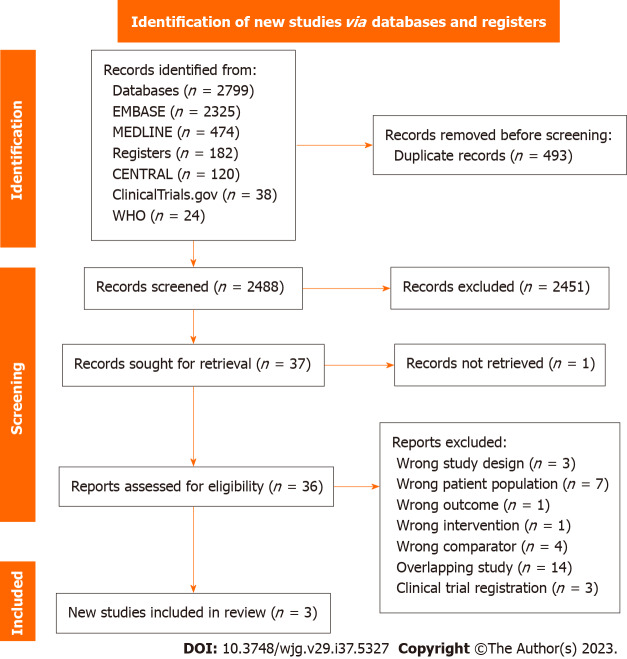
Methods: MEDLINE, CENTRAL, and EMBASE were searched from inception to May 1, 2023, to identify eligible randomized controlled trials (RCTs). Meta-analysis was performed using random effects model expressing continuous outcomes as mean differences (MD) or standardized MDs (SMD), and dichotomous outcomes as odds ratios (OR) with 95% confidence intervals (CI). Statistical heterogeneity was assessed using the Cochran's Q test and I2 statistic.
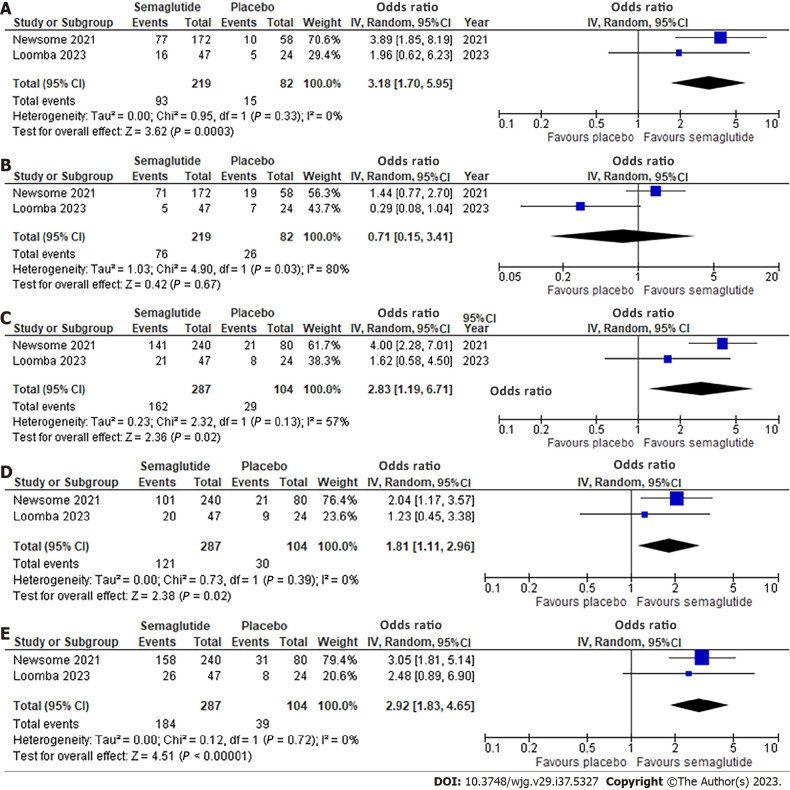
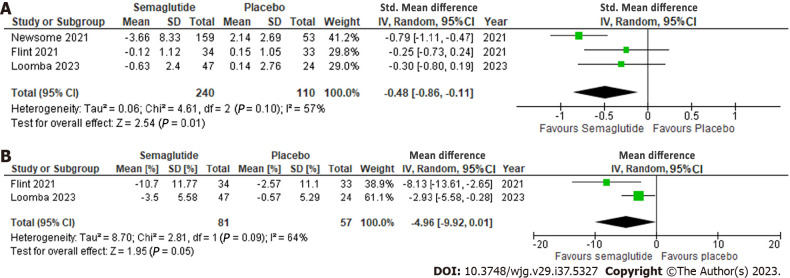
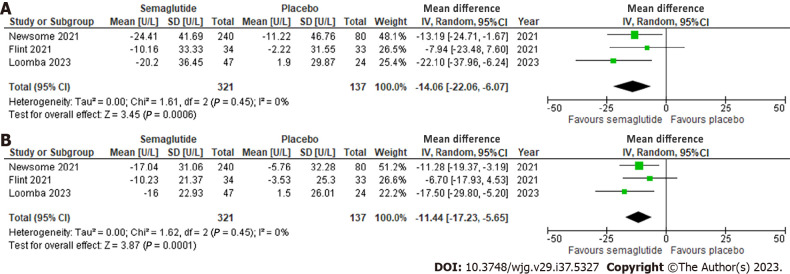
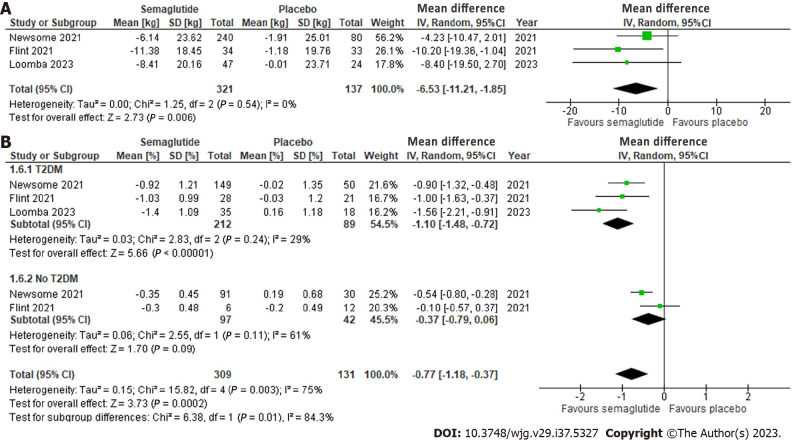
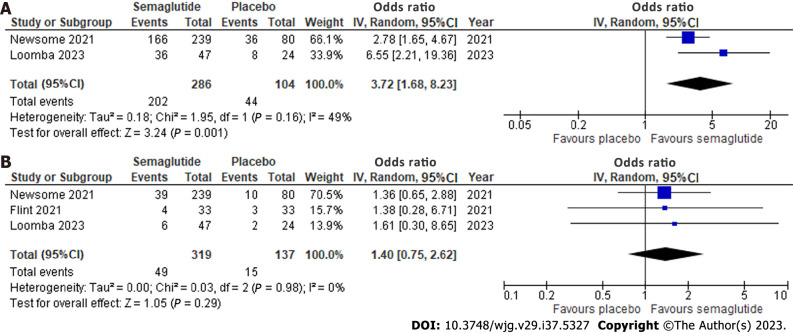
Results: Three RCTs involving 458 patients were included. Semaglutide increased the likelihood of NASH resolution (OR: 3.18, 95%CI: 1.70, 5.95; P < 0.001), improvement in steatosis (OR: 2.83, 95%CI: 1.19, 6.71; P = 0.03), lobular inflammation (OR: 1.81, 95%CI: 1.11, 2.96; P = 0.02), and hepatocellular ballooning (OR: 2.92, 95%CI: 1.83, 4.65; P < 0.001), but not fibrosis stage (OR: 0.71, 95%CI: 0.15, 3.41; P = 0.67). Radiologically, semaglutide reduced liver stiffness (SMD: -0.48, 95%CI: -0.86, -0.11; P = 0.01) and steatosis (MD: -4.96%, 95%CI: -9.92, 0.01; P = 0.05). It also reduced alanine aminotransferase (MD: -14.06 U/L, 95%CI: -22.06, -6.07; P < 0.001) and aspartate aminotransferase (MD: -11.44 U/L, 95%CI: -17.23, -5.65; P < 0.001). Semaglutide led to improved cardiometabolic outcomes, including decreased HgA1c (MD: -0.77%, 95%CI: -1.18, -0.37; P < 0.001) and weight loss (MD: -6.53 kg, 95%CI: -11.21, -1.85; P = 0.006), but increased the occurrence of GI-related side effects (OR: 3.72, 95%CI: 1.68, 8.23; P = 0.001). Overall risk of serious adverse events was similar compared to placebo (OR: 1.40, 95%CI: 0.75, 2.62; P < 0.29).
Conclusion: Semaglutide is effective in the treatment of NAFLD while maintaining a well-tolerated safety profile. Future studies are required to evaluate its effects on fibrosis regression and different phases of NAFLD.
Keywords: Fatty liver; Metabolic-associated fatty liver; Non-alcoholic fatty liver disease; Semaglutide.
©The Author(s) 2023. Published by Baishideng Publishing Group Inc. All rights reserved.
Conflict of interest statement
Conflict-of-interest statement: Zhu K, Kakkar R and Chahal D have no conflicts of interests to declare; Yoshida EM is an investigator of clinical trials sponsored by Gilead Sciences, Pfizer, Genfit, Intercept, Celgene, Allergan, and Madrigal; Yoshida EM has received research funding from Paladin Labs Inc; Hussaini T has received research funding from Transplant Research Foundation of BC, and Paladin Labs Inc.
Figures
References
-
- Riazi K, Azhari H, Charette JH, Underwood FE, King JA, Afshar EE, Swain MG, Congly SE, Kaplan GG, Shaheen AA. The prevalence and incidence of NAFLD worldwide: a systematic review and meta-analysis. Lancet Gastroenterol Hepatol. 2022;7:851–861. - PubMed
-
- Younossi ZM, Blissett D, Blissett R, Henry L, Stepanova M, Younossi Y, Racila A, Hunt S, Beckerman R. The economic and clinical burden of nonalcoholic fatty liver disease in the United States and Europe. Hepatology. 2016;64:1577–1586. - PubMed
Publication types
MeSH terms
Substances
LinkOut - more resources
Full Text Sources
Medical
Research Materials
Miscellaneous
