


Hypokinetic Dysarthria in Parkinson's Disease: A Narrative Review
- PMID: 37899809
- PMCID: PMC10600629
- DOI: 10.14744/SEMB.2023.29560
Hypokinetic Dysarthria in Parkinson's Disease: A Narrative Review
Abstract
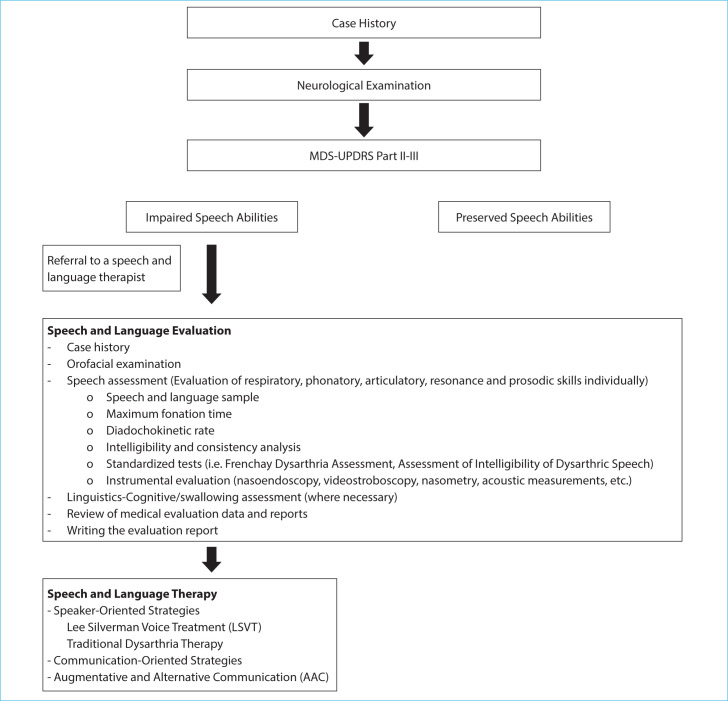
Numerous disabling motor and non-motor symptoms occur during Parkinson's disease (PD), including speech disorders, often referred to as hypokinetic dysarthria. PD is the most common cause of this type of dysarthria. About 90% of PD patients experience hypokinetic dysarthria, which is exacerbated as the disease progresses and makes it very difficult for other people to understand the person with PD. This disorder is characterized by a monotonous speech pattern, reduced and monotonous loudness, decreased stress, a breathy or hoarse voice quality, an increase in speech rate, rapid repetition of phonemes, and impreciseness in consonant production. However, patients may also have sensory symptoms including inaccurate perceptions of their own loudness and decreased awareness of speech problems. Hypokinetic dysarthria in PD may not only result from dopamine degeneration in the nigrostriatal pathway but also from disturbances in the motor and somatosensory systems. All speech components, such as phonation, articulation, respiration, resonance, and prosody should be assessed carefully in PD patients with hypokinetic dysarthria. Taking medical history, an oral motor assessment, a perceptual evaluation of speech characteristics, intelligibility, efficiency, and participation in communication all need to be a part of the assessment. The tasks of maximum phonation time, diadochokinetic rate, reading sentences, words, and passages, describing pictures, and spontaneous speech are used to assess the features of speech components and intelligibility. The evaluation should include physiological, acoustic, or imaging modalities as well. Speech therapy is typically the main treatment of speech problems in PD. The management of PD-related hypokinetic dysarthria basically focuses on speaker-oriented and communication-oriented strategies. In addition to these strategies, Augmentative Alternative Communication (AAC) should be considered in patients with severe dysarthria. Loudness, intelligibility, and sound perception may all significantly improve with the Lee Silverman Voice Therapy LOUD (LSVT LOUD) program which is an evidence-based program. The beneficial effect of pharmacological and surgical treatment approaches has not been proven in improving speech. Deep brain stimulation may carry the risk of the deterioration of speech as the illness progresses.
Keywords: Assessment; Parkinson’s disease; hypokinetic dysarthria; speech disorders; treatment.
©Copyright 2023 by The Medical Bulletin of Sisli Etfal Hospital.
Conflict of interest statement
None declared.
Figures
References
-
- Freed DB. 3rd ed. San Diego, CA: Plural Publishing; 2020. Motor Speech Disorders: Diagnosis and Treatment.
-
- Schrag A, Horsfall L, Walters K, Noyce A, Petersen I. Prediagnostic presentations of Parkinson's disease in primary care: a case-control study. Lancet Neurol. 2015;14:57–64. - PubMed
-
- Moreau C, Pinto S. Misconceptions about speech impairment in Parkinson's disease. Mov Disord. 2019;34:1471–5. - PubMed
-
- Miller N, Noble E, Jones D, Burn D. Life with communication changes in Parkinson's disease. Age Ageing. 2006;35:235–9. - PubMed
Publication types
LinkOut - more resources
Full Text Sources