. 2023 Nov 1;16(11):dmm050392.
doi: 10.1242/dmm.050392. Epub 2023 Nov 13.

Genetic background determines severity of Loxl1-mediated systemic and ocular elastosis in mice

Affiliations

Genetic background determines severity of Loxl1-mediated systemic and ocular elastosis in mice

Maria F Suarez et al. Dis Model Mech. .

Abstract

Pseudoexfoliation syndrome (PEX) is a systemic, age-related disorder characterized by elastosis and extracellular matrix deposits. Its most significant ocular manifestation is an aggressive form of glaucoma associated with variants in the gene encoding lysyl oxidase-like 1 (LOXL1). Depending upon the population, variants in LOXL1 can impart risk or protection for PEX, suggesting the importance of genetic context. As LOXL1 protein levels are lower and the degree of elastosis is higher in people with PEX, we studied Loxl1-deficient mice on three different genetic backgrounds: C57BL/6 (BL/6), 129S×C57BL/6 (50/50) and 129S. Early onset and high prevalence of spontaneous pelvic organ prolapse in BL/6 Loxl1-/- mice necessitated the study of mice that were <2 months old. Similar to pelvic organ prolapse, most elastosis endpoints were the most severe in BL/6 Loxl1-/- mice, including skin laxity, pulmonary tropoelastin accumulation, expansion of Schlemm's canal and dilation of intrascleral veins. Interestingly, intraocular pressure was elevated in 50/50 Loxl1-/- mice, depressed in BL/6 Loxl1-/- mice and unchanged in 129S Loxl1-/- mice compared to that of control littermates. Overall, the 129S background was protective against most elastosis phenotypes studied. Thus, repair of elastin-containing tissues is impacted by the abundance of LOXL1 and genetic context in young animals.

Keywords: Glaucoma; Lysyl oxidase; Mechanical stress; Pseudoexfoliation syndrome; Trabecular meshwork.


Conflict of interest statement

Competing interests The authors declare no competing or financial interests.

Figures
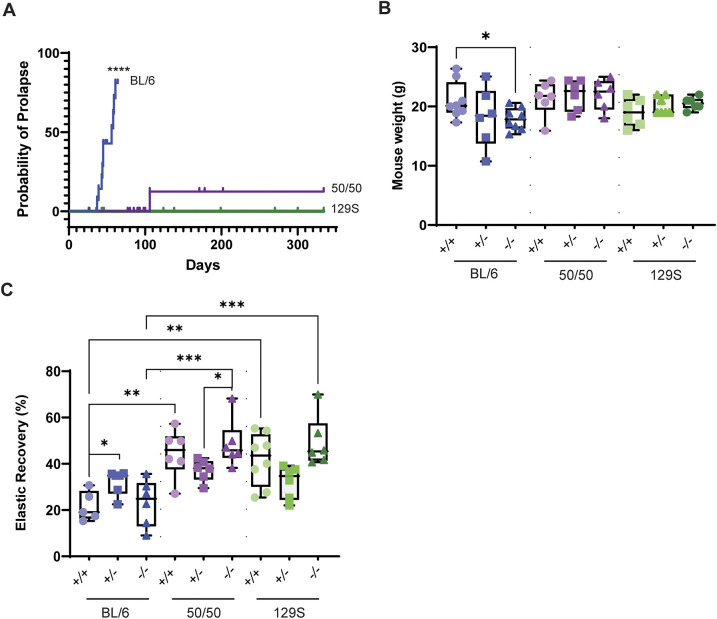
Fig. 1.
Fig. 1.
Loxl1 deficiency and genetic background affects probability of prolapse, weight gain and skin laxity. (A) The probability of spontaneous organ prolapse increased to 81% at postnatal day 60 in BL/6 Loxl1−/− mice (n=16) and to 12.5% at postnatal day 106 in 50/50 Loxl1−/− mice (n=25), and remained unchanged until the last day of follow up (postnatal day 334) for 129S Loxl1−/− mice (0%, n=16). BL/6 Loxl1−/− versus 50/50 Loxl1−/− and BL/6 Loxl1−/− versus 129S Loxl1−/−, ****P<0.0001. (B) Weight was monitored in 2-month-old Loxl1+/+, Loxl1+/− and Loxl1/ mice from the three different strains (BL/6, n=6-8; 50/50, n=6 for all genotypes; 129S, n=6-7). *P<0.05. (C) Skin recovery displacement after applying a suction force was quantified in all three genotypes from BL/6 (n=5-6), 50/50 (n=6) and 129S (n=6-8) background mice (*P<0.05; **P<0.01; ***P<0.001). For B,C, boxes show the 25-75th percentiles, whiskers show the minimum and maximum, and the median is marked with a line. For A-C, ordinary one-way ANOVA followed by Tukey's multiple comparisons test was used for statistical analysis.
Fig. 2.
Fig. 2.
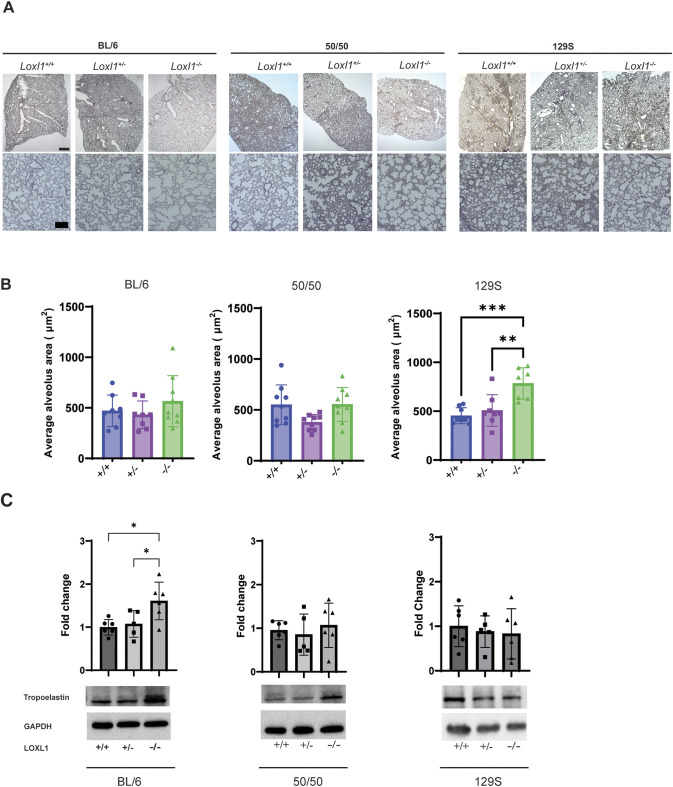
Loxl1 deficiency alters morphology and tropoelastin expression in young mouse lungs. (A) Representative images of Weigert's Resorcin-Fuchsin-stained sagittal lung sections showing expanded alveolar spaces in 2-month-old Loxl1−/− BL/6, 50/50 and 129S mice. Scale bars: 100 μm (upper panels); 20 μm (lower panels). (B) The average alveolus area was quantified from five images from four mice/genotype/background at 20× magnification using particle analysis in Fiji. (C) Tropoelastin expression was determined by immunoblotting in lung tissue homogenates from BL/6, 50/50 and 129S mice (n=5-6 mice/genotype/background) and normalized to GAPDH expression. Bars show the mean±s.d. For B and C, ordinary one-way ANOVA followed by Tukey's multiple comparisons test was used for statistical analysis. *P<0.05; **P<0.01; ***P<0.001.
Fig. 3.
Fig. 3.
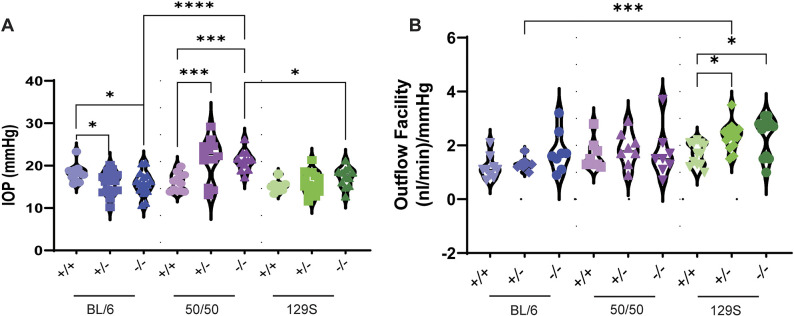
IOP and outflow facility are differentially affected in young Loxl1 mutant mice on three different genetic backgrounds. (A) Two-month-old BL/6 Loxl1+/− and Loxl1−/− mice displayed decreased IOP (n=6-8 mice, 12-16 eyes, *P<0.05), whereas 2-month-old 50/50 Loxl1+/− and Loxl1−/− mice presented with increased IOP (n=6 mice, 12 eyes, ***P<0.001). Two-month-old mice on the 129S background showed a trend of increasing IOP (n=6-8 mice, 12-16 eyes, P>0.05) (B) The outflow facility was unchanged except in Loxl1+/− and Loxl1−/− mice on the 129S background (n=6-7 mice, 12-14 eyes, *P<0.05). BL/6: n=4-5 mice, 8-10 eyes; 50/50: n=4 mice, 8 eyes. Violin plots show the full distribution of all data points acquired in A,B, and ordinary one-way ANOVA followed by Holm-Šídák's multiple comparisons test was used for statistical analysis.
Fig. 4.
Fig. 4.
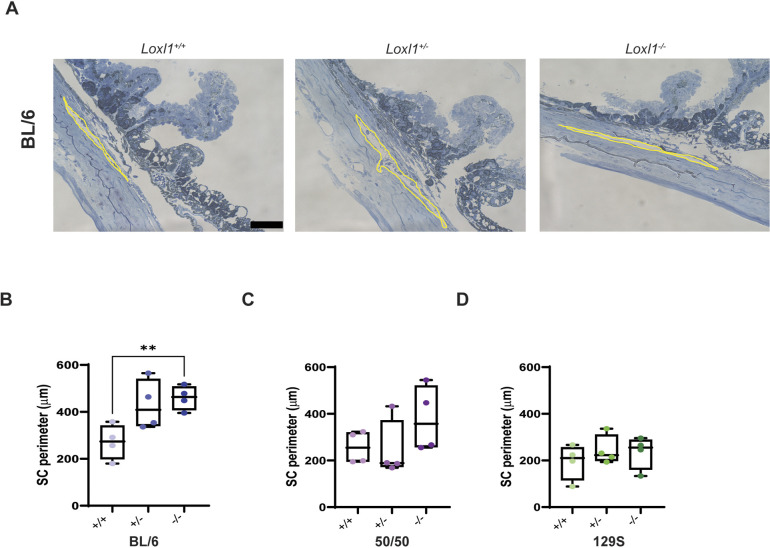
Loxl1 deficiency in mice containing BL/6 causes enlargement of Schlemm's canal lumen. (A) Representative images of the outflow tract from sagittal semi-thin sections stained with Methylene Blue in BL/6 Loxl1+/+, Loxl1+/− and Loxl1−/− mice. The Schlemm's canal (SC) perimeter is highlighted in yellow. Scale bar: 20 µm. (B) Quantitative analysis of SC perimeter revealed an enlarged SC in BL/6 Loxl1+/− and Loxl1−/− mice and in 50/50 Loxl1−/− mice (n=4 mice, averaging three cross-sectional images/eye; **P<0.01). Boxes show the 25-75th percentiles, whiskers show the minimum and maximum, and the median is marked with a line. Ordinary one-way ANOVA followed by Dunnett's multiple comparisons test was used for statistical analysis.
Fig. 5.
Fig. 5.
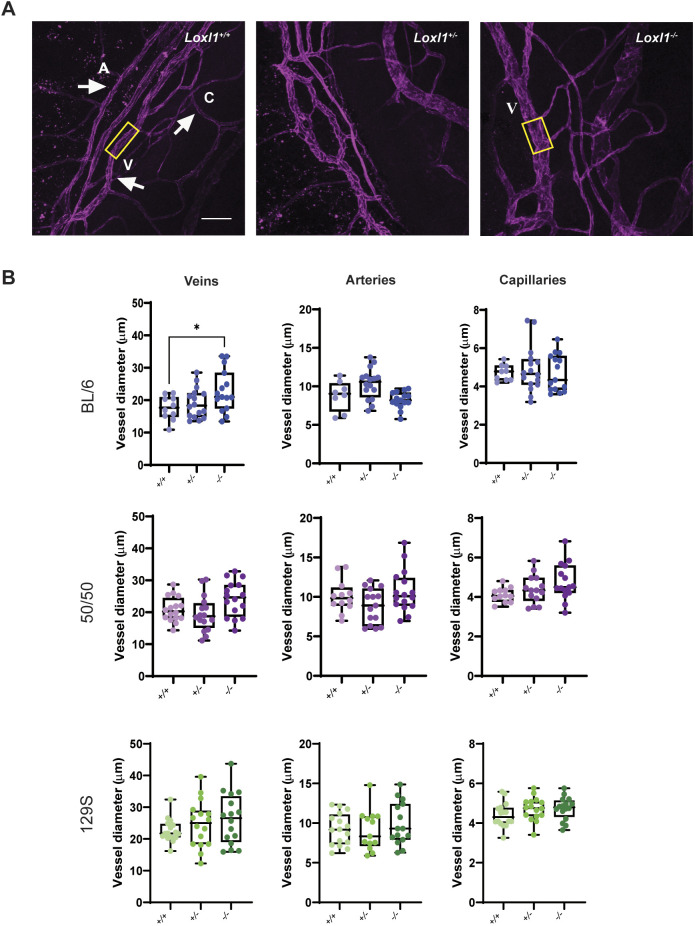
Young BL/6 Loxl1−/− mice have dilated intrascleral veins. (A) Representative images of anterior chamber flat mounts immunostained with anti-CD31 antibody in BL/6 Loxl1+/+, Loxl1+/− and Loxl1−/− mice. Yellow rectangles highlight the difference between distal vein diameter in Loxl1+/+ versus Loxl1−/− mice. A, artery; C, capillary; V, vein. Scale bar=100 µm. (B) Vessel diameter measurements for Loxl1+/+, Loxl1+/− and Loxl1−/− mice from the three different studied backgrounds. Only BL/6 Loxl1−/− mice displayed significantly dilated distal veins but not arteries or capillaries (n=4 eyes/mice, 4 quadrants/eye, *P<0.05). Boxes show the 25-75th percentiles, whiskers show the minimum and maximum, and the median is marked with a line. Ordinary one-way ANOVA followed by Dunnett's multiple comparisons test was used for statistical analysis.
Fig. 6.
Fig. 6.
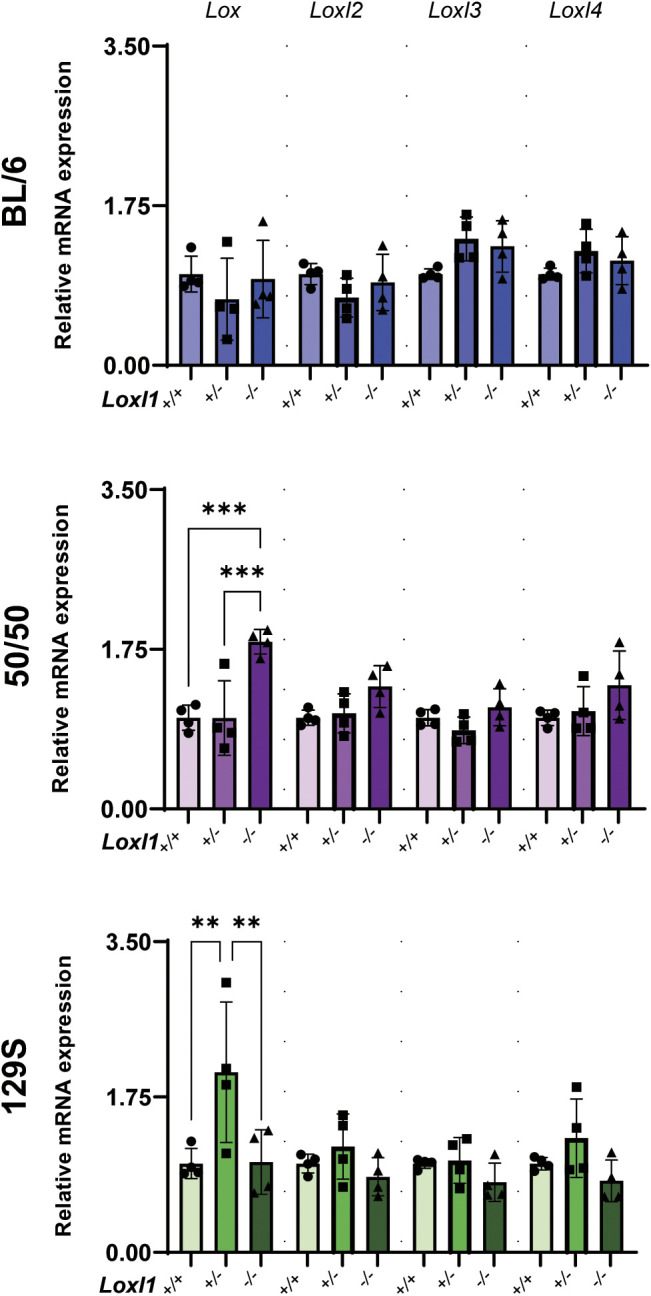
Effects of Loxl1 deficiency on expression of lysyl oxidase family members in mice of defined backgrounds. Messenger RNA levels for Lox, Loxl2, Loxl3 and Loxl4 from lung tissues of Loxl1+/+, Loxl1+/− and Loxl1−/− BL/6, 50/50 and 129S mice were analyzed by qPCR (n=4 mice/genotype/genetic background) and normalized to Gapdh expression levels. Bars show the mean±s.d. Ordinary one-way ANOVA followed by Tukey's multiple comparisons test was used for statistical analysis. **P<0.01, ***P<0.001.

References

    1. Abbas, D. B., Lavin, C. V., Fahy, E. J., Griffin, M., Guardino, N., King, M., Chen, K., Lorenz, P. H., Gurtner, G. C., Longaker, M. T.et al. (2022). Standardizing dimensionless cutometer parameters to determine in vivo elasticity of human skin. Adv. Wound Care 11, 297-310. 10.1089/wound.2021.0082 - DOI - PMC - PubMed
    1. Aboobakar, I. F., Johnson, W. M., Stamer, W. D., Hauser, M. A. and Allingham, R. R. (2017). Major review: exfoliation syndrome; advances in disease genetics, molecular biology, and epidemiology. Exp. Eye Res. 154, 88-103. 10.1016/j.exer.2016.11.011 - DOI - PubMed
    1. Acott, T. S., Kelley, M. J., Keller, K. E., Vranka, J. A., Abu-Hassan, D. W., Li, X., Aga, M. and Bradley, J. M. (2014). Intraocular pressure homeostasis: maintaining balance in a high-pressure environment. J. Ocul. Pharmacol. Ther. 30, 94-101. 10.1089/jop.2013.0185 - DOI - PMC - PubMed
    1. Aung, T., Ozaki, M., Lee, M. C., Schlotzer-Schrehardt, U., Thorleifsson, G., Mizoguchi, T., Igo, R. P., Jr., Haripriya, A., Williams, S. E., Astakhov, Y. S.et al. (2017). Genetic association study of exfoliation syndrome identifies a protective rare variant at LOXL1 and five new susceptibility loci. Nat. Genet. 49, 993-1004. 10.1038/ng.3875 - DOI - PMC - PubMed
    1. Behmoaras, J., Slove, S., Seve, S., Vranckx, R., Sommer, P. and Jacob, M. P. (2008). Differential expression of lysyl oxidases LOXL1 and LOX during growth and aging suggests specific roles in elastin and collagen fiber remodeling in rat aorta. Rejuvenation Res. 11, 883-889. 10.1089/rej.2008.0760 - DOI - PubMed

Publication types

Substances