. 2023 Oct 31;13(1):18764.
doi: 10.1038/s41598-023-44813-0.

Effect of multimorbidity on hypertension management

Affiliations

Effect of multimorbidity on hypertension management

Eunjeong Ji et al. Sci Rep. .

Abstract

Multimorbidity, the coexistence of multiple health conditions, is associated with functional decline, disability, and mortality. We aimed to investigate the effects of multimorbidity on hypertension treatment and control rates by analyzing data from the Korean National Health and Nutrition Examination Survey database, which is a cross-sectional, nationally representative survey conducted by the Korean government. Multimorbidity, defined as having two or more chronic diseases, was evaluated by blood pressure measurements, blood chemistry examinations, and questionnaires. We classified the participants according to the number of multimorbidities from 0 to ≥ 6. Association analysis was performed to identify the patterns of multimorbidity related to hypertension control. From 2016 to 2020, 30,271 adults (≥ 20 years) were included in the analysis (age: 52.1 ± 16.8 years, male: 44.0%), and 14,278 (47.2%) had multimorbidity. The number of chronic conditions was significantly higher in older adults, women, and hypertensive patients. Multimorbidity was associated with hypertension treatment. The number of chronic conditions was significantly higher in controlled compared to uncontrolled patients (3.6 ± 1.7 vs 2.9 ± 1.6, p < 0.001). But the control rate of hypertension among treated patients was lower in patients with multimorbidity (75.6% in hypertension only group vs 71.8% in multimorbidity group, p = 0.009). Multimorbidity patterns showed distinct features in treated and controlled hypertensive patients. In conclusion, multimorbidity has a beneficial effect on the treatment of hypertension, but the control rate of systolic blood pressure was lower among the patients with multimorbidity. More attention should be paid to the hypertensive patients with multimorbidity to improve the control rate of hypertension.


Conflict of interest statement

The authors declare no competing interests.

Figures

Figure 1
Figure 1
Distribution of the number of chronic medical conditions according to age of participants. Female participants had more chronic diseases than male participants. The mean number of chronic diseases among women was 1.9 ± 1.9, which was significantly greater than that among men (1.7 ± 1.6, p < 0.0001). (a) All participants; (b) male participants; and (c) female participants.
Figure 2
Figure 2
Hypertension prevalence, treatment, and control rate according to multimorbidity. Hypertension prevalence, treatment, and control rates significantly increased with an increase in the burden of multimorbidity. However, the hypertension control rate among the treated patients did not differ according to multimorbidity status. Systolic and diastolic blood pressure control rates were higher in patients with multimorbidities. However, the systolic blood pressure control rate among the treated patients was inversely related to the burden of multimorbidity. (a) Hypertension prevalence, treatment, and control rate. (b) Systolic and diastolic blood pressure control rates according to the number of multimorbidities.
Figure 3
Figure 3
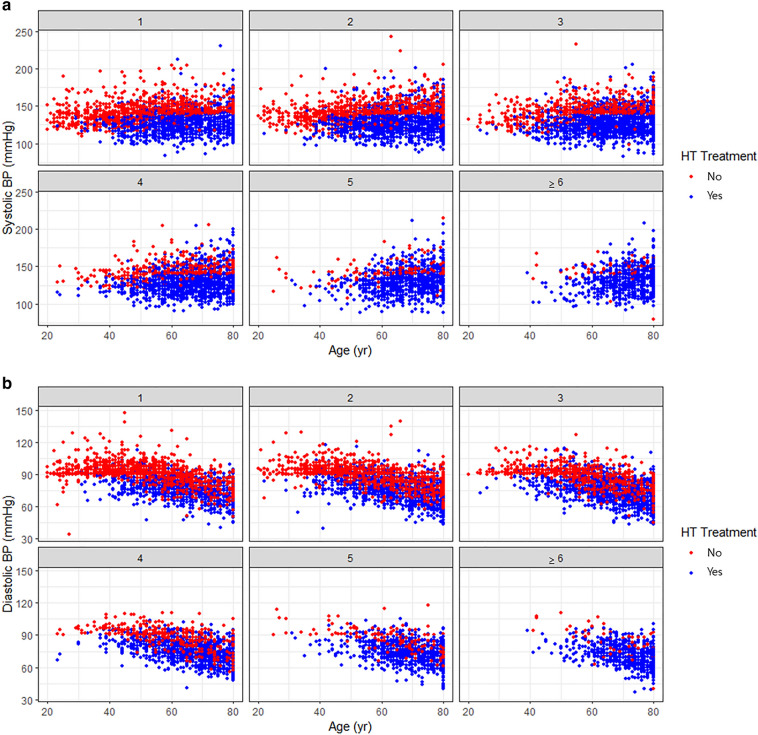
Distribution of blood pressure according to age and hypertension treatment among the hypertensive patients. Most participants with higher blood pressure (≥ 140 mmHg of systolic blood pressure or ≥ 90 mmHg of diastolic blood pressure) were untreated and younger patients among the hypertension only or hypertension plus one other comorbidity group (multimorbidity groups 1 and 2). However, among the multimorbid group (multimorbidity groups 5 and ≥ 6), most of the participants with higher blood pressure were treated patients. (a) Systolic blood pressure and (b) diastolic blood pressure.
Figure 4
Figure 4
Multimorbidity pattern according to hypertension control among all or treated hypertensive patients. Multimorbidity patterns related to hypertension control among all patients with hypertension or those without hypertension control despite antihypertensive treatments are presented. The balloon size represents support and the color indicates lift. Greater lift values (≫ 1) indicate stronger associations. (a) All hypertensive patients, and (b) treated hypertensive patients.

References

    1. Diederichs C, Berger K, Bartels DB. The measurement of multiple chronic diseases—A systematic review on existing multimorbidity indices. J. Gerontol. A Biol. Sci. Med. Sci. 2011;66:301–311. doi: 10.1093/gerona/glq208. - DOI - PubMed
    1. Johnston MC, Crilly M, Black C, Prescott GJ, Mercer SW. Defining and measuring multimorbidity: A systematic review of systematic reviews. Eur. J. Public Health. 2018;29:182–189. doi: 10.1093/eurpub/cky098. - DOI - PubMed
    1. Garin N, et al. Global multimorbidity patterns: A cross-sectional, population-based, multi-country study. J. Gerontol. A Biol. Sci. Med. Sci. 2016;71:205–214. doi: 10.1093/gerona/glv128. - DOI - PMC - PubMed
    1. Rodrigues LP, et al. Association between multimorbidity and hospitalization in older adults: Systematic review and meta-analysis. Age Ageing. 2022;51:155. doi: 10.1093/ageing/afac155. - DOI - PMC - PubMed
    1. Picco L, et al. Economic burden of multimorbidity among older adults: Impact on healthcare and societal costs. BMC Health Serv. Res. 2016;16:173. doi: 10.1186/s12913-016-1421-7. - DOI - PMC - PubMed

Publication types