


High incidence of catheter-associated urinary tract infections and related antibiotic resistance in two hospitals of different geographic regions of Sierra Leone: a prospective cohort study
- PMID: 37907960
- PMCID: PMC10619308
- DOI: 10.1186/s13104-023-06591-w
High incidence of catheter-associated urinary tract infections and related antibiotic resistance in two hospitals of different geographic regions of Sierra Leone: a prospective cohort study
Abstract
Objective: Catheter-associated urinary tract infections (CAUTI) are common worldwide, but due to limited resources, its actual burden in low-income countries is unknown. Currently, there are gaps in knowledge about CAUTI due to lack of surveillance activities in Sierra Leone. In this prospective cohort study, we aimed to determine the incidence of CAUTI and associated antibiotic resistance in two tertiary hospitals in different regions of Sierra Leone.
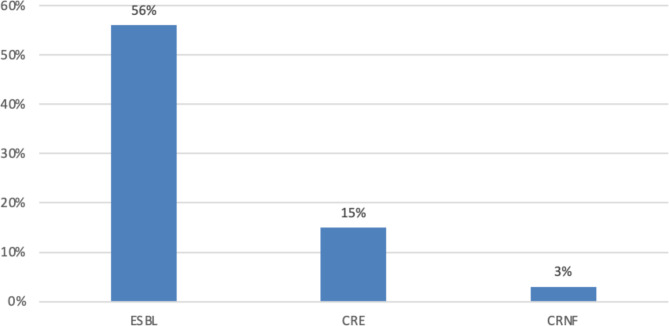
Results: The mean age of the 459 recruited patients was 48.8 years. The majority were females (236, 51.3%). Amongst the 196 (42.6%) catheterized patients, 29 (14.8%) developed CAUTI. Bacterial growth was reported in 32 (84%) patients. Escherichia coli (14, 23.7%), Klebsiella pneumoniae (10, 17.0%), and Klebsiella oxytoca (8, 13.6%) were the most common isolates. Most isolates were ESBL-producing Enterobacteriaceae (33, 56%) and WHO Priority 1 (Critical) pathogens (38, 71%). Resistance of K. pneumoniae, K. oxytoca, E. coli, and Proteus mirabilis was higher with the third-generation cephalosporins and penicillins but lower with carbapenems, piperacillin-tazobactam and amikacin. To reduce the high incidence of CAUTI and multi-drug resistance organisms, urgent action is needed to strengthen the microbiology diagnostic services and develop and implement catheter bundles that provide clear guidance for catheter insertion, care and removal.
Keywords: Carbapenem resistance Enterobacteriaceae (CRE); Catheter-associated urinary tract Infections (CAUTI); Extended spectrum β-lactamase (ESBL)-producing Enterobacteriaceae; Multidrug resistance organisms (MRO); WHO priority pathogens.
© 2023. The Author(s).
Conflict of interest statement
E.F. receives his salary from the European Union’s Horizon 2020 research and innovation programme under Marie Skłodowska-Curie grant agreement (No 801076), through SSPH+ Global PhD Fellowship Programme in Public Health Sciences (GlobalP3HS). G.A.Y. reports salary support from the National Institutes of Health/AIDS Clinical Trials Group under Award Numbers 5UM1AI068636-15, 5UM1AI069501-09 and AI068636(150GYD212), and consultancy fees from Pfizer. All other authors do not have any conflict of interest.
Figures
References
-
- WHO. 2011: Report on the Burden of Endemic Health Care-Associated Infection Worldwide. Available at: https://apps.who.int/iris/bitstream/handle/10665/80135/9789241501507_eng.... Accessed on: May 1, 2022.
-
- Caramujo N, Carvalho M, Caria H. Prevalência Da algaliação sem indicação: um factor de risco evitável [Prevalence of inappropriate urinary catheterization: a preventable risk factor] Acta Med Port. 2011;24 Suppl 2:517–22. - PubMed
MeSH terms
Substances
Grants and funding
LinkOut - more resources
Full Text Sources
Medical
