. 2023 Oct 16:14:1256404.
doi: 10.3389/fimmu.2023.1256404. eCollection 2023.

Enhanced expression of natural cytotoxicity receptors on cytokine-induced memory-like natural killer cells correlates with effector function

Affiliations

Enhanced expression of natural cytotoxicity receptors on cytokine-induced memory-like natural killer cells correlates with effector function

Sofía Carreira-Santos et al. Front Immunol. .

Abstract

Introduction: Natural killer (NK) cells are a key component of the innate immune system, involved in defending the host against virus-infected cells and tumor immunosurveillance. Under in vitro culture conditions, IL-12/15/18 can induce a memory-like phenotype in NK cells. These cytokine-induced memory-like (CIML) NK cells possess desirable characteristics for immunotherapies, including a longer lifespan and increased cytotoxicity.

Methods: In this study, NK cells were isolated from peripheral blood of healthy donors and stimulated with IL-12/15/18 to induce a memory-like phenotype or with IL-15 alone as a control. After seven days of culture, multiparametric flow cytometry analysis was performed to evaluate the phenotypic and functional profiles of CIML and control NK cells.

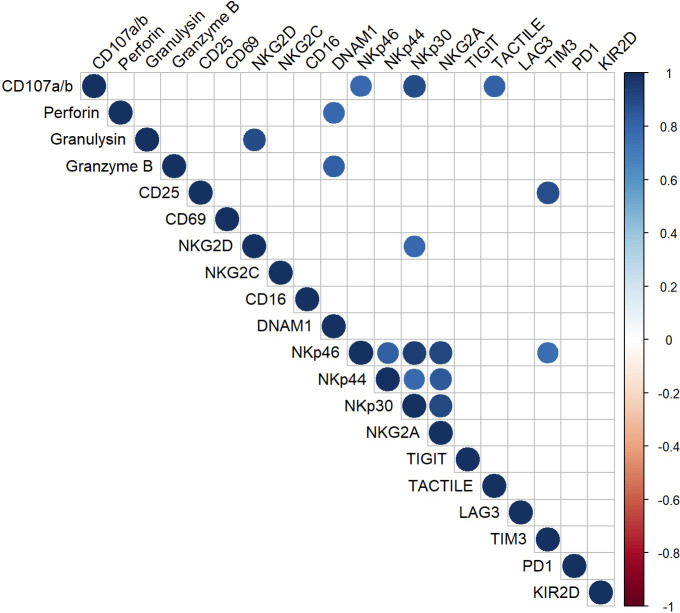
Results: Our results showed a significantly higher expression of CD25, CD69, NKG2D, NKp30, NKp44, NKp46, TACTILE, and Granzyme B in CIML NK cells compared to control NK cells. In contrast, KIR2D expression was significantly lower in CIML NK cells than in control NK cells. Moreover, functional experiments demonstrated that CIML NK cells displayed enhanced degranulation capacity and increased intracellular IFN-γ production against the target cell line K562. Interestingly, the degranulation capacity of CIML NK cells was positively correlated with the expression of the activating receptors NKp46 and NKp30, as well as with the inhibitory receptor TACTILE.

Discussion: In conclusion, this study provides a deep phenotypic characterization of in vitro-expanded CIML NK cells. Moreover, the correlations found between NK cell receptors and degranulation capacity of CIML NK cells allowed the identification of several biomarkers that could be useful in clinical settings.

Keywords: NK cells; NKG2D; cancer immunotherapy; cytokine-induced memory-like NK cells; degranulation capacity; memory-like; natural cytotoxicity receptors.


Conflict of interest statement

The authors declare that the research was conducted in the absence of any commercial or financial relationships that could be construed as a potential conflict of interest.

Figures
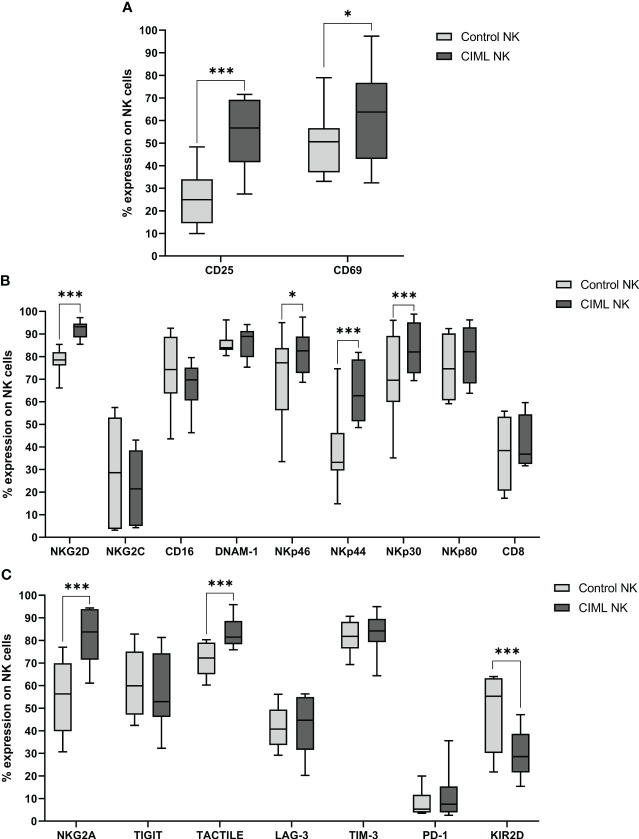
Figure 1
Figure 1
Phenotypic analysis of CIML and control NK cells after 7 days of culture. (A) Expression of the activating markers CD25 and CD69. (B) Expression of NK cell activating receptors and CD8. (C) Expression of NK cell inhibitory receptors. p-values were calculated by using the non-parametric Friedman test, followed by pairwise comparisons (Durbin-Conover test), * p ≤ 0,05, *** p ≤ 0,001.
Figure 2
Figure 2
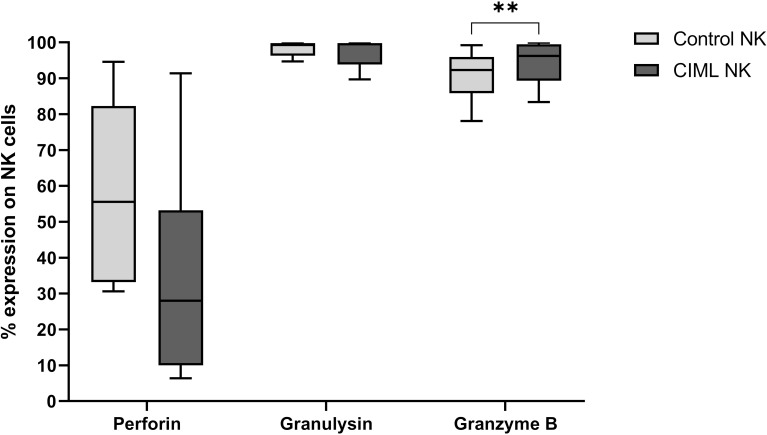
Expression of the cytotoxic proteins Perforin, Granulysin, and Granzyme B in CIML and control NK cells after 7 days of culture. p-values were calculated by using the non-parametric Friedman test, followed by pairwise comparisons (Durbin-Conover test), ** p ≤ 0,01.
Figure 3
Figure 3
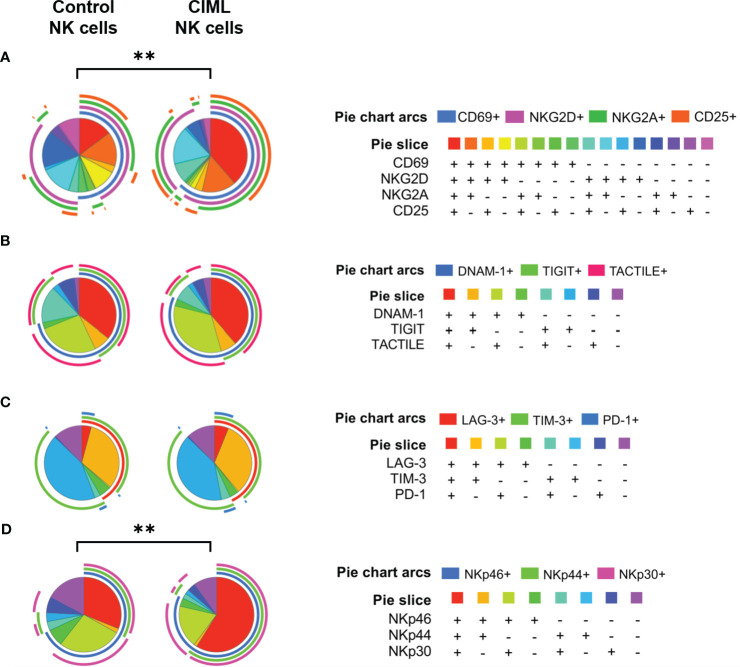
Co-expression of activating and inhibitory receptors in CIML and control NK cells after 7 days of culture. (A) Pie charts represent the percentages of CIML and control NK cells expressing CD69, NKG2D, NKG2A, and CD25. (B) Pie charts represent percentages of CIML and control NK cells expressing DNAM-1, TIGIT, and TACTILE. (C) Pie charts represent percentages of CIML and control NK cells expressing LAG-3, TIM-3, and PD-1. (D) Pie charts represent percentages of CIML and control NK cells expressing NKp46, NKp44, and NKp30. p-values were calculated by a non-parametric partial permutation test, ** p ≤ 0,01.
Figure 4
Figure 4
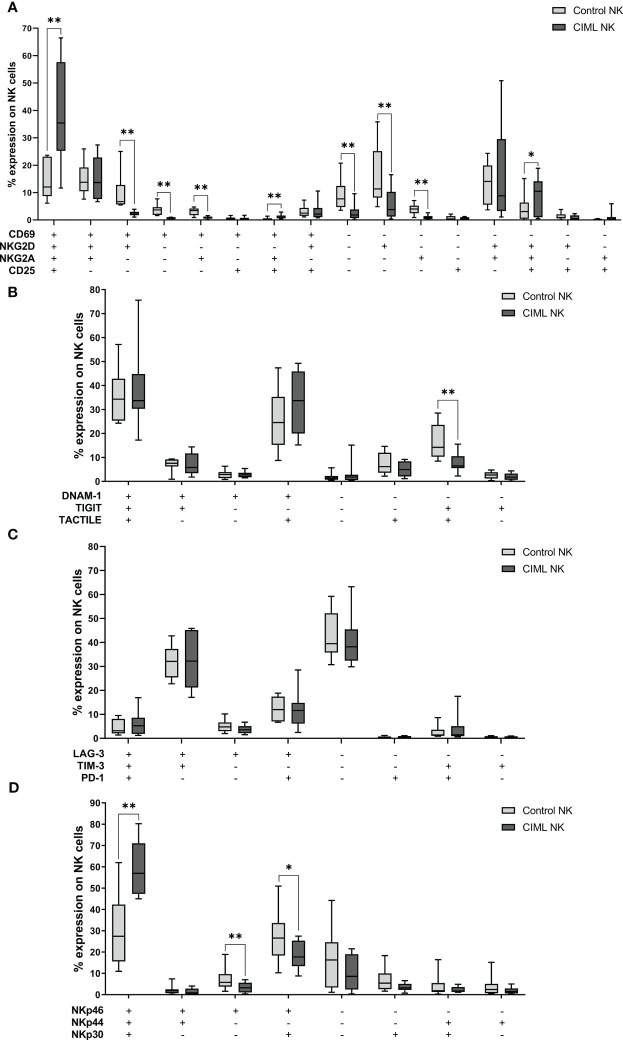
Co-expression of activating and inhibitory receptors in CIML and control NK cells after 7 days of culture. (A) Expression of CD69, NKG2D, NKG2A, and/or CD25. (B) Expression of DNAM-1, TIGIT, and/or TACTILE. (C) Expression of LAG-3, TIM-3, and/or PD-1. (D) Expression of NKp46, NKp44, and/or NKp30. p-values were calculated by pairwise comparison using the non-parametric Wilcoxon test, * p ≤ 0,05, ** p ≤ 0,01.
Figure 5
Figure 5
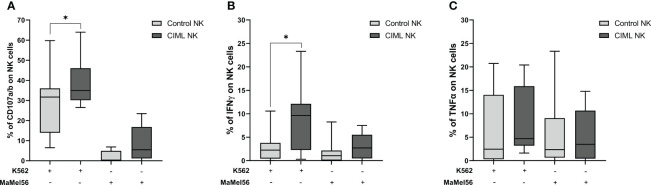
Specific degranulation capacity and production of intracellular IFN-γ and TNF-α in CIML and control NK cells after 7 days of culture. Specific degranulation capacity of NK cells was calculated after subtracting the basal degranulation in the absence of target cell from the degranulation in the presence of target cell. (A) Degranulation capacity of CIML and control NK cells against K562 and MaMel56. (B) Intracellular IFN-γ production of CIML and control NK cells against K562 and MaMel56. (C) Intracellular TNF-α production of CIML and control NK cells against K562 and MaMel56. p-values were calculated by pairwise comparison using the non-parametric Wilcoxon test, * p ≤ 0,05.
Figure 6
Figure 6
Multiple correlation analysis of CIML NK cells after 7 days of culture. The Pearson correlation coefficient was used to determine multiple correlations. The color and size of the circles in the graph correspond to the obtained r-value; only significant correlations (p ≤ 0.05) are displayed in the graph.

References

    1. Terrén I, Orrantia A, Astarloa-Pando G, Amarilla-Irusta A, Zenarruzabeitia O, Borrego F. Cytokine-induced memory-like NK cells: from the basics to clinical applications. Front Immunol (2022) 13:884648. doi: 10.3389/fimmu.2022.884648 - DOI - PMC - PubMed
    1. Caligiuri MA. Human natural killer cells. Blood (2008) 112:461–9. doi: 10.1182/blood-2007-09-077438 - DOI - PMC - PubMed
    1. Tarazona R, Lopez-Sejas N, Guerrero B, Hassouneh F, Valhondo I, Pera A, et al. . Current progress in NK cell biology and NK cell-based cancer immunotherapy. Cancer Immunol Immunother CII (2020) 69:879–99. doi: 10.1007/s00262-020-02532-9 - DOI - PMC - PubMed
    1. Morgado S, Sanchez-Correa B, Casado JG, Duran E, Gayoso I, Labella F, et al. . NK cell recognition and killing of melanoma cells is controlled by multiple activating receptor-ligand interactions. J Innate Immun (2011) 3:365–73. doi: 10.1159/000328505 - DOI - PubMed
    1. Montaldo E, Del Zotto G, Della Chiesa M, Mingari MC, Moretta A, De Maria A, et al. . Human NK cell receptors/markers: a tool to analyze NK cell development, subsets and function. Cytom Part J Int Soc Anal Cytol (2013) 83:702–13. doi: 10.1002/cyto.a.22302 - DOI - PubMed

Publication types

MeSH terms

LinkOut - more resources