


Exploring the Cardiovascular Benefits of Sodium-Glucose Cotransporter-2 (SGLT2) Inhibitors: Expanding Horizons Beyond Diabetes Management
- PMID: 37908957
- PMCID: PMC10613932
- DOI: 10.7759/cureus.46243
Exploring the Cardiovascular Benefits of Sodium-Glucose Cotransporter-2 (SGLT2) Inhibitors: Expanding Horizons Beyond Diabetes Management
Abstract
Globally, cardiovascular disease (CVD) continues to be the primary cause of morbidity and mortality. The risk of cardiovascular disease is markedly increased in individuals with type 2 diabetes mellitus (T2DM), making managing cardiovascular health a top priority. Initially developed for their glucose-lowering properties, sodium-glucose cotransporter 2 (SGLT2) inhibitors have emerged as a transformative class of pharmaceuticals with profound cardiovascular benefits that extend far beyond glycemic control. One of the most striking findings is the substantial reduction in major adverse cardiovascular events (MACE), including myocardial infarction, stroke, and cardiovascular mortality, observed in clinical trials evaluating SGLT2 inhibitors. These extraordinary cardioprotective effects are demonstrated by landmark trials such as EMPA-REG OUTCOME, CANVAS, and DECLARE-TIMI 58, which are discussed in detail. In addition, SGLT2 inhibitors have demonstrated positive outcomes in heart failure (HF) with reduced ejection fraction, which has led to their incorporation into HF treatment guidelines. SGLT2 inhibitors offer renoprotection by delaying the progression of diabetic kidney disease, reducing albuminuria, preserving glomerular filtration rates, and their immediate cardiovascular benefits. We investigate the potential mechanisms underlying these renal benefits, focusing on the role of hemodynamic alterations and intraglomerular pressure reduction. In addition, SGLT2 inhibitors have a distinct diuretic effect that can contribute to volume reduction and symptom alleviation in patients with heart failure (HF). This diuretic action, distinct from conventional diuretics, warrants additional research to optimize their use in T2DM and HF patients. The risk of euglycemic diabetic ketoacidosis, genital mycobacterial infections, and bone fractures are also discussed. Understanding these issues is essential for making educated clinical decisions. In conclusion, SGLT2 inhibitors have transcended their initial function as anti-diabetic agents to become essential components of cardiovascular and renal protection strategies in T2DM patients. Their diverse benefits, which include cardioprotection, renoprotection, and the potential for HF management, highlight their potential to transform cardiovascular medicine. Optimizing the use of SGLT2 inhibitors in clinical practice bears the promise of improved cardiovascular outcomes for patients with T2DM and beyond as we navigate this changing landscape.
Keywords: cardioprotection; cardiovascular benefits; diabetes management; heart failure management; renoprotection; sglt2 inhibitors.
Copyright © 2023, Fatima et al.
Conflict of interest statement
The authors have declared that no competing interests exist.
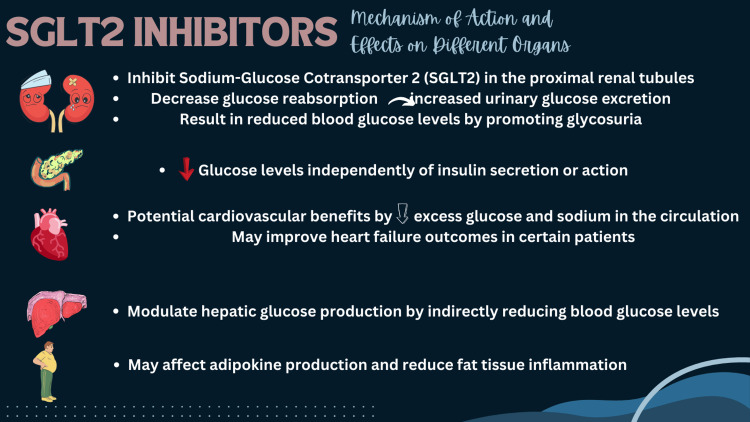
Figures
References
-
- Global and regional diabetes prevalence estimates for 2019 and projections for 2030 and 2045: results from the International Diabetes Federation Diabetes Atlas, 9(th) edition. Saeedi P, Petersohn I, Salpea P, et al. Diabetes Res Clin Pract. 2019;157:107843. - PubMed
-
- 2. Classification and diagnosis of diabetes: standards of medical care in diabetes-2021. American Diabetes Association. Diabetes Care. 2021;44:0–33. - PubMed
-
- SGLT2 inhibitors for primary and secondary prevention of cardiovascular and renal outcomes in type 2 diabetes: a systematic review and meta-analysis of cardiovascular outcome trials. Zelniker TA, Wiviott SD, Raz I, et al. Lancet. 2019;393:31–39. - PubMed
-
- 2. Classification and diagnosis of diabetes: standards of medical care in diabetes-2021. Neal B, Perkovic V, Mahaffey KW, et al. N Engl J Med. 2017;377:644–657. - PubMed
-
- Dapagliflozin and cardiovascular outcomes in type 2 diabetes. Wiviott SD, Raz I, Bonaca MP, et al. N Engl J Med. 2019;380:347–357. - PubMed
Publication types
LinkOut - more resources
Full Text Sources
Research Materials
Miscellaneous