


The role of internalised HIV stigma in disclosure of maternal HIV serostatus to children perinatally HIV-exposed but uninfected: a prospective study in the United States
- PMID: 37909234
- PMCID: PMC10618870
- DOI: 10.1002/jia2.26167
The role of internalised HIV stigma in disclosure of maternal HIV serostatus to children perinatally HIV-exposed but uninfected: a prospective study in the United States
Abstract
Introduction: Decisions to disclose HIV serostatus may be complicated by internalised HIV stigma. We evaluated the association of internalised HIV stigma in biological mothers living with HIV with disclosure of their serostatus to their children perinatally HIV-exposed but uninfected (CHEU).
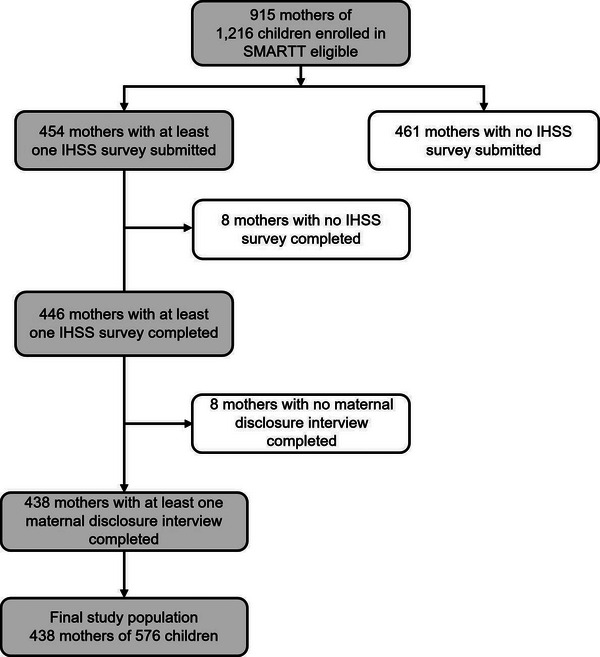
Methods: Mothers and their CHEU were enrolled in the United States (U.S.)-based Surveillance Monitoring for Antiretroviral Therapy (ART) Toxicities (SMARTT) study of the Pediatric HIV/AIDS Cohort Study (PHACS), a longitudinal study of outcomes related to in utero exposure to HIV and ART among CHEU. Mothers completing at least one stigma and disclosure assessment starting at the child's age 11-, 13-, 15- and/or 17-year study visits between 16 August 2016 and 1 October 2020 were eligible. Stigma was measured with the 28-item Internalised HIV Stigma Scale (IHSS). Mean stigma scores were linearly transformed to a range of 0-100, with higher scores indicating greater levels of stigma. At each visit, mothers were asked if their child was aware of their HIV diagnosis and at what age the child became aware. The Kaplan-Meier estimator evaluated the cumulative probability of disclosure at each child age. Logistic regression models with generalised estimating equations to account for repeated measures were fit to examine the association between stigma and disclosure, controlling for relevant socio-demographic variables.
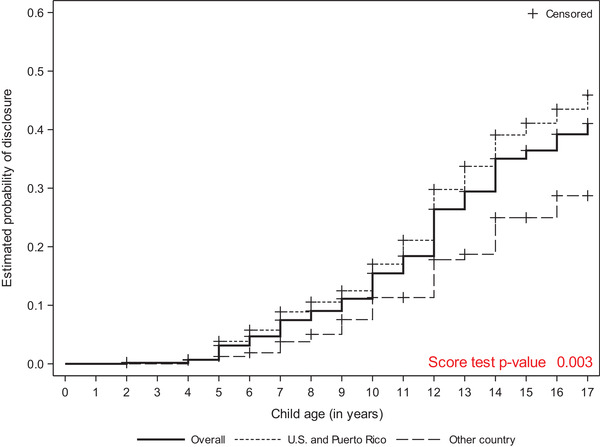
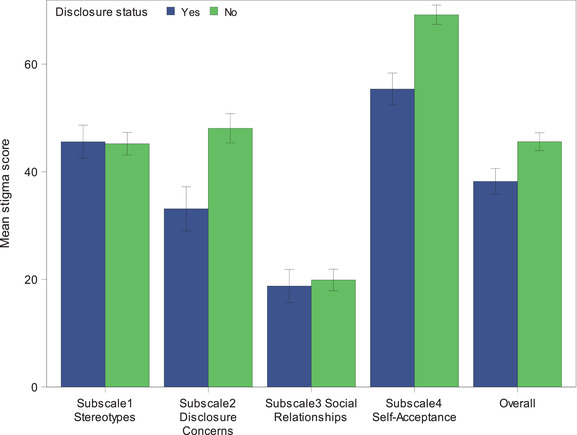
Results: Included were 438 mothers of 576 children (mean age 41.5 years, 60% U.S.-born, 60% Black/African American and 37% with household income ≤$10,000). The prevalence of disclosure across all visits was 29%. Mothers whose children were aware versus not aware of their serostatus reported lower mean IHSS scores (38.2 vs. 45.6, respectively). The cumulative proportion of disclosure by age 11 was 18.4% (95% CI: 15.5%, 21.8%) and 41% by age 17 (95% CI: 35.2%, 47.4%). At all child ages, disclosure was higher among children of U.S.-born versus non-U.S.-born mothers. After adjusting for age, marital status and years since HIV diagnosis, higher IHSS scores were associated with lower odds of disclosure (OR = 0.985, 95% CI: 0.975, 0.995).
Conclusions: Providing support to women as they make decisions about serostatus disclosure to their children may entail addressing internalised HIV stigma and consideration of community-level factors, particularly for non-U.S.-born mothers.
Keywords: PHACS; SMARTT; internalised HIV stigma; maternal HIV disclosure; parental HIV disclosure; perinatal HIV exposure.
© 2023 The Authors. Journal of the International AIDS Society published by John Wiley & Sons Ltd on behalf of International AIDS Society.
Conflict of interest statement
The authors declare that they have no competing interests.
Figures
References
-
- Armoon B, Fleury MJ, Bayat AH, Fakhri Y, Higgs P, Moghaddam LF, et al. HIV related stigma associated with social support, alcohol use disorders, depression, anxiety, and suicidal ideation among people living with HIV: a systematic review and meta‐analysis. Int J Ment Health Syst. 2022;. 16(1):1–7. - PMC - PubMed
-
- Jones HS, Floyd S, Stangl A, Bond V, Hoddinott G, Pliakas T, et al. Association between HIV stigma and antiretroviral therapy adherence among adults living with HIV: baseline findings from the HPTN 071 (PopART) trial in Zambia and South Africa. Trop Med Int Health. 2020;. 25(10):1246–60. - PMC - PubMed
-
- Daniels I, Anthony T, Peavie J, Miesfeld N, Pyatt T, Robinson D, et al. Black men who have sex with men with HIV and providers in HIV care settings reflect on stigma reducing strategies to promote engagement in health care. AIDS Patient Care STDs. 2022;. 36(S1):S–28. - PubMed
Publication types
MeSH terms
Grants and funding
LinkOut - more resources
Full Text Sources
Medical
