. 2023 Dec 18;62(51):e202311924.
doi: 10.1002/anie.202311924. Epub 2023 Nov 14.

Chemical Proteomic Discovery of Isotype-Selective Covalent Inhibitors of the RNA Methyltransferase NSUN2

Affiliations

Chemical Proteomic Discovery of Isotype-Selective Covalent Inhibitors of the RNA Methyltransferase NSUN2

Yongfeng Tao et al. Angew Chem Int Ed Engl. .

Abstract

5-Methylcytosine (m5 C) is an RNA modification prevalent on tRNAs, where it can protect tRNAs from endonucleolytic cleavage to maintain protein synthesis. The NSUN family (NSUN1-7 in humans) of RNA methyltransferases are capable of installing the methyl group onto the C5 position of cytosines in RNA. NSUNs are implicated in a wide range of (patho)physiological processes, but selective and cell-active inhibitors of these enzymes are lacking. Here, we use cysteine-directed activity-based protein profiling (ABPP) to discover azetidine acrylamides that act as stereoselective covalent inhibitors of human NSUN2. Despite targeting a conserved catalytic cysteine in the NSUN family, the NSUN2 inhibitors show negligible cross-reactivity with other human NSUNs and exhibit good proteome-wide selectivity. We verify that the azetidine acrylamides inhibit the catalytic activity of recombinant NSUN2, but not NSUN6, and demonstrate that these compounds stereoselectively disrupt NSUN2-tRNA interactions in cancer cells, leading to a global reduction in tRNA m5 C content. Our findings thus highlight the potential to create isotype-selective and cell-active inhibitors of NSUN2 with covalent chemistry targeting a conserved catalytic cysteine.

Keywords: 5-Methylcytosine; Activity-Based Protein Profiling; Covalent Inhibitor; NSUN2; RNA Methylation.


Conflict of interest statement

Competing interests

Dr. Cravatt is a founder and advisor to Vividion Therapeutics. C.H. is a scientific founder, a member of the scientific advisory board and equity holder of Aferna Green, Inc. and AccuaDX Inc., and a scientific co-founder and equity holder of Accent Therapeutics, Inc. Drs. Cravatt, Melillo, and Schreiber are founders and/or scientific advisors to Magnet Therapeutics.

Figures
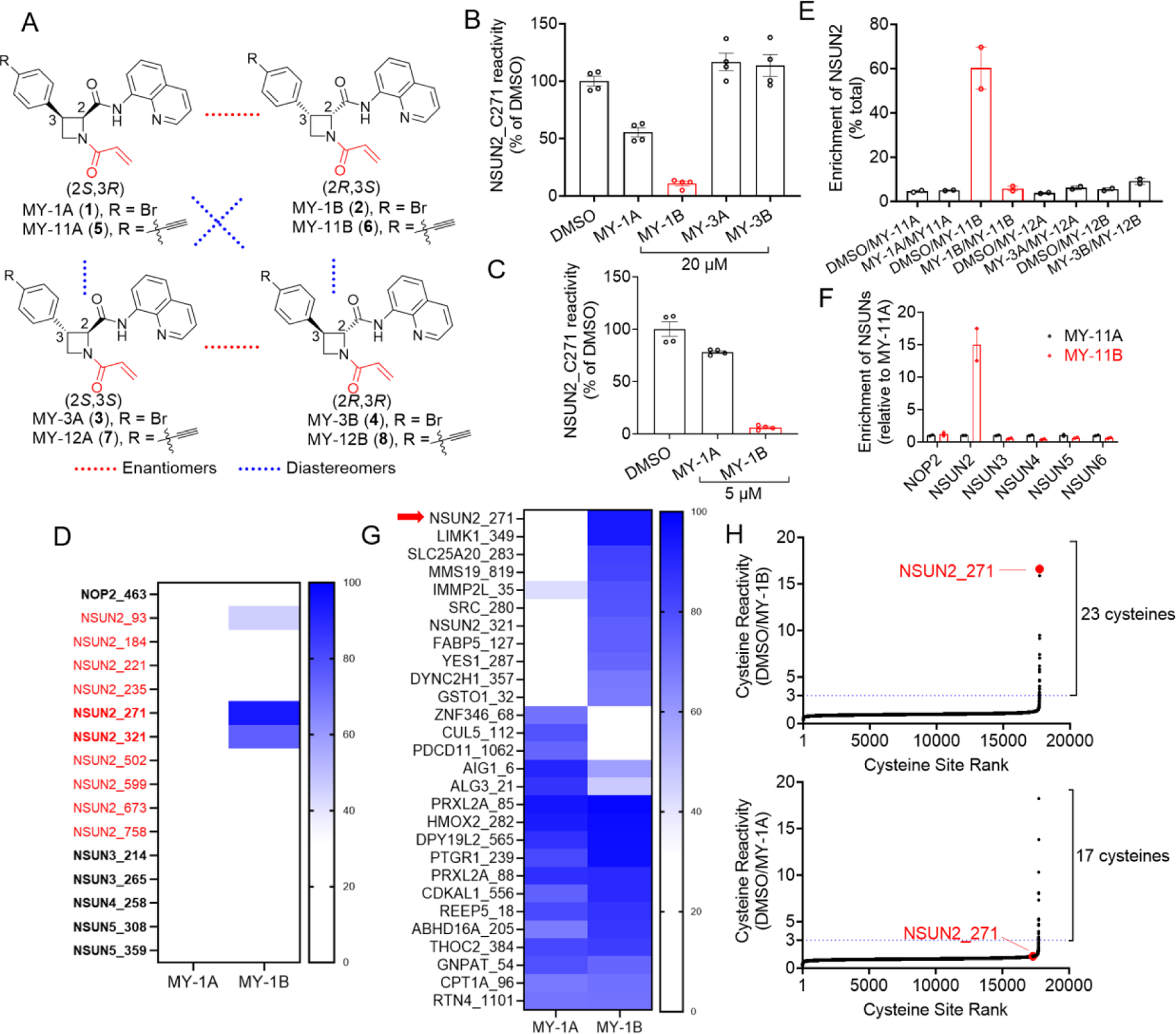
Figure 1.
Figure 1.
ABPP of human cancer cells identifies azetidine acrylamides that stereo- and site-selectively engage C271 of NSUN2. (A) Structures of a set of azetidine acrylamide stereoprobes MY-1A (1), MY-1B (2), MY-3A (3), and MY-3B (4) and respective alkynylated analogs MY-11A (5), MY-11B (6), MY-12A (7), and MY-12B (8). (B, C) Cysteine-directed ABPP data for NSUN2_C271 from 22Rv1 cells treated with the indicated azetidine acrylamides (20 µM, 3 h for (B), 5 µM, 3 h for (C)) relative to control 22Rv1 cells treated with DMSO. For (B-C), data were taken from ref. 14B and represent average values ± SEM from two independent experiments each performed with two technical replicates. (D) Heatmap showing engagement data for MY-1A and MY-1B (5 µM, 3 h) with the indicated cysteines in NSUN2 (red) and catalytic cysteines of other NSUNs (bold type) as determined by cysteine-directed ABPP experiments described in (C). Data represent average values from two independent experiments each performed with two technical replicates. (E) Protein-directed ABPP data for NSUN2 from Ramos cells treated with DMSO or the indicated azetidine acrylamides (MY-1A/1B/3A/3B) (20 µM, 2 h) followed by corresponding alkyne analogs (MY-11A/11B/12A/12B) (5 µM, 1 h). Enrichment values for each condition indicate the fraction of signal intensity for that condition relative to the total signal intensities for all conditions. (F) Protein-directed ABPP data for indicated NSUN proteins from DMSO/MY-11A or DMSO/MY-11B experimental groups in (E). Data for each NSUN in the DMSO/MY-11A group were set to a value of 1 and DMSO/MY-11B data were normalized to these values. For (E) and (F), data represent average values ± SEM for two replicate experiments. (G) Heatmap showing data for cysteines exhibiting > 67% engagement with either MY-1A or MY-1B (5 µM, 3 h) as determined by cysteine-directed ABPP of stereoprobe-treated 22RV1 cells (% changes in cysteine reactivity are reported relative to DMSO-treated cells). Data represents average values from two independent experiments each performed with two technical replicates. (H) Waterfall plots of cysteine-directed ABPP data showing IA-DTB reactivity ratios (DMSO/MY-1A or DMSO/MY-1B) for all quantified cysteines in the proteome of 22RV1 cells treated with MY-1A or MY-1B (5 µM, 3 h). The blue dashed line denotes a three-fold decrease in cysteine reactivity (67% engagement). NSUN2_271 is highlighted in red. Data represents average values from two independent experiments each performed with two technical replicates.
Figure 2.
Figure 2.
Azetidine acrylamides stereoselectively engage recombinant NSUN2. (A) Gel-ABPP showing the reactivity of alkynylated azetidine acrylamide stereoprobes MY-11A/11B/12A/12B (1 h) with lysate of WT-NSUN2-expressing HEK293T cells. Lysates from mock (empty vector)-transfected cells treated with MY-11B are shown for comparison. Stereoprobe-labeled proteins were visualized by copper-catalyzed azide-alkyne cycloaddition (CuAAC)[15] to an azide-rhodamine tag followed by SDS-PAGE and in-gel fluorescence scanning[16]. Left, representative gel-ABPP result. Right, quantification of data presented as mean values ± SEM from three independent experiments. Statistical significance was calculated with unpaired two-tailed Student’s t-tests. ****P < 0.0001. (B) Gel-ABPP showing the concentration-dependent effects of MY-1A and MY-1B on MY-11B reactivity with recombinant WT-NSUN2 in HEK293T cells. Cells were treated in situ with MY-1A/B for 3 h, followed by MY-11B (10 µM, 1 h) and analyzed as described in (A). Left, representative gel-ABPP result. Right, quantification of data presented as mean values ± SEM from three independent experiments. Uncropped images can be found in the Supporting Information.
Figure 3.
Figure 3.
Azetidine acrylamides engage C271 of NSUN2. (A) Schematic showing methyltransferase mechanism of NSUN2 where C321 forms an adduct with cytidine in RNA that requires subsequent release mediated by C271. (B) Gel-ABPP showing MY-11B (in vitro, 10 µM, 1 h) reactivity with recombinant WT-NSUN2 and NSUN2 mutants, with or without the addition of nuclease or pre-treatment with MY-1B (in vitro, 10 µM, 1 h). Samples were analyzed as described in Fig. 2A. Top, representative gel-ABPP results and Western blots corresponding to the ABPP gel. Lower graph, quantification of data presented as mean values ± SEM from two independent experiments. Uncropped images can be found in the Supporting Information.
Figure 4.
Figure 4.
Potency and initial SAR for azetidine acrylamide reactivity with NSUN2. (A) Gel-ABPP showing the concentration-dependent effects of MY-1B and DO-26B on MY-11B reactivity with NSUN2-WT. Also shown are the effects of MY-1A and DO-26A tested at a single concentration (20 µM). Lysate of WT-NSUN2-expressing HEK293T cells (or mock-transfected cells) were treated with azetidine compounds (1 h), followed by MY-11B (10 µM, 1 h) and analyzed by gel-ABPP as described in Fig. 2A. (B) Quantification of data presented as mean values ± SEM from two independent experiments with calculated IC50 values and 95% confidence limits. Uncropped images can be found in the Supporting Information.
Figure 5.
Figure 5.
Azetidine acrylamides inhibit NSUN2 methyltransferase activity. (A) Gel-ABPP showing the concentration-dependent effects of SAH on MY-11B reactivity with recombinant WT-NSUN2 in HEK293T cell lysates. Samples were analyzed as described in Fig. 2A. (B) Quantification of gel-ABPP data presented as mean values ± SEM from two independent experiments. (C) Effects of azetidine acrylamides on the methyltransferase activity of NSUN2. Lysate of Flag-WT-NSUN2-expressing HEK293T cells were treated with MY-1A or DO-26A/B (20 µM, 1 h), or MY-1B (various concentrations, 1 h) and then NSUN2 was enriched using anti-Flag agarose and on-bead methyltransferase assays performed with a synthetic tRNA substrate (Gly-CCC) and analyzed by LC-MS/MS. Left, m5Cy/Cy ratios calculated for the indicated samples. Right, concentration-dependent effects of MY-1B on m5Cy/Cy ratio. Data presented as mean values ± SEM from three independent experiments. Statistical significance was calculated with unpaired two-tailed Student’s t-tests. ****P < 0.0001 (D) The effect of azetidine acrylamides on the methyltransferase activity of recombinant NSUN6, where assays were performed as described in panel (C), but with a Cys-GCA tRNA substrate. Quantification of data presented as mean values ± SEM from three independent experiments. Uncropped images can be found in the Supporting Information.
Fig 6.
Fig 6.
Azetidine acrylamides stereoselectively suppress NSUN2-tRNA interactions in human cells. (A) Fraction of mapped reads of NSUN2-bound RNA from Aza-IP experiments performed in THP-1 cells treated with active (MY-1B, DO-26B) or inactive control (MY-1A, DO-26A) azetidine acrylamides (10 µM, 2 h) or DMSO. Total reads for experimental group were: 39,159,526 (Input #1), 36,529,622 (Input #2), 43,180,843 (DMSO #1), 49,513,712 (DMSO #2), 57,287,020 (MY-1A #1), 44,913,838 (MY-1A #2), 36,000,565 (MY-1B #1), 45,057,427 (MY-1B #2), 42,262,985 (DO-26A #1), 50,975,977 (DO-26A #2), 37,076,827 (DO-26B #1), and 42,223,295 (DO-26B #2). (B) Relative fractions of tRNA bound to NSUN2 in cells treated with indicated compounds. #1 and 2 refer to independent replicate experiments. Input refers to RNA sample before immunoprecipitation.

References

    1. Frye M, Harada BT, Behm M, He C, Science 2018, 361, 1346–1349. - PMC - PubMed
    1. Shi H, Wei J, He C, Mol. Cell 2019, 74, 640–650. - PMC - PubMed
    1. Thüring K, Schmid K, Keller P, Helm M, Methods 2016, 107, 48–56. - PubMed
    1. Schaefer M, Pollex T, Hanna K, Lyko F, Nucleic Acids Res. 2009, 37, e12. - PMC - PubMed
    1. a) Motorin Y, Lyko F, Helm M, Nucleic Acids Res. 2010, 38, 1415–1430; - PMC - PubMed
    2. b)Guo G, Pan K, Fang S, Ye L, Tong X, Wang Z, Xue X, Zhang H, Mol. Ther. Nucleic. Acids 2021, 26, 575–593; - PMC - PubMed
    3. c)Squires JE, Preiss T, Epigenomics 2010, 2, 709–715; - PubMed
    4. d)Trixl L, Lusser A, Wiley Interdiscip. Rev. RNA 2019, 10, e1510. - PMC - PubMed

Publication types

LinkOut - more resources
