


The ability of biomarkers to assess the severity of atopic dermatitis
- PMID: 37915726
- PMCID: PMC10616407
- DOI: 10.1016/j.jacig.2023.100175
The ability of biomarkers to assess the severity of atopic dermatitis
Abstract
Background: To develop precision medicine for atopic dermatitis (AD), it is critical to establish relevant biomarkers. However, the characteristics of various biomarkers have not been fully understood. We previously carried out the Biomarkers to Predict Clinical Improvement of AD in Patients Treated with Dupilumab (B-PAD) study, a comprehensive nationwide study in Japan, to explore biomarkers for AD.
Objective: The aim of this study is to find biomarkers associated with objective and subjective clinical findings in patients with moderate-to-severe AD based on the B-PAD study and to identify biomarkers sensitive enough to assess the severity of AD.
Methods: We performed the B-PAD study as a consortium composed of 19 medical facilities in Japan, enrolling 110 patients with moderate-to-severe AD. We evaluated the Eczema Area and Severity Index (EASI) for objective assessment as well as the Patient-Oriented Eczema Measure (POEM) and a numeric rating scale for pruritus (pruritis-NRS) for subjective assessment, measuring 19 biomarkers at baseline.
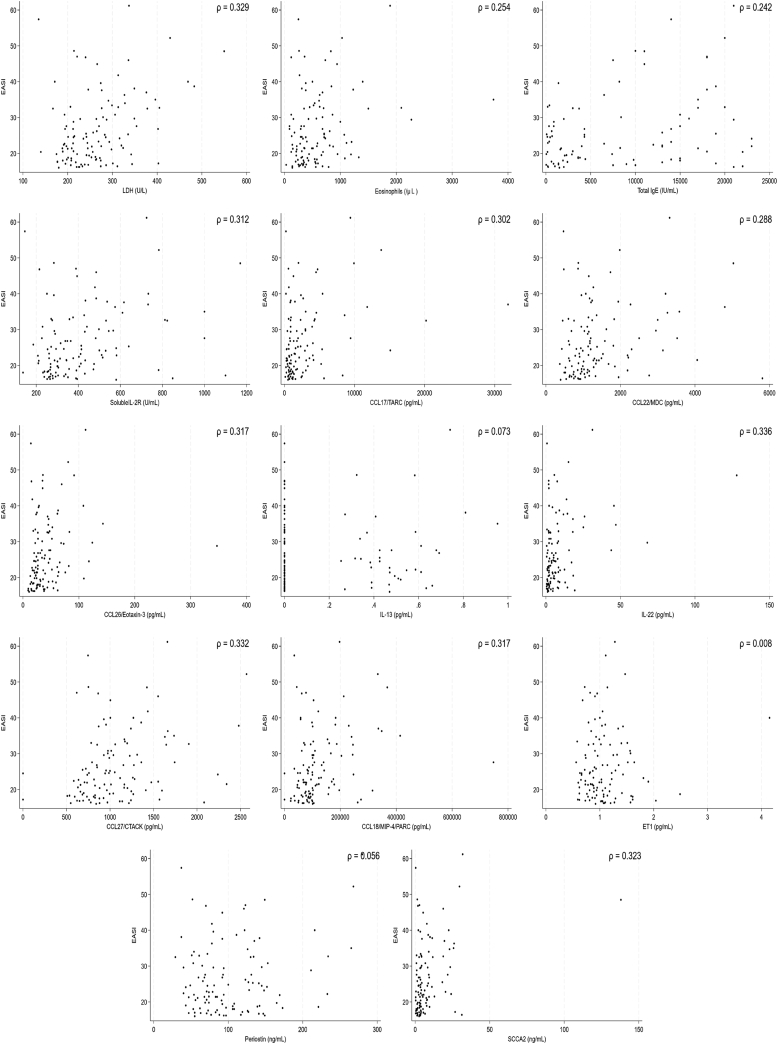
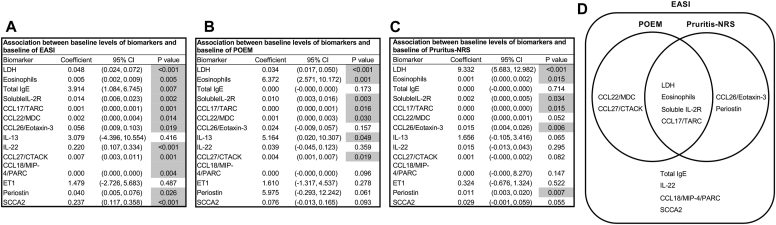
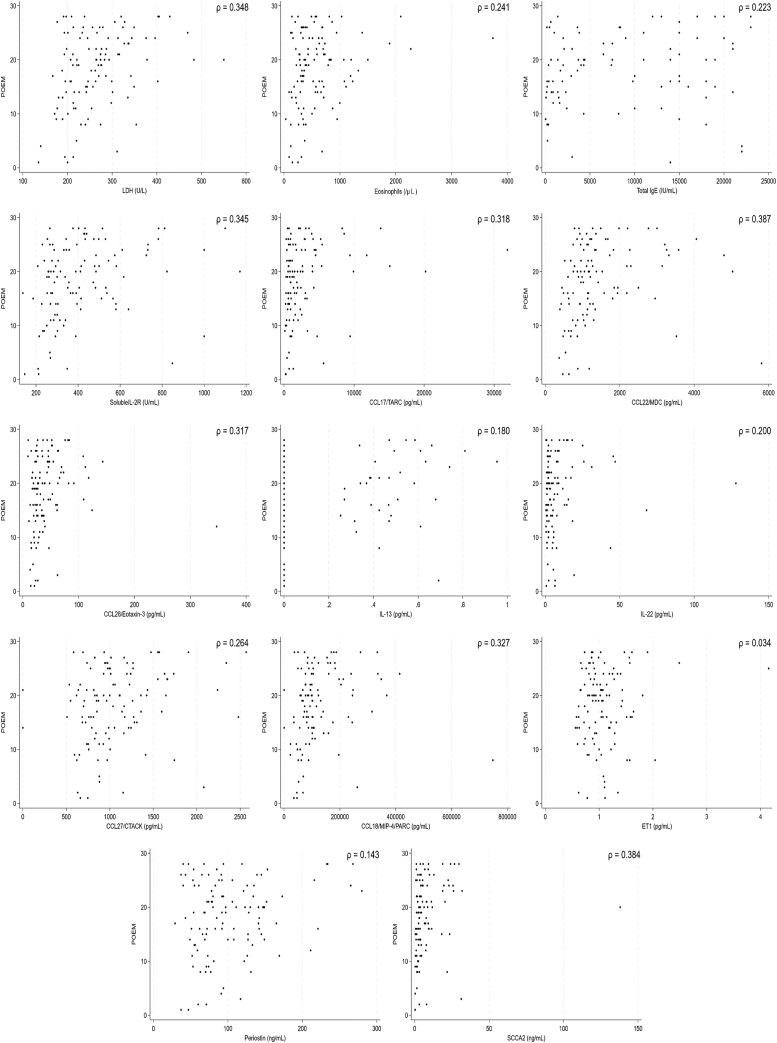
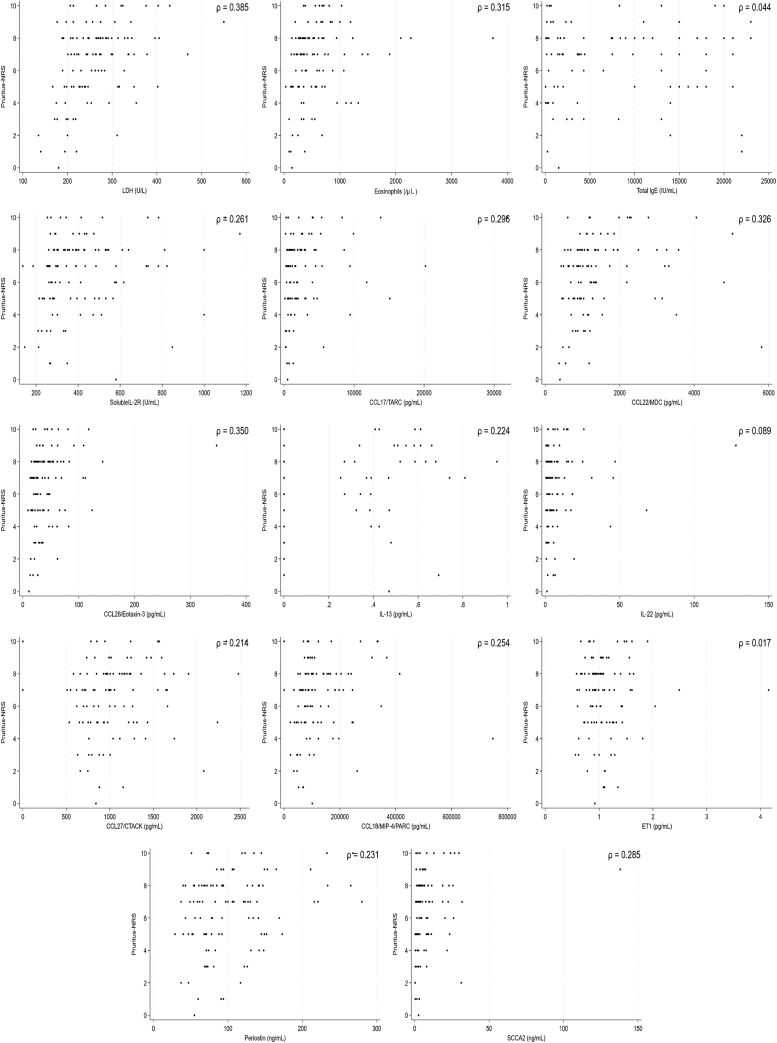
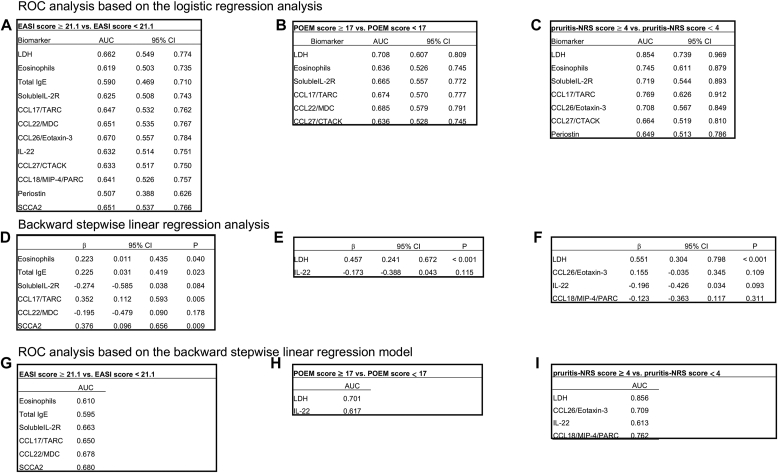
Results: We found that 12, 6, and 7 biomarkers showed significant and positive associations with the EASI, POEM, and pruritis-NRS, respectively. Most of the biomarkers associated with either the POEM or the pruritis-NRS were included among the biomarkers associated with EASI. Of the biomarkers examined, CCL26/eotaxin-3 and SCCA2 were the most capable of assessing severity for EASI, as shown by the 2 kinds of receiver operating characteristic analyses, respectively, whereas lactate dehydrogenase was the best for both the POEM and pruritis-NRS, again using the 2 analyses.
Conclusion: We found biomarkers associated with the EASI, POEM, and pruritis-NRS, respectively, based on the B-PAD study. Moreover, we identified CCL26/eotaxin-3 and/or SCCA2 as the biomarkers having the greatest ability to assess severity in the EASI; lactate dehydrogenase did the same for the POEM and pruritis-NRS. These findings will be useful in treating patients with moderate-to-severe AD.
Keywords: Atopic dermatitis; B-PAD; Biomarkers to Predict Clinical Improvement of AD in Patients Treated With Dupilumab; EASI; LDH; POEM; SCCA2; biomarker; eotaxin-3; precision medicine; pruritus-NRS.
© 2023 The Author(s).
Figures
References
-
- Furue M., Chiba T., Tsuji G., Ulzii D., Kido-Nakahara M., Nakahara T., et al. Atopic dermatitis: immune deviation, barrier dysfunction, IgE autoreactivity and new therapies. Allergol Int. 2017;66:398–403. - PubMed
-
- Bieber T., Traidl-Hoffmann C., Schappi G., Lauener R., Akdis C., Schmid-Grendlmeier P. Unraveling the complexity of atopic dermatitis: the CK-CARE approach toward precision medicine. Allergy. 2020;75:2936–2938. - PubMed
-
- Bakker D., de Bruin-Weller M., Drylewicz J., van Wijk F., Thijs J. Biomarkers in atopic dermatitis. J Allergy Clin Immunol. 2023;151:1163–1168. - PubMed
-
- Nakahara T., Izuhara K., Onozuka D., Saeki H., Nunomura S., Takenaka M., et al. Exploring biomarkers to predict clinical improvement of atopic dermatitis in patients treated with dupilumab (B-PAD study) Clin Exp Allergy. 2023;53:233–238. - PubMed
LinkOut - more resources
Full Text Sources
