


White matter microstructural integrity continues to develop from adolescence to young adulthood in mice and humans: Same phenotype, different mechanism
- PMID: 37916059
- PMCID: PMC10619509
- DOI: 10.1016/j.ynirp.2023.100179
White matter microstructural integrity continues to develop from adolescence to young adulthood in mice and humans: Same phenotype, different mechanism
Abstract
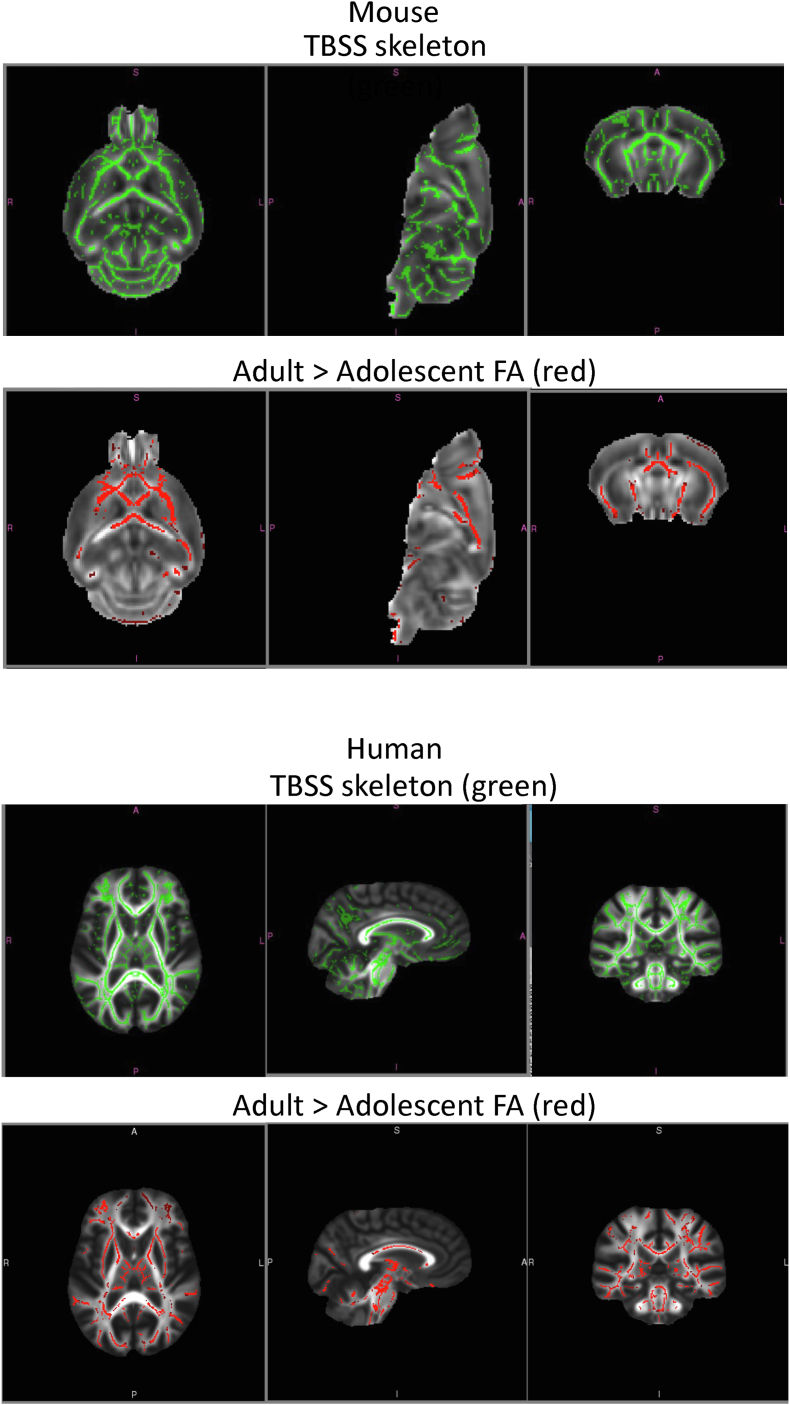
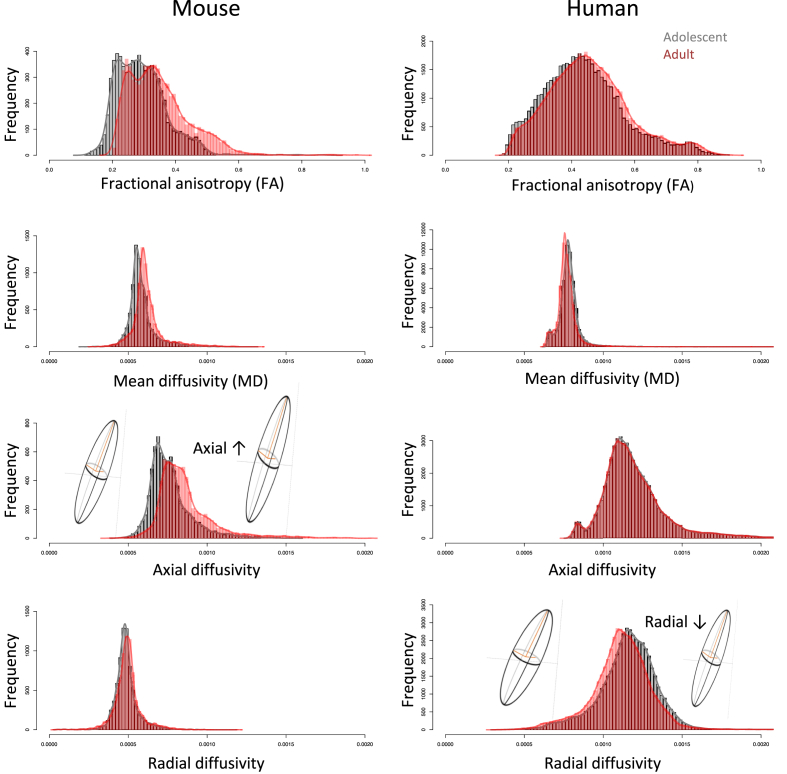
As direct evaluation of a mouse model of human neurodevelopment, adolescent and young adult mice and humans underwent MR diffusion tensor imaging to quantify age-related differences in microstructural integrity of brain white matter fibers. Fractional anisotropy (FA) was greater in older than younger mice and humans. Despite the cross-species commonality, the underlying developmental mechanism differed: whereas evidence for greater axonal extension contributed to higher FA in older mice, evidence for continuing myelination contributed to higher FA in human adolescent development. These differences occurred in the context of species distinctions in overall brain growth: whereas the continued growth of the brain and skull in the murine model can accommodate volume expansion into adulthood, human white matter volume and myelination continue growth into adulthood within a fixed intracranial volume. Appreciation of the similarities and differences in developmental mechanism can enhance the utility of animal models of brain white matter structure, function, and response to exogenous manipulation.
Keywords: Adolescence; Development; Diffusion tensor imaging; Human; Mouse; Translational.
Conflict of interest statement
Declaration of competing interest The authors declare that they have no known competing financial interests or personal relationships that could have appeared to influence the work reported in this paper. The authors have no competing interests to disclose.
Figures

References
Grants and funding
- R01 AA005965/AA/NIAAA NIH HHS/United States
- U24 AA021697/AA/NIAAA NIH HHS/United States
- U01 AA021696/AA/NIAAA NIH HHS/United States
- U01 AA021691/AA/NIAAA NIH HHS/United States
- U01 AA021681/AA/NIAAA NIH HHS/United States
- U01 AA021695/AA/NIAAA NIH HHS/United States
- U01 AA021692/AA/NIAAA NIH HHS/United States
- K99 AA028840/AA/NIAAA NIH HHS/United States
- R00 AA028840/AA/NIAAA NIH HHS/United States
- U24 AA021695/AA/NIAAA NIH HHS/United States
- R37 AA005965/AA/NIAAA NIH HHS/United States
- R37 AA010723/AA/NIAAA NIH HHS/United States
- U01 AA021690/AA/NIAAA NIH HHS/United States
- R01 DA057567/DA/NIDA NIH HHS/United States
- U01 AA021697/AA/NIAAA NIH HHS/United States
- R01 AA010723/AA/NIAAA NIH HHS/United States
LinkOut - more resources
Full Text Sources
Research Materials