. 2023 Nov 2;14(1):7003.
doi: 10.1038/s41467-023-42830-1.

Structural basis for stabilisation of the RAD51 nucleoprotein filament by BRCA2

Affiliations

Structural basis for stabilisation of the RAD51 nucleoprotein filament by BRCA2

Robert Appleby et al. Nat Commun. .

Abstract

The BRCA2 tumour suppressor protein preserves genomic integrity via interactions with the DNA-strand exchange RAD51 protein in homology-directed repair. The RAD51-binding TR2 motif at the BRCA2 C-terminus is essential for protection and restart of stalled replication forks. Biochemical evidence shows that TR2 recognises filamentous RAD51, but existing models of TR2 binding to RAD51 lack a structural basis. Here we used cryo-electron microscopy and structure-guided mutagenesis to elucidate the mechanism of TR2 binding to nucleoprotein filaments of human RAD51. We find that TR2 binds across the protomer interface in the filament, acting as a brace for adjacent RAD51 molecules. TR2 targets an acidic-patch motif on human RAD51 that serves as a recruitment hub in fission yeast Rad51 for recombination mediators Rad52 and Rad55-Rad57. Our findings provide a structural rationale for RAD51 filament stabilisation by BRCA2 and reveal a common recruitment mechanism of recombination mediators to the RAD51 filament.


Conflict of interest statement

The authors declare no competing interests.

Figures

Fig. 1
Fig. 1. An acidic patch on the RAD51 surface mediates binding of BRCA2 TR2 and BRC4.
A Molecular surface representation of the RAD51 NPF (PDB ID: 8BQ2) with two adjacent RAD51 molecules coloured thistle and light pink, and the acidic patch coloured in brighter pink. The inset shows the the position of the alpha helix bearing acidic residues D184 and D187, as well as F86 of the adjacent RAD51 molecule, which is important for RAD51 self-association in a filament. B Multiple sequence alignment of acidic patch residues in RAD51 (Hse: Homo sapiens; Dre: Danio rerio; Dme: Drosophila melanogaster; Cel: Caenorhabditis elegans; Ath: Arabidopsis thaliana; Sce: Saccharomyces cerevisiae; Spo: Schizosaccharomyces pombe). The position of D184 and D187 in the alignment is highlighted. C Electrophoretic mobility shift assay of TR2 peptide titrations on RAD51 NPFs reconstituted with wild-type, single D184A or double D184A, D187A mutant protein and ss- or dsDNA. DNA was visualised by 473 nm excitation of the fluorescein label. ssDNA experiment performed twice, dsDNA experiment performed once. D Same assay as in C, but with the BRC4 peptide. BRC4 was incubated with RAD51 prior to addition of ss- or dsDNA. Both experiments performed once. E Steady-state binding curves of surface plasmon resonance (SPR) measured upon TR2 peptide injection on immobilised RAD51 NPFs coupled to a streptavidin chip via biotin-tagged DNA. NPFs comprised wild-type, single D184A or double D184A, D187A RAD51 and ss- or dsDNA. Data are presented as mean values ± SEM, n = 3 independent experiments. F Same SPR assay as in E but titrating the BRC4 peptide on RAD51 NPFs. Data are presented as mean values ± SEM, n = 3 independent experiments. Source data are provided as a Source Data file.
Fig. 2
Fig. 2. BRCA2 TR2 induces bundling of RAD51 nucleoprotein filaments.
A Cryo-electron micrographs of RAD51 NPFs formed on ssDNA and dsDNA in the presence of 1:0.5 molar ratio of TR2 peptide. Extensive NPF aggregation into bundles of aligned filaments is clearly visible (examples marked with dashed white boxes). Two independent repeats. B EMSA analysis of RAD51 binding to doubly-biotinylated ss- and dsDNA, in the absence or presence of mono-streptavidin (mSA). DNA was visualised with SYBR Gold staining. Two independent repeats. C Cryo-electron micrographs of RAD51 NPFs in the presence of 1:0.5 molar ratio of TR2 peptide and mSA. Capping of ss- and dsDNA by mSA prevents TR2-dependent filament aggregation. Two independent repeats. Source data are provided as a Source Data file.
Fig. 3
Fig. 3. Structural basis for the interaction of BRCA2 TR2 with the RAD51 nucleoprotein filament.
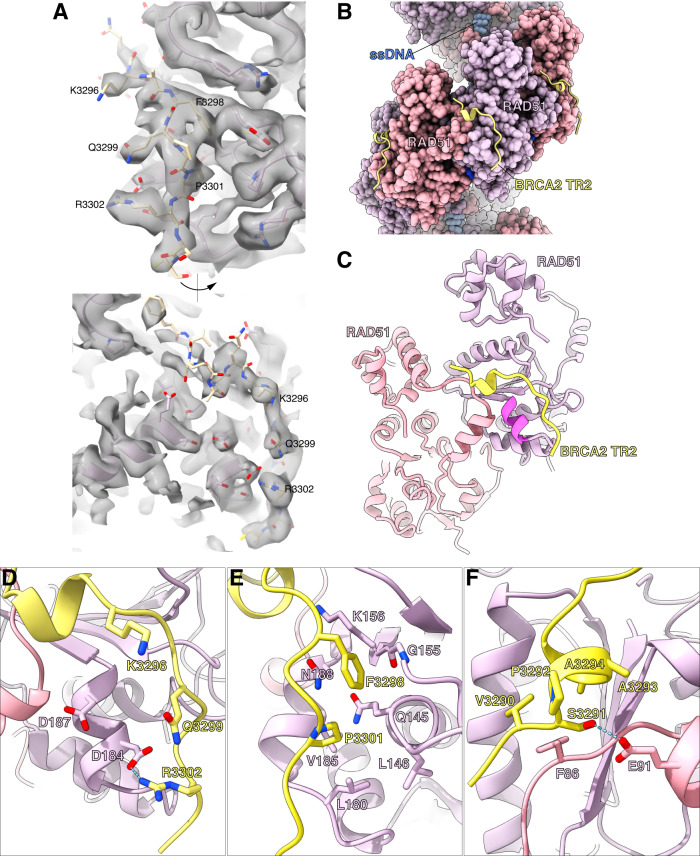
A CryoEM map of the RAD51 nucleoprotein filament on ssDNA with bound BRCA2 TR2. Two rotated views of the map at the TR2 site are shown, with fitted TR2 peptide bound to the RAD51 filament. The side chains of conserved amino acids in the TR2 sequence are labelled for reference. B CryoEM structure of the RAD51–ssDNA NPF bound with TR2 peptide. RAD51 and ssDNA are in spacefill representation; RAD51 protomers are coloured alternatively in thistle and light pink. The TR2 peptides that decorate the filament surface are drawn as yellow ribbons. C The BRCA2 TR2-RAD51 interface. The TR2 peptide engages the acidic patch of one RAD51 protomer and reaches over to contact the self-association motif of the adjacent RAD51 protomer. RAD51 and TR2 are drawn as ribbons, coloured as in B. The acidic patch is shown in pink. DF Details of the atomic interactions at the RAD51–TR2 interface. Polar interactions of BRCA2 residues K3296, Q3299 and R3302 with RAD51 D184 and D187 (D); hydrophobic contacts of BRCA2 F3298 and P3301 in the groove adjacent to RAD51’s acidic patch (E); BRCA2’s CDK-target residue S3291 becomes partially buried at the TR2-RAD51 interface, where it is hydrogen bonded to RAD51 E91 (F).
Fig. 4
Fig. 4. Structure-based mutational analysis of the BRCA2 TR2-RAD51 interface.
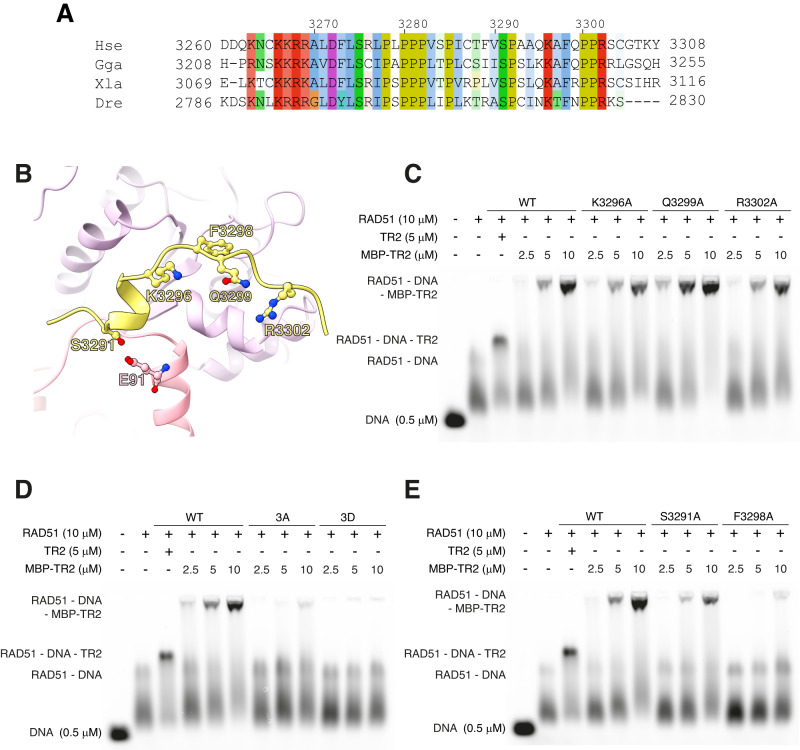
A Multiple sequence alignment of BRCA2 TR2 sequences, coloured according to residue type (Hse: Homo sapiens; Gga: Gallus gallus; Xla: Xenopus laevis; Dre: Drosophila melanogaster). B Drawing of TR2 and RAD51 amino acids targeted for mutagenesis. Drawing style as in D–F of Fig. 3. CE EMSA analysis of RAD51–ssDNA NPF binding by MBP-fusion TR2 mutants K3296A, Q3299A, R3302A (C); 3A (K3296A, Q3299, R3302A), 3D (K3296D, Q3299D, R3302D) (D); S3291A, F3298A (E). The TR2 peptide was used as a control. EMSA experiments repeated once. Source data are provided as a Source Data file.
Fig. 5
Fig. 5. Structure-guided BRCA2 TR2 cross-linking to RAD51.
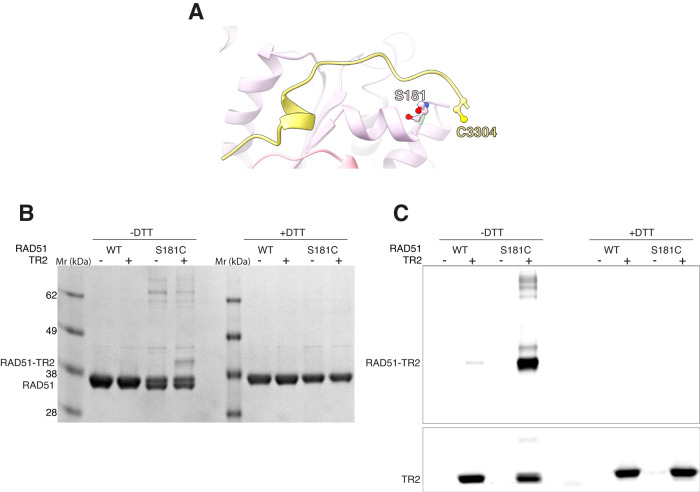
A Drawing of the RAD51–TR2 interface, highlighting that amino acids BRCA2 C3304 and RAD51 S181 are spatially close, so that the RAD51 S181C mutant can form a disulphide bridge with C3304 in the TR2 peptide. B SDS-PAGE analysis of cross-linking reactions between RAD51 S181C and TR2 in the presence of hydrogen peroxide. Wild-type RAD51 and the reducing agent DTT were used as controls. Protein bands were visualised with Coomassie Blue. C Same experiment as in B, visualised with 532 nm excitation of the Cy3-labelled TR2 peptide. Experiment was repeated three times. Source data are provided as a Source Data file.
Fig. 6
Fig. 6. A model for the role of BRCA2 TR2 in homology-directed repair and protection of stalled forks.
The model envisages a possible TR2 intervention at two stages: to promote formation of pre-synaptic filaments on resected DNA ends (HDR) or ssDNA gaps (stalled fork), and to assist in the pairing of the filament with its target homologous dsDNA. In both cases, the underlying mechanism would involve concurrent TR2 engagement in trans with RAD51 and either ss- or dsDNA. The ovals show spacefill models of RAD51 (pink) with bound TR2 (yellow); the N-terminal sequence of the RAD51-bound TR2, not visible in our structure, has been drawn to illustrate how it could interact with DNA. The model involves the participation of several BRCA2 molecules; the stoichiometry of the BRCA2–RAD51 interaction is currently unknown.

References

    1. Feng W, Jasin M. Homologous recombination and replication fork protection: BRCA2 and more! Cold Spring Harb. Sym. 2017;82:329–338. doi: 10.1101/sqb.2017.82.035006. - DOI - PMC - PubMed
    1. Tye S, Ronson GE, Morris JR. A fork in the road: Where homologous recombination and stalled replication fork protection part ways. Semin. Cell Dev. Biol. 2020;113:14–26. doi: 10.1016/j.semcdb.2020.07.004. - DOI - PMC - PubMed
    1. Antoniou A, et al. Average risks of breast and ovarian cancer associated with BRCA1 or BRCA2 mutations detected in case series unselected for family history: a combined analysis of 22 studies. Am. J. Hum. Genet. 2003;72:1117–1130. doi: 10.1086/375033. - DOI - PMC - PubMed
    1. Sharan SK, et al. Embryonic lethality and radiation hypersensitivity mediated by Rad51 in mice lacking Brca2. Nature. 1997;386:804–810. doi: 10.1038/386804a0. - DOI - PubMed
    1. Connor F, et al. Tumorigenesis and a DNA repair defect in mice with a truncating Brca2 mutation. Nat. Genet. 1997;17:423–430. doi: 10.1038/ng1297-423. - DOI - PubMed

Publication types